Please download the worship aid to participate in Friday’s evening prayer, which will begin at 5 PM.
Instructions on how to join are available here.
Please download the worship aid to participate in Friday’s evening prayer, which will begin at 5 PM.
Instructions on how to join are available here.
Perhaps Pope Francis’ main target in his papacy has been Clericalism. Clericalism is hard to define, but in its extreme form holds that the Church belongs to Bishops and Priests and the rest of you can pray, pay and obey. We see its birth in today’s gospel.
“Teacher, we saw someone driving out demons in your name, and we tried to prevent him because he does not follow us.”
Note that last part: not he does not follow “you” – Jesus – but “us” the Apostles, in our terminology the clergy. Jesus immediately tells them that this exorcist is performing a mighty deed in His name, not theirs so let him continue. Ultimately, Clericalism is dangerous because leaders follow themselves for their own advancement, not Jesus for everyone’s.
In last week’s Gospel, the Twelve boasted among themselves about who was the most important. They used human criteria and Jesus showed them that only their love of God was important. It was better to be a child with a strong love of Jesus than a philosopher with a weak one.
This continues that line of thought. Not only should they not be jealous of each other – they should not be jealous of others who call upon the name and power of Jesus. The importance is following Him, not them.
This had a very specific application. The Gospel spread quickly but unevenly usually around trade routes. In the very beginning of the Church, there was no effective coordinating body and “missionaries” would be sent by many different groups. These usually associated themselves with an Apostle. This included not only the Twelve, but also figures like Paul and James. A city might have several Christian Churches – for us, parishes – which were more connected to other Parishes in different cities who followed the same apostle than to other Christian communities in their own city. This situation could not last for long. The message of Jesus is inherently unifying – it must bring people together.
Christianity was almost immediately a global movement and would need to express itself in different cultures but always seeking unity in the essentials. Last summer, our Parish Bible Study focused on St John. The community was divided between those who prized independence and those who saw the need to join the greater Church, the Church of Peter, which we now recognize as the Catholic Church.
Today’s Gospel reflects this world. It is thought that this Gospel is written in and for Rome, where there would have been many house churches. There was a large Jewish Christian presence to which Paul seems to have written but there was a more gentile group as well to which Mark was predominately addressed. They had different emphases and perhaps even used different languages, but they all believed that Jesus died and rose for them and formed a new and everlasting covenant with them. The pedigree of the performer is not important only his or her devotion to Jesus.
This is the role of the leader. Clericalism was a way of running the Church – it cannot be merely abandoned: it must be replaced. Pope Francis, wily old Jesuit that he is, while dismantling clericalism has also enhanced lay ministries. The new leaders of the Church may be yourself or sitting next to you. So, to avoid irony, listen well.
A Chistian leader must seek union among Christians. To use an old Italian expression “The fish stinks from the head down”. The little ones of today’s Gospel are the rank-and-file Christian believer. These are to be guided to accepting, at very least, other Christians as brothers and sisters. It would be better for a leader, clerical or lay, who fails at this that a great millstone be put around their neck and be thrown into the sea. A leader who creates his or now increasingly her own parish or organization and not a true community no matter how financially sound or culturally significant has failed.
We may not have competing house churches, but we do have causes of division. Most polling has indicated that in the United States religion does not influence our political beliefs as much as political and partisan affiliations form our religious positions. Even issues which do not immediately seem political like vaccinations have taken on a partisan edge. This is true across the religious spectrum, but is utterly ridiculous for Catholics. We have a profound and clear social teaching and it cannot be shoehorned into any political straightjacket. We must choose which option most reflects our conscience, knowing that the fit will be uncomfortable. If you are completely at peace with your political options, we need to talk. It will be long. Our leaders are called from the Pope down to bring us together through these difficulties and differences.
Many commentaries on this passage emphasize the sense of working together across denominations. Our separation from our Protestant and Orthodox brothers and sisters may be a scandal, but has not prevented us from working together. Yet it must mean more than this. Community organizers have discovered that to have a substantial effect on a community all religious communities must work together. They may not all use the name of Jesus, but they can reflect his presence. So let me end with a personal anecdote.
One night in London, I saw what looked like a Good Humor truck pull up to a homeless man. Two men with turbans got out and pulled out a meal tray and fed him. I asked who they were and was told that they were Sikhs and that they go out at night to find and feed the poor. I was – and am – extremely impressed. They did not wait for the poor to come begging to them, but found them. How could this not reflect the presence of Jesus?
As we bring our world back from COVID, let us join with anyone who seeks the good of everyone then we will truly know that we are not an elite following ourselves, but servants following Jesus.
Please join us to celebrate the 26th Sunday in Ordinary Time on Sunday, September 26, 2021.
Our current Mass times are:
Entrance: Glory and Praise to Our God – 606
Responsorial Psalm & Readings – 1168
Offertory: Eye Has Not Seen – 728
Communion: One Bread, One Body – 932
Closing: Rain Down – 582
The Gather 3rd Edition Hymnal/Missals are now available for use in the church – pick one up as you enter and return it after Mass. Instructions on how to use the hymnal missal are available here: https://www.stcharlesbklyn.org/hymnal-missal/ .
Today’s readings are also available to read online at the USCCB website https://bible.usccb.org .
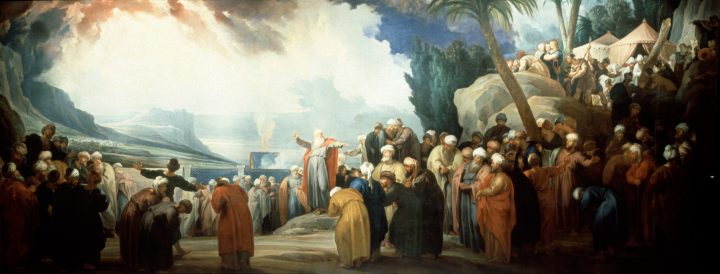
Moses Elects the Council of Seventy Elder,
Jacob de Wit, 1737, Royal Palace of Amsterdam
(About this Image)
Then the LORD said to Moses:
Assemble for me seventy of the elders of Israel,
whom you know to be elders and authorities among the people,
and bring them to the tent of meeting.
When they are in place beside you,
I will come down and speak with you there.
I will also take some of the spirit that is on you
and will confer it on them,
that they may share the burden of the people with you.
You will then not have to bear it by yourself.
(Numbers 11:16-17)
Fr. Smith’s Commentary on the Second Reading
Twenty-Sixth Sunday of Ordinary Time
Letter of St. James 3:16-4:3
September 26, 2021
This week we will end our examination of the Letter of St. James. Although it is not the final section of the letter, it will allow us to clarify two themes we have been following throughout. James has spoken to the community as a whole and provides a “community ethics.” Today, he will show us the individual consequences of participating in corporate sin. We have often commented on James’ connection to what we now call Catholic Social Teaching. This week we will see the roots in greater depth but also where it must be expanded.
For James, riches can cause progressive moral decay. In the section immediately following last week’s reading he writes to the entire community:
Lament and mourn and weep.
(Jas 4:9–10)
Let your laughter be turned into mourning
and your joy into dejection.
Humble yourselves before the Lord,
and he will exalt you.
These are strong words, but there is great hope. Compare this with the opening of today’s selection:
Continue reading “26th Sunday in Ordinary Time – Rebuilding with Charity and Justice”Please download the worship aid to participate in Friday’s evening prayer, which will begin at 5 PM.
Instructions on how to join are available here.
There is a Hasidic story about a poor man who became a great rabbi. He was not well educated, nor handsome nor a great orator but he knew God, loved his people, and developed a large congregation. He had a son who was good looking, blessed with a great voice and due to his father’s success received a splendid education. When he returned from his schooling, his father retired and turned his synagogue over to him. He was not a great success. He did all he was supposed to do and when that did not work, he strived harder trying many styles of preaching and teaching. But something was missing, and his congregation drifted away. In frustration he went to a mountain, stood at a cliff, and called out to God that he would not leave until God told him what to do.
A voice came from heaven: JUMP.
The story ends here, but I think Mark is answering it for Christians today.
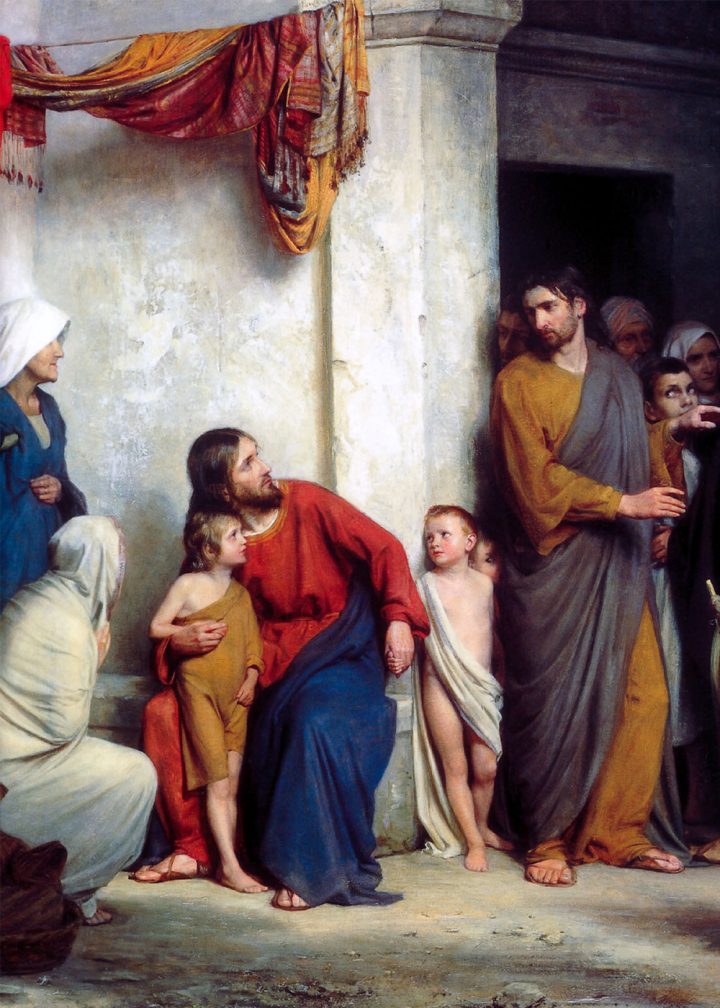
Continue reading “25th Sunday Ordinary Time – Homily (Fr. Smith)”Suffer the Children, Carl Bloch, 1865-1879, Frederiksborg Palace (Denmark)
Taking a child, he placed it in their midst,
and putting his arms around it, he said to them,
“Whoever receives one child such as this in my name, receives me;
and whoever receives me,
receives not me but the One who sent me.”
(Mark 9:36-37)
Fr. Smith’s Commentary on the Second Reading
Twenty-Fifth Sunday in Ordinary Time
Letter of St James, 3:16-4:3
September 18, 2021
The first Mass reading is often from the Wisdom Literature of the Old Testament. We have seen especially in the books of Sirach (see commentary for March 3, 2019) and Wisdom (see commentary for Nov. 8, 2020) that the authors were aware of what could be accepted from pagan thought and custom and what could not. They also insisted that Jews maintain their distinctive acts of worship especially the sacrifices in the Temple. These authors knew that their readers lived in a non-Jewish world and even if they wished to cut themselves off from pagan influence it was ultimately impossible, and they would need to address these concerns. This was a challenging task and we read these books because the authors succeeded.
St. James’s task was even more difficult. Many different groups of people read his letter. The primary audience were Christian converts from Judaism. They would be judging his letter by Jewish standards. Would following Jesus make them participate more deeply in their covenant with the Lord? Did it make them better Jews? We must also remember that Christianity was an urban religion and there might be several house churches, parishes, in the city or town. These were connected not so much to the other churches in that town, but to a confederation of churches in other cities who looked to one of the apostles or gospel writers for inspiration. There would be some in these local churches who wanted to reach out to the other local parishes and others who did not. This tension was evident in the letters of St. John which we read this Easter Season. We have noted previously that the author of the letter of St. James is very aware of the writings of St. Paul and shares many ideas and indeed much of the same language as the gospel of St. Matthew. He is actively seeking to show his unity with other Christian parishes. Like Sirach or the author of the book of Wisdom, he is also aware that his people do not live in a bubble and will be exposed to pagan thought particularly pagan moral thought. He will need to show that Jesus provides a superior philosophy. Remember however that in the classical world “philosophy” meant more than it does today. It expressed a way of life. A good philosophy gave both diagnosis and prescription.
Both are present in today’s reading.
James’ community was not without conflict and tension. We do not know the full details, but can assume from what we have previously read and what we will read next week, it reflected the difference between how the rich and the poor were treated. James gives his diagnosis several verses before today’s reading:
Who among you is wise and understanding?
(Jas 3:14–15)
Let him show his works by a good life
in the humility that comes from wisdom.
But if you have bitter jealousy
and selfish ambition in your hearts,
do not boast and be false to the truth.
Wisdom of this kind does not come down
from above but is earthly, unspiritual, demonic.
For both Jews and Gentiles, “core” beliefs are revealed in behavior. For James, true wisdom is expressed in humility. This would not be immediately apparent to people in his world. As we saw when we examined the letter to the Ephesians, humility was considered if not a vice far from a virtue. (see commentary for July 25, 2021) It is however a common Christian belief:
Take my yoke upon you, and learn from me;
(Mt 11:29)
for I am gentle and humble in hear
In a community divided between rich and poor, jealousy was an easy vice to embrace the expression. “Selfish ambition” originally meant cheating to achieve political office, but here it meant using unsavory methods to obtain anything. Wisdom is used sarcastically for “the philosophy or way of life” that comes not from God but from the devil.
This creates disorder and uncleanliness: “foul practice.” The wisdom, way of life, that comes from God is pure, clean, and undefiled. Because it is an expression of humility, it creates good fruits that flow from harmony. This too is reflected in other Christian communities:
Those who look to Paul
(Ga 6:7)
Do not be deceived; God is not mocked,
for you reap whatever you sow
Or those who look to Matthew:
“Blessed are the peacemakers,
(Matt 5:9)
for they will be called children of God”
However, there is rarely peace. James states that this is because our “passions make war within our members.”
This is many times found in the New Testament
“Beloved, I urge you as aliens and exiles
(1 Pet 2:11)
to abstain from the desires of the flesh
that wage war against the soul”
Paul also speaks of a war within his body (Rom 7:21-23).
But this is also common to classical literature: Plato wrote:
“Whence come wars, and fighting’s, and factions?
(Phaedrus, 66C)
Whence but from the body and the lusts of the body?”
And Cicero:
Hatred, discord, disagreements, seditions,
(Concerning the ends of goods and evils)
wars are all born from desires …”
Our desires aim as much for recognition as actual objects of that desire They will not give us wisdom – an effective way of life. What we really need and ultimately desire is the wisdom with comes from above. It can only be received as a gift.
Again, this may be found in Matthew’s gospel:
Ask and it will be given to you;
(Mt 7:7–8)
seek and you will find;
knock and the door will be opened to you.
For everyone who asks, receives;
and the one who seeks, finds;
and to the one who knocks,
the door will be opened.
If we ask for what will build up the community and ultimately bring us happiness we will receive it, because it will be for our benefit. If not, he will not give us anything which would not help us.
Which one of you would hand his son a stone
(Mt 7:9–10)
when he asks for a loaf of bread,
or a snake when he asks for a fish?
You ask but do not receive,
(Jas 4:3)
because you ask wrongly,
to spend it on your passions
James is not asking his readers to accept his diagnosis “on faith.” Look and see if the strife and disharmony you see comes from people seeking to be noticed, affirmed, and rewarded at the expense of others. If yes, then he asks that they all ask about the virtues which come from above, especially humility. Pagans and those Jews influenced by their philosophy would have found this humiliating. Yet James proclaims that if they accepted these gifts no matter how counter-intuitive, they would have the peace and harmony they all claim to desire. He tells us the same thing. Have things changed much in 2,000 years? Are we still seeking the wisdom from below and wondering why peace eludes us? Next week’s selection from St. James will show us the personal consequences of division and disorder, but he wisely insists that we first acknowledge that it will come from assuming that we can attain the fruit of heaven with the wisdom of hell.