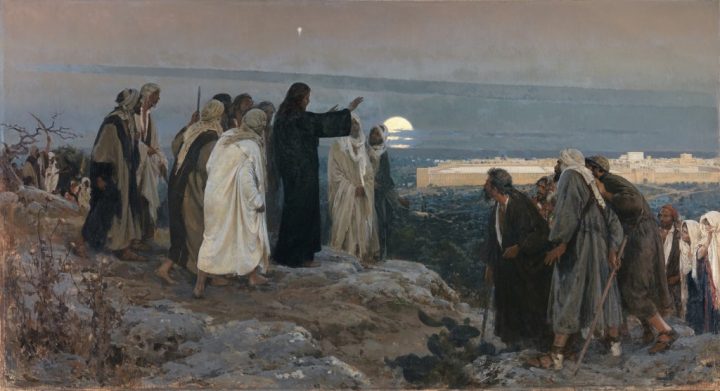
Flevit super illam [He wept over it (Luke 19:41)], Enrique Simonet, 1892
Triduum
The major celebrations of Holy Thursday (Mass of the Lord’s Supper). Good Friday (Good Friday of the Lord’s Passion) and Holy Saturday (Mass of the Resurrection of the Lord – Easter Vigil) although celebrated with separate services are liturgically one day. The United States Conference of Catholic Bishops remind us that “(This day unfolds) for us the unity of Christ’s Paschal Mystery.” The single celebration of the Triduum marks the end of the Lenten season, and leads to the Mass of the Resurrection of the Lord at the Easter Vigil.”
Each of these Liturgies is beautiful and powerful in themselves, but achieve their full effect only if they are celebrated together. I urge you to make every attempt to celebrate them with and in the Parish. The full schedule for Holy Week may be found below but a few notes on the Triduum.
We encourage people attending the Holy Thursday and Holy Saturday Masses to bring hand bells to ring at the Gloria. From Gloria to Gloria the Church lives in solemn silence.
The collection for Holy Thursday will go to Catholic Charities for the replenishment of the local food pantries.
The collection for Good Friday will go to the upkeep of the Catholic Churches in the Holy Land. This is a most important duty of the faithful.
The Easter Vigil must begin in darkness. As Easter is late this year, we will begin at 9:00 PM. As it is a complicated liturgy, please read my prayer guide for it here.
First Reading
April 14, 2019
Palm Sunday
Isaiah 50:4-7
Readers of these reflections with a good memory will note that we covered most of this passage several months ago (Sept 17th). We will essentially repeat the exegesis (interpretation) from that reading in the body of this essay, but make different applications at the end.
As with so many of the passages we have examined we must return to the mindset of the people who returned to rebuild Jerusalem around 520 BC. A miracle had occurred. Jerusalem and the temple had been destroyed and the leaders brought into exile in Babylon. This should have been the end of the Jewish People. Yet God through the unlikely intermediary of Cyrus, Prince of Persia, has given them a chance to start again. Enough decided to return to the ruins of Jerusalem that they could contemplate reconstruction. Yet, they needed a second miracle to know why they were there.
Many seemed to believe that they would be rewarded by God for their faith in the common way of the world: comfort, wealth and power. They were living, however, spartan lives in rubble as the employees of a foreign emperor. They asked Isaiah why God had abandoned them. Like their forefathers who left Egypt, they began to believe they were better off in captivity.
In the passage immediately before today’s reading God answers them:
Where is the bill of divorce
with which I dismissed your mother?
Or to which of my creditors
have I sold you?
It was for your sins that you were sold,
for your crimes that your mother was dismissed. (Isaiah 50:1)
They were exiled because of their refusal to follow God, but there was no bill of divorce or sale to anyone else. They were not abandoned permanently. God did not want to sever His ties with them, but to chastise them. Note, however, this is not the past but the present. He is referring to them, not their forebears:
2 Why was no one there when I came?
Why did no one answer when I called?
Is my hand too short to ransom?
Have I not the strength to deliver? (50:2)
He called them to make a new Exodus following him to a new land, but they did not follow with their hearts, only their bodies. Note the references to the Exodus in the next line:
Lo, with my rebuke I dry up the sea,
I turn rivers into a desert;
Their fish rot for lack of water,
and die of thirst. 50:3
The next line however marks a change and it is Isaiah who speaks:
4 The Lord GOD has given me
a well-trained tongue,
That I might know how to speak to the weary
a word that will rouse them.
Morning after morning
he opens my ear that I may hear; (50:4)
A better translation for “a well-trained tongue” would be the tongue of a disciple. His responsibly is not to convey information, however true, but to exhort the people to fulfill their tasks. This requires continued effort (Morning after Morning) and is not the message we might first have considered.
A key part of “Second Isaiah” are the four “suffering servant songs” in which he speaks as one who has taken on the burden of his people. This is the third. We will, however, just examine this one.
5 And I have not rebelled,
have not turned back.
6 I gave my back to those who beat me,
my cheeks to those who plucked my beard;
My face I did not shield
from buffets and spitting. (50:5–6)
Voluntary suffering was not common in the Old Testament, but it was not unknown. Jeremiah refers to himself as like a trusting lamb led to the slaughter. (Jer 12:19). This was, however, before the exile. Isaiah wishes to show them what is expected of them in this new world.
7 The Lord GOD is my help,
therefore I am not disgraced;
I have set my face like flint,
knowing that I shall not be put to shame. (50:7–9)
However unpleasant life may become, he knows that God will never abandon him and dares those who thought him only oppressed to take him to court:
8 He is near who upholds my right;
if anyone wishes to oppose me,
let us appear together.
Who disputes my right?
Let him confront me.
9 See, the Lord GOD is my help;
who will prove me wrong?
Lo, they will all wear out like cloth,
the moth will eat them up. (50:8-9)
In the verse immediately following he then addresses the people directly:
10 Who among you fears the LORD,
heeds his servant’s voice,
And walks in darkness
without any light,
Trusting in the name of the LORD
and relying on his God? (50:10)
He knows that they do not understand him, that they would be expected to follow God for seemingly no earthly reward does not make sense to them. But it is their role to trust God.
11 All of you kindle flames
and carry about you fiery darts;
Walk by the light of your own fire
and by the flares you have burnt!
This is your fate from my hand:
you shall lie down in a place of pain. (50:10–11)
If they think they are walking by light it is their own and not God’s. Their fate will be pain forever.
There are many statements to the effect that we learn by our successes when young and failures when old. God is teaching the people what he wants them to be mature disciples. In a previous “suffering servant song” Isaiah writes:
It is too little, he says, for you to be my servant,
to raise up the tribes of Jacob,
and restore the survivors of Israel;
I will make you a light to the nations,
that my salvation may reach to the ends of the earth. (Isaiah 49:6)
The Jews were called to lead others to the God of Abraham, Isaac and Jacob. They would need to learn that the required humility comes by sacrifice and suffering. Their effectiveness will not be because of their power but their trust.
If we are reading any Lenten and Holy Week reflections, we will most likely come upon the “Suffering Servant” passages as referring to Jesus. We must be very careful how we interpret this. The New Testament uses the Suffering Servant many times to explain Jesus’ self-understanding and it most likely this reflects Jesus’ own thinking. This should not be considered a Christian interpretation in the obvious sense of that word. Jesus was born a Jew and died a Jew. His mind was Jewish and would have read the Scriptures as a Jew.
If we accept that he saw himself as the Messiah (the Christ, the Anointed one), then one of his tasks was to bring the nation back together again. Israel – the northern kingdom – was destroyed and the people scattered in 721, and Judah – the southern kingdom – rendered powerless by 586. The nation would need to be restored for any Jew to consider Jesus the Messiah. The Scriptures hold that Jesus did this by forming a new covenant with God though his willing sacrifice on the Cross. This brought together not only the Jews but truly allowed them to be “a light to the nations”. We can see Paul who also possessed a Jewish mind had to say that Romans “ For I am not ashamed of the gospel. It is the power of God for the salvation of everyone who believes: for Jew first, and then Greek”. (1:16)
As we celebrate the great feast of faith, let us remember that no matter how forceful our preaching or wise our teaching, we are not truly faithful unless we seek to bring people together, even if that means that we too will be servants who suffer. Could we have a better model to follow or a better time to try?