32nd Sunday Ordinary Time – Fr. Smith homily

Today’s gospel reading may seem arcane at best and ludicrous at worst. Yet it is serious and raises a crucial question for both the Jews and Christians: “What happens to the good person after death? 

The Sadducees did not believe in immortality in the Greek sense of the word. The Greek belief that purely spiritual soul was separated from the person at death to exist independently for all eternity was incomprehensible. Like the Pharisees they thought that humanity required having a body. Unlike the Pharisees the Sadducees did not believe that our body was resurrectedwhich our first reading showed meant restored and returned to the person at “the end of the world”, but held that the person lived on in their families. That is why a brother had to marry a deceased brothers wife if she was childless. The deceased brother could live on only in his children. We laugh as one brother after another married this unfortunate woman but for them it was not a laughing matter at all. They may have desired to put Jesus on the spot but it was not done frivolously.  

If people of our time were to object to a rather literal understanding of the resurrection of the Body, we would mostly ask where would all the people be put. They would take up too much space. That was not a pressing issue for the Sadducees. They were more concerned about community. The legitimacy that marriage provided for lineage was the most important issue. When Jesus says that in the coming age people neither marry nor are given in marriage he is challenging their beliefs to their core. Why should they believe him, indeed why should we? 

St Lukes answer is fascinating and beautifully crafted.  

After Jesus’ execution, Mary Magdalene and the other women go to the tomb and discover that it is empty. Two men in dazzling garments tell them that He is risen as hH said. What this means is revealed to the disciples on the road to Emmaus. They meet Jesus and do not in any way think He is a ghost or spirit. He reveals himself to them and then disappears. He reappears seemingly out of nowhere as they were telling their story to the apostles in the upper room. He is not a ghost nor is he a zombie: He has a real body, He is risen.  

So what? 

It could seem as this is a nice way for Jesus to tell us that He has won and that we should follow him here so that we can also be risen and to go to heaven. True enough, but insufficient and no Jew would have made that mistake. That Jesus has been risen NOW means that the new world he promised has begun NOW. There are consequences not only in how we are to act, but why. 

Matthew and Mark as well as Luke tell us that Jesus has come to bring the Kingdom. The Kingdom is harmony between god and humankind, among all people and with nature. It begins with his resurrection. It will not be completed on earth but it is our task to make it as present as we can here and now. The Kingdom is not made real by our eloquence but by our actions. 

We have a perfect example of this with the recently concluded synod on the Amazon. The church called Bishops but also lay leaders to Rome to discuss the needs of this important region.  Disharmony reigns on every level. The Amazon is the lungs of the world and is being destroyed by carelessness and greed. This is maintained by an unjust use of power that has reduced many indigenous people to virtual slavery. The church is the only institution capable of combating it but because of lack of access to the Eucharist, antiquated notions of leadership and a failure to use the actual cultural expressions of the people, the church discovered that she too needs reform. The demands of the kingdom are immediate because Christ IS risen here and now and here and now we are called to manifest our rebirth. 

Too often envisioning the afterlife can become a parlor game. This is pointless and unscriptural: St Paul tells us: 

Eye has not seen, nor ear heard, 
Nor have entered into the heart of man 
The things which God has prepared for those who love Him (1 Cor 2:9) 

Paul also tells us: But now Christ has been raised from the dead, the first fruits of those who have fallen asleep.” (1 Cor 15:20)

We must then ask if we have been raised with him what fruits of the Kingdom have been born through us. 
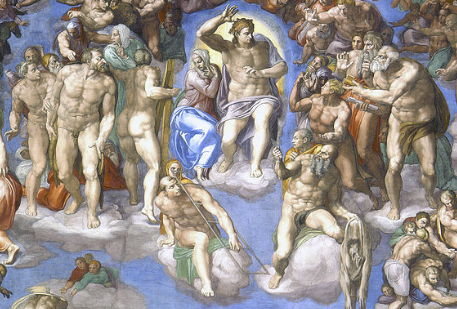


32nd Sunday Ordinary Time – Resurrection of the Body To Come; Active Discipleship Today

The Last Judgment, Michelangelo, 1536–1541, Sistene Chapel (zoomed-in view of central figures).

FIRST READING
2 Maccabees 7:1–2, 9–14
November 10, 2019

The books of Maccabees can be confusing and have been very controversial over the centuries. Luther and the other reformers banished both books from the Bible because of praying for the dead and thus providing an opening for Purgatory (2 Mac. 12:38–46). Its clear statement on the resurrection of the body, not merely immortality, has made some Jews very uneasy as well. The seeming passivity applauded in 2 Maccabees has annoyed those of a more activist bent who fully endorse 1 Maccabees. Yet there is great wisdom to be found in them both.

Today, we read from 2 Maccabees and the first confusion is that it was completed before 1 Maccabees by a different author with a different theology about persecution and resistance. They do however share a common origin in the relentless assault on Jewish customs and worship by King Antiochus IV. This began around 200 BC with educational “reform” and culminated with his demand that Greek gods be worshiped in the temple at Jerusalem. We have looked at this historical situation previously in some detail, but will now look at its spiritual dimension.

Continuing this false worship would have ended Judaism. Some people, mostly the rich and powerful who did not wish to lose their positions, consented, sometimes indeed enthusiastically. Others however resisted. There were thus, as always, two principal options. The first was armed resistance. These books take their name from Judas Maccabaeus who led the eventually successful guerrilla movement. The story of his family is related in 1 Maccabees. However, there is the opposite approach of prayer and martyrdom. This is the approach proclaimed in 2 Maccabees. The tone of the book is set in the chapter before this with the martyrdom of Eleazar, an elderly and highly respected scribe. He was told that he had to publicly eat pork, for him a grave sin. When he objected his friends, who had previously capitulated, told him that he could bring food of his own choosing escaping the death penalty (2 Mac 6:22).

His response: Continue reading “32nd Sunday Ordinary Time – Resurrection of the Body To Come; Active Discipleship Today”

31st Sunday Ordinary Time/St. Charles Borromeo – 11:15 am (Fr. Smith homily)

We celebrate today the feast of our Patron Saint, Charles Borromeo. To list even the most basic facts of his life, much less his accomplishments, would be an impossible task for a brief homily. Even more amazing is that he was only 46 when he died in 1584.

High points are found in the main window above the main altar. The principal scene is St. Charles distributing communion to a sick person on a stretcher. This commemorates his distribution of the Eucharist to the sick during a plague and for having Mass said in the open air, allowing the afflicted to more easily attend. If you look above the main window there are three windows with angels: the one on the left shows a scroll referring to his institution of religious education in his Diocese of Milan. He is considered the founder of both Catholic schools and Sunday school. On the right, the window reflects his emphasis on the Sacrament of Penance. In the central window, two angels bear a crown which foretells his canonization after his death. Not on our window is the clearest sign that he was a reformer: one of his priests who did not want to be reformed tried to assassinate him.

We remind everyone that there is more information on St Charles and the art in the church on our website. https://www.stcharlesbklyn.org/history/stained-glass-windows/

We could say much more about St Charles, but more relevant for us today is his cousin and successor Federico Borromeo. Like Charles, he was born a rich man destined for effortless success. He originally wanted to become a Jesuit, but although he did not, he was nonetheless claimed by the Church and named a cardinal at the age of 23. A most cultured man, he was dedicated to scholarship and moved by beauty. He created leaned societies and the first truly public library on the European continent. He wrote over 100 books and monographs on many subjects and, why we remember him especially today, can be credited as publishing the first hymnal for lay people. He also renovated the Cathedral in Milan, shoring up its foundations and beautifying its interior.

Now I do not mean to suggest that he was a mere aesthete. During the great famine of 1627-1628 he fed 2,000 poor people daily at the gates of his residence from his own income. He was an example of such absolute heroism that nearly one hundred of his clergy died caring for their flocks in the famine and resulting plague. This is beautifully told in Alessandro Manzoni’s novel “The Betrothed”. I should note that this is Pope Francis’ second favorite novel; coming after only the Brothers Karamazov. In it, Federico is portrayed as the model priest, and I must admit that I give it to young priests particularly to read his admonition to a well-meaning but cowardly pastor. I have no reason to believe that this did not reflect his actual beliefs and actions. After his death, the citizens of Milan erected a statue in his honor and wrote on the pedestal: “He was one of those men rare in every age, who employed extraordinary intelligence, the resources of an opulent condition, the advantages of privileged station, and an unflinching will, in the search and practice of higher and better things.”

He demonstrates the connection between beauty, worship and charity. Much of our efforts as a parish for at least the next 3 years will be to renovate the fabric of the Church building. There will be no major changes in the sanctuary or nave – the major visible changes will be decent bathrooms and a usable basement. Through it all, we must seek not to lose the forest for the trees and must remember that this building exists for worship: turning our minds and hearts to God. Beauty has always been the handmaid of worship, and a church needs to be a place where we recognize that we are doing something different. A church such as ours can literally stop us in our footsteps, slow us down and center us on the most important things. Given the distractions of our times, this is more important and needed than ever

Although I hope that people leave here feeling blessed and holy, worship is ultimately judged not by what we feel on Sunday but what we do the rest of the week. Who is better off among your family and friends or in our community because you went to Mass today? Did you help someone at work, did you show kindness to an annoying person, did you take time to offer your services to someone who needs them? The needs are endless, the opportunities without limit, and the power that comes from true worship beyond comprehension. Yet, how much of Jesus do we see in a country in which most people call themselves Christian, and more to the point what does St Charles add to this community? Who outside these walls would know or care if we disappeared tomorrow?

Today we will add another aid to our worship with our new hymnals.

We are bodily creatures and the more senses we can engage in our worship, the more effective it will be. Philosophers (eg. Suzanne Langer) tell us that each art form allows our bodies to connect with a dimension in the real world. Buildings engage us in space. A grand church building can be literally awesome and an intimate one engenders a serenity that no other structure can provide.

Music in this theory connects and develops our sense of time. Many of us seem dominated by time and trying to make each second effective. No wonder time itself may seem exhausting. Great music can suspend time and give us a taste of the infinite and a moment’s peace to gather ourselves together to praise and worship God

Please embrace this opportunity. We bless not so much the hymn books as ourselves, and desire to offer not only everything to God, but every moment. Unlike Federico Borromeo, we may not have extraordinary intelligence to display, nor either the resources of an opulent condition nor privileged station, but we can ask for an unflinching will to – by our worship – search for and practice higher and better things.