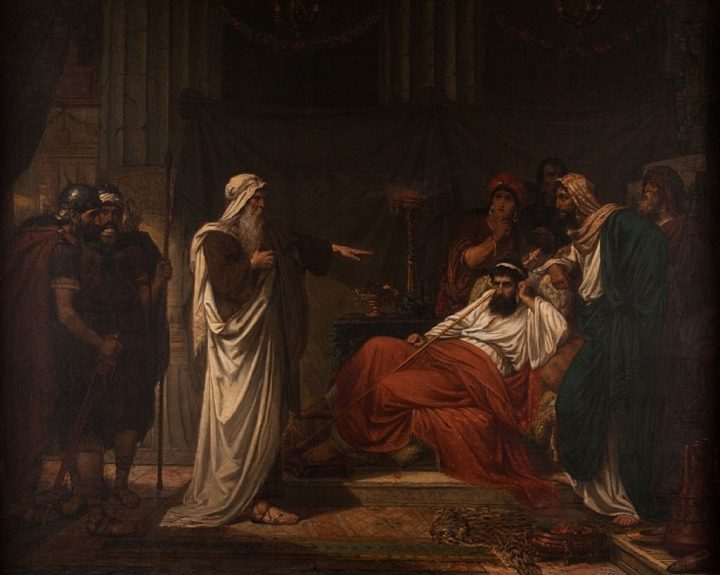
The Prophet Nathan Rebukes King David, Eugène Siberdt, 19th Century.
FIRST READING Solemnity of Christ the King 2 Sam. 5:1–3
We end the liturgical year with the beginning of the Davidic monarchy. We have seen elements of this story before (kingship and the failures of Saul). We will nonetheless begin with a brief overview of the political realities and then look at how David responded to them.
After leading the Israelites out of Egypt and through the desert for 40 years, Moses ceded leadership to Joshua to enter the promised land. After Joshua died about 1250 BC, the Israelites formed a loose confederation among themselves, but joined under a leader in times of need. This leader, called a judge, was more a general than a jurist. A judge was called by God and was not restricted to hereditary clan leaders. Thus Deborah, a woman, could be a judge. This worked well until other groups in the area began to develop a more centralized organization. The Philistines were especially threatening for the Israelites since they used their trading network to import superior weapons. By 1100 BC, this had become a crisis and another way of organizing themselves was needed. A king was the obvious solution, but the Israelites were quite aware of the dangers of kingship as well as its benefits. Although it would allow for a more coherent response to danger, there would be a price to pay. The prophet Samuel, quite literally the king maker for the early monarchy, will tell the people: Continue reading “Christ the King – Leaders who Beg for and Receive God’s Mercy”→
It would be difficult for us to understand the effect the Temple in Jerusalem had on Jesus’ contemporaries. It was the only “high rise” building in Jerusalem and could be seen to the horizon. Some of its exterior was covered in gold and when it reflected the midday sun, even visitors from Rome were amazed. When Jesus predicted that it will be completely destroyed, he is saying that the world as they knew it will end.
Indeed, those who first encountered Luke’s Gospel knew that this had occurred. They knew the Roman interpretation of the event: that the gods of Rome were stronger than the Lord of Israel,as well as the Jewish interpretation: that as in its previous destruction, they themselves had sinned and needed to repent. (Jeremiah 17:20-21). Did Christianity have anything different to offer?
St. Luke does, and being Luke, we must look at not only what he says but how he says it.
He first connects the destruction of the temple to other terrifying, disturbing and potentially lifechanging events. Wars and insurrections, earthquakes, famines and plagues: these are all mighty signs, but of what? Although they may totally disrupt people’s lives, they are then, as now, the background noise of earthly existence. Because of their powerful effects we may think that literally the world is coming to an end and believe that prophets must come in Jesus’ name. This denies God’s freedom, for only He decides when the end truly comes. Jesus alone provides the punctuation to history.
It is important to note that Luke also wrote the Acts of the Apostles: his second decision was to connect the two works. The Gospel tells us what to expect and Acts shows what has occurred. If you check even one of the selections from the Acts of the Apostles below, you can see what Luke is doing.
They will seize and persecute you. This happened to Peter and the other apostles almost immediately after the Ascension, (Act 4 1-4)
hand you over in synagogues (Acts 22:19) and prisons. Both Peter (Act 12:5) and Paul (Acts 16: 16-40) spent their time in jail and both were arranged by religious authorities (Acts 4:1-22, 18:12-17). Paul was tried by kings (Acts 25:23) and governors. (Act 23:33)
Remember, you are not to prepare your defense beforehand,for I myself shall give you a wisdom in speakingthat all your adversaries will be powerless to resist or refute.Although Paul was a highly educated man,Peter and Stephen were not. (Act 4:13)Yet, they spoke with an eloquence that was truly divine (Acts 4:8-10 and 6:10)
You will even be handed over by parents, brothers, relatives, and friends, and they will put some of you to death.Jesus has already told his disciples, and they would no doubt have already seen, that even family members would cast them out. (Luke 12:51-53) Stephen was the first Martyr. (Acts 7:54-60)
You will be hated by all because of my name,but not a hair on your head will be destroyed.Predicting the future was considered a prophetic act taken seriously by both Jew and Gentile. Luke would expect that this would predispose his audience to accept his conclusions: followers of Jesus will be hated by the world, but they are beloved by God andwill be saved and restored in the resurrection of the Body. Literallynot a hair of their heads would be destroyed.(See last week’s reading from Second Maccabees.)
By your perseverance you will secure your lives.As he told us with the faithful steward it is in following Jesus by living good and holy lives,each day, here and now that will always and everywhere connect us to him. (Luke 12:42-48)
Let us remember the Beatitudes:
Blessed are you when people hate you, and when they exclude and insult you, and denounce your name as evil on account of the Son of Man(Luke 6:22)
It is one of the great paradoxes of our faith that the seemingly indestructible temples of stone and gold protected by kings and armies will dissolve but the community of faith, the church of God in flesh and blood, will last as long as we are formed by the Spirit of God.
In the end, what prevails is neither power, nor even penance, but blessing.
Thursday, November 28: Thanksgiving Day
Mass at 9 AM – no midday Mass
Sunday, December 1: 1st Sunday of Advent
Mass at 9 AM, 11:15 AM, 7 PM
Advent Faith Sharing Program Begins
Sunday, December 8: 2nd Sunday of Advent
Mass at 9 AM, 11:15 AM, 7 PM
Advent Wreath Sale after all Masses
Monday, December 9: Immaculate Conception
Mass at 12:10 PM
Sunday, December 15: 3rd Sunday of Advent
Morning Mass at 9 AM
Mass with Nativity Pageant 11:15 AM followed by Meet & Greet Reception
Evening Mass at 7 PM followed by Meet & Greet Reception
Sunday, December 22: 4th Sunday of Advent
Mass at 9 AM, 11:15 AM, 7 PM
Tuesday, December 24: Christmas Eve
Children’s Mass with Nativity Pageant at 5 PM
Christmas Mass During the Night (Midnight Mass) at 8 PM
Wednesday, December 25: Christmas Day
Mass at 9 AM and 11:15 AM (No 7 PM Mass)
The Parish Pastoral Council and Finance Council presented a five-year strategic planlast year at this time.
One year in, we offer a status report of our progress, as well as a summary of our current financial situation, at the following link: St Charles Annual Report Final Nov
We ask that you carefully read the report and prayerfully consider how you can help St. Charles and each other over the next year.