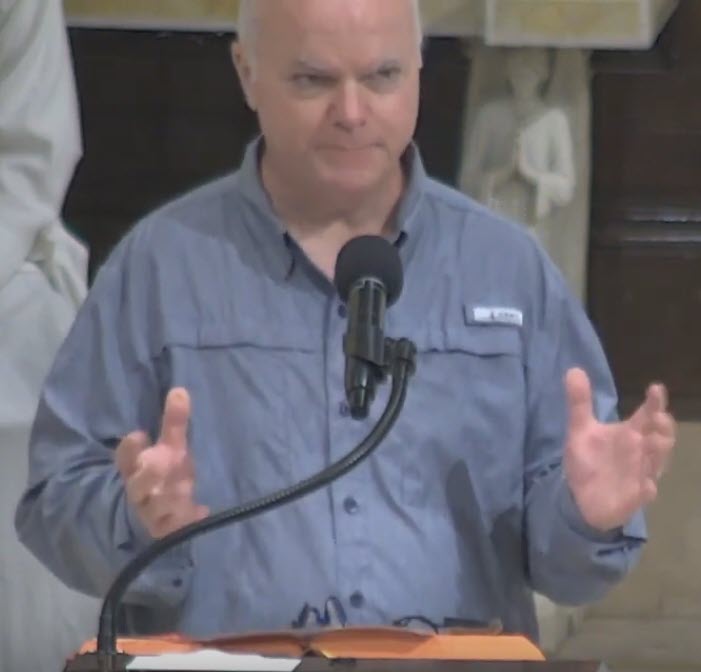
So joyous to be here with you this morning, so many faces from so many different parts of my life actually here today.
And they’re all here for one reason. That is to welcome Jason Chen into the church, we have with us someone who has been on a journey.
A journey that has led him to having an encounter with Jesus Christ and that encounter has led him to affirm it through the sacraments of baptism, confirmation and communion, the three sacraments that initiate you into the church and not just becoming a member of a social organization, but becoming actually who you are called to be the very presence of Jesus Christ in the world.
That’s what we are all called to be as Christians, the very presence of Jesus Christ in the world, when people gaze upon us, they should see something different coming through our eyes and how we speak.
Please join us to celebrate the 23rd Sunday in Ordinary Time on Sunday, September 5, 2021. The 11:15 am mass will be Fr. John Gribowich’s last mass with us. He will be leaving to join the Trappists this month. Please pray for the success of his vocation.
Our current Mass times are:
9 AM EDT – Morning Mass – in person
11:15 AM EDT – Community Mass – in person and livestreamed online
7 PM EDT – Evening Mass – in person
Watch the video live or on replay via YouTube Live by clicking in the window above.
The Gather 3rd Edition Hymnal/Missals are now available for use in the church – pick one up as you enter and return it after Mass. Instructions on how to use the hymnal missal are available here: https://www.stcharlesbklyn.org/hymnal-missal/ .
Todays music and readings can be found in the Hymnal Missal at the following numbers:
Entrance: The King of Love My Shepherd Is – 712 Readings and Psalm -1159 Offertory: Open My Eyes – 651 Communion: Christ, Be Our Light – 590 Closing: Healing River – 643
A talk for married couples, engaged couples, and those in the single life
Sunday, October 3, 12:15 PM
All are welcome Sunday, October 3rd, after the 11:15 AM Mass, to a talk on how couples can stay connected in the midst of busy lives. The talk will provide research-based practical tips on how to have more fun in relationships, how to have more intimate conversations, and how to find more joy in the humdrum of daily life.
Our presenter, Peter McFadden, is a New York-based marriage educator who has worked with more than five thousand couples over the past eighteen years. He has received training directly from Dr. John Gottman, the world’s leading researcher on marriage. This talk is the first of many he will be giving at St. Charles over the coming year. You can watch Peter’s introduction to the Marriage and Relationships program here.
So we can prepare for how many will be in attendance, please RSVP to Peter at [email protected]. If you can’t attend in person, you can email Peter to obtain the Zoom link.
Streams will burst forth in the desert, and rivers in the steppe. The burning sands will become pools, and the thirsty ground, springs of water. (Isaiah, 35:6-7)
Fr. Smith’s Commentary on the Second Reading Twenty-third Sunday in Ordinary Time Letter of St. James 2:1-6 September 5, 2021
We continue today with the Letter of St. James. It was, as we discovered last week, written by a Jew to fellow Jews. Whether the author was James, the kinsman of Jesus or not, he had significant prestige among the people and insight into their communities.
These communities were within the Roman empire. It was part of the managerial genius of the Romans to realize that they could not directly administer every aspect of life, especially in small towns in faraway places. Therefore, they used the native ruling elites to maintain order and peace. We see this with the trial of Jesus. The priests were the local elite entrusted with this task and they first examined Jesus. When they deemed him a greater danger than a mere rabble rouser and thought he needed to be put to death, they needed the Romans to approve and perform the execution.
This week we return to Mark’s gospel and discuss the Pharisees. They are interesting for many reasons. By the time the gospels were written as they were the only Jewish group that survived the destruction of Jerusalem, so they were competition. Simultaneously, as some of their beliefs, resurrection of the body and angels for example were close to Christian beliefs they were prime candidates for conversion. Remember that St Paul was a Pharisee. But I think the prime reason for their importance was that they were good examples of what could happen to us. They still are.
To understand the pharisees we need to remember that the principal act of Jewish worship. was animal sacrifice in the temple in Jerusalem. Indeed, only in the temple of Jerusalem. It would be as if we could only celebrate Mass at St Peter’s Basilica in Rome. People wanted more than this and so they came together to pray, sing and celebrate the law as their connection with God. Some wished to go even further and took on the laws for priests as their own and applied them to every part of their lives. When the gospel today speaks about cleaning hands it was not for hygiene but for ritual and was extremely complicated and meticulous. This was impossible for most people so those who could do so were called “Pharisees” literally the separated ones. This caused some problems.
First, Spiritual elitism. Separate does not in and of itself mean better. Indeed, the original desire was possibly to do these rituals for the people. Yet that changed and the Pharisees thought of themselves and were thought of by others as being a higher, more noble and better Jew. By the time of Jesus, some professions were considered unfitting for a Jew because it would be impossible to obey these laws. Shepherds were one of these and it is no accident that they are the first to greet the baby Jesus.
Before we criticize the Pharisees, let us remember that until a half century ago Catholics commonly held that despite baptism there were two kinds of believers the laity – lower – and the clergy and religious – higher. It took the 2nd Vatican council proclamation of the universal call to holiness to begin to change this attitude.
Second, habit replacing spirit. The pharisees began as a movement of great and sincere devotion. There who still many who were joyous and devoted to the Lord. But placing such an emphasis on the externals of worship can loosen the grasp of the basic realties. The worship of the Jews as ours is to form a covenant, a living relationship with God and his people. If that is lost, worship becomes dry and meaningless. Jesus calls the pharisees hypocrites. A hypocrite is literally one who wears a mask. The mask may be noble but that does not mean that there was real flesh and blood behind it. For all the posturing there might be no there, there,
We may soon see this in our own Church and Parish. If covid restrictions are ever completely lifted, we will be able to see who comes back to church and who does not. Perhaps many will discover that Mass was just a habit which may take many years to develop but may dissolve in a few months.
Finally, blindness. The laws which the pharisees felt called to obey were personal in nature. They sought to make an individual ritually clean as if he were a priest called to the sacrifice. Once more we need to say that this can be very noble and good. But it can become very private and isolating,
Jesus calls them to task by quoting from the prophet Isaiah. As those who will participate in our bible study this Fall will learn there were three prophets who took the name Isaiah. Our quote today is from the first one. He lived in the 8th century before Jesus and he spoke at a crucial time in Jewish history,
A characteristic of Jewish society was the small farmer. He owned his own land and there were many laws established to prevent him from losing it. This was not particularly profitable or efficient, but it formed a stable society. Some landowners wanted greater profits and by various means were able to take the land of these small owners. When we hear that Isaiah was a great prophet of social justice this is primarily what it meant. He saw how gross inequity would change society for the worse. He will often ask, as he does today, where were the religious leaders when their world was overturned?
The covenant, the relationship between God and man was not created and sustained only by animal sacrifice but by charity and justice. Many priests of Isaiah’s time and Pharisees of Jesus’ sacrificed love and justice on the altar of mere ritual.
I lived in South Jamaica during the subprime mortgage crisis and Isaiah’s lines haunted me. This middle-class black bastion was being eviscerated, did my worship make me see it more clearly and connect with the victims more closely, or did my practices make me blind and complacent?
To see a Pharasee we often do not have to open a book just look in the mirror.
The gospels reveal mysteries to show us a deeper way to live the cross of Christ.
The Cross reveals at very least that Jesus’s love for us is complete and limitless. With this kind of love there is no room for cast or distinction. Through the cross we know that we are all sinners seeking to be saints.
The crucifixion shows God’s compete commitment to his relationship with us. Can we call ourselves a follower of Jesus and put on even the most pious mask?
The crucifixion was for all, and we reflect that love when we see and care for the needy. We need to see with the eyes of the Good Samaritan who saw and cared for the man in the gutter not those of the Priest or Levite who passed by.
Let us learn from the mistakes of the Pharisees, old and new, Jewish and Christian and offer ourselves with Jesus, let us put down our masks and take up his cross.