Please download the worship aid to participate in Friday’s evening prayer, which will begin at 5 PM.
Instructions on how to join are available here.
Please download the worship aid to participate in Friday’s evening prayer, which will begin at 5 PM.
Instructions on how to join are available here.
The book of Numbers is part of the Pentateuch, the first five books of the Bible. All literate Jews would have known this passage, and the others would have known of it. Because of it Messianic expectations included that a star would be a sign of his arrival.
This is the primary background for today’s gospel but there is one other dimension. Matthew calls the visitors from the east magi. For many of his readers these would have been the court advisors and magicians who confronted Daniel in the court of Babylon. They had an extremely negative connotation. Using Magi is not neutral like simply saying king or wise man. We should see them like the Samaritan in Luke’s gospel. It was shocking that people who were not only not Jews but hostile to them would have an insight into the nature and actions of the Messiah.
For centuries people have tried to discover what the Star was and from where did the Magi come. Some of the answers were ingenious but most rather silly and all distracting. A great principle for bible reading is the best interpreter of scripture is scripture. We should always first look at the scriptures for the meaning of a bible passage. In this case we would very definitely be rewarded with the story of Balaam.
It is found in the book of Numbers and is set during the invasion of Canann by the Israelites. Under Moses they had been wandering and fighting for 40 years and had become a fierce and disciplined fighting force. The king of Moab, Balak, realized that he was about to be attacked by Moses and that he could not win by force of arms. He decided however to use different means and sought out Balaam a “seer” from the east to curse the Israelites. This was about 1400 BC and seer, or prophet, meant not someone who could predict or envision the future but someone who could change it. Balak wanted to hire Balaam as a supernatural hit man. Balaam is contacted by the emissaries of Balek and somewhat reluctantly he follows them to Canann. Though he tried to curse the Israelites, the LORD puts words of blessing in his mouth and the Israelites steadily improve their position. His final utterance however goes far beyond just this one battle”
I see him, but not now;
I behold him, but not near—
a star shall come out of Jacob,
and a scepter shall rise out of Israel; (Nu 24:17).
On Sunday, January 2, 2022, join us in person or online for the Epiphany of the Lord.
Our current Mass times are:
The readings will be from Cycle C.
Opening – O Little Town of Bethlehem – 446
Readings and Responsorial Psalm – 1011
Offertory – Away in a Manger – 448
Communion – Angels We Have Heard on High – 430
Recessional – Joy to the World – 437
The Gather 3rd Edition Hymnal/Missals are available for use in the church – pick one up as you enter and return it after Mass. Instructions on how to use the hymnal missal are available here: https://www.stcharlesbklyn.org/hymnal-missal/ .
Today’s readings are also available to read online at the USCCB website https://bible.usccb.org .
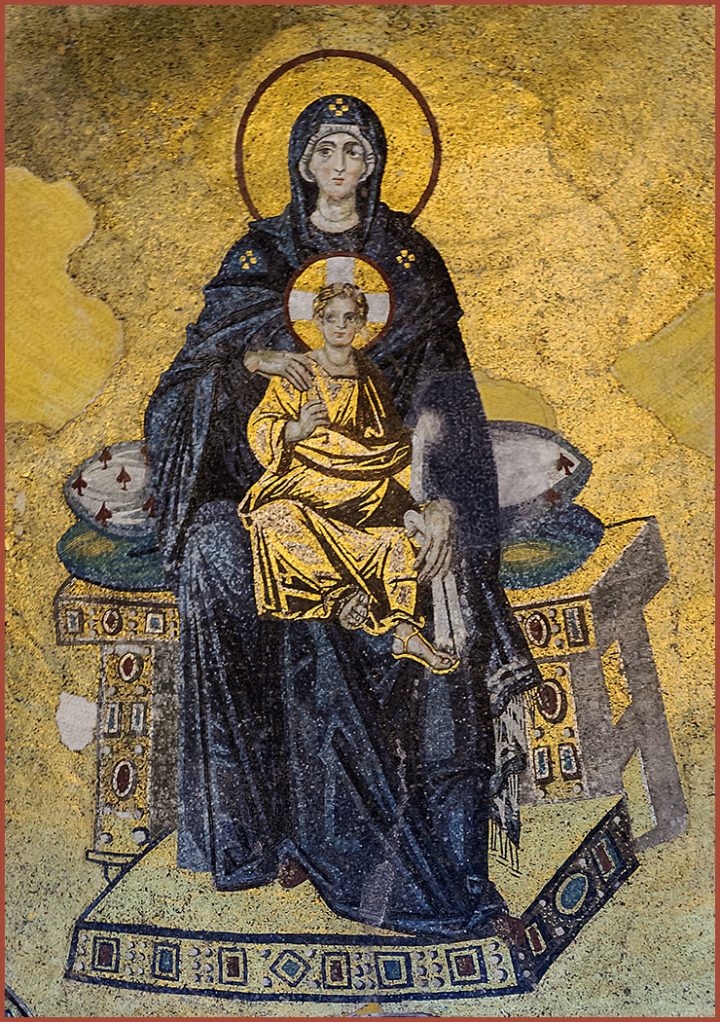
Virgin and Child mosaic, 9th century, Hagia Sophia
(About this Image)
Fr. Smith’s Commentary on the Second Reading
Feast of the Epiphany
Letter to the Ephesians 3:2–6
January 2, 2022
The second reading for the feast of the Epiphany is from the “Letter to the Ephesians.” (Ep 3:2-3a, 5-6). We examined this letter last summer in these commentaries. Those who read them will see that many passages from the letter would be very appropriate for the feast of the Epiphany but this one is particularly well suited.
We must remember a few things to start. Most scholars would agree that it was written by a disciple of St. Paul after his death. As we have many times noted, this would not be deceitful as his readers would have known that Paul was dead. As we saw last week with the reading of the letter to Titus, this allowed the author and indeed the leaders who followed Paul to show that they were in continuity with him. Who would follow the original apostles as leaders was a real problem and Ephesians is one of the clearest statements on how and why the Catholic Church developed. Continue reading “Epiphany – Joining Together To Be His Presence in the World”
Please download the worship aid to participate in Friday’s evening prayer, which will begin at 5 PM.
Instructions on how to join are available here.
Friday, December 31
5 PM – Vespers on Zoom
7 PM – Mary, Mother of God (Vigil Mass) in church, live streamed on Youtube
Saturday, January 1: Mary, Mother of God
12:10 PM – Mass at Church, live streamed on Youtube
Sunday, January 2: Epiphany
Mass at 9 AM, 11:15 AM, 7 PM, live streamed on Youtube
St. Luke was very much a Roman citizen and knew that the ultimate competition for Jesus was the emperor. He had lived through the reigns of several emperors and realized that the first – Augustus – was the most formidable, and so he begins the story of the birth of Jesus with him. We are meant to make comparisons.
The emperor was born Octavian in 63 BC. He came from a solid family but was not of the highest nobility. He was however the adopted son of Julius Caesar and demonstrated such military and political skill after his death that he became the most powerful man in Rome. He also understood how to use symbols and what we would now call public relations.
Continue reading “Christmas and the Holy Family – Homily (Fr. Smith)”