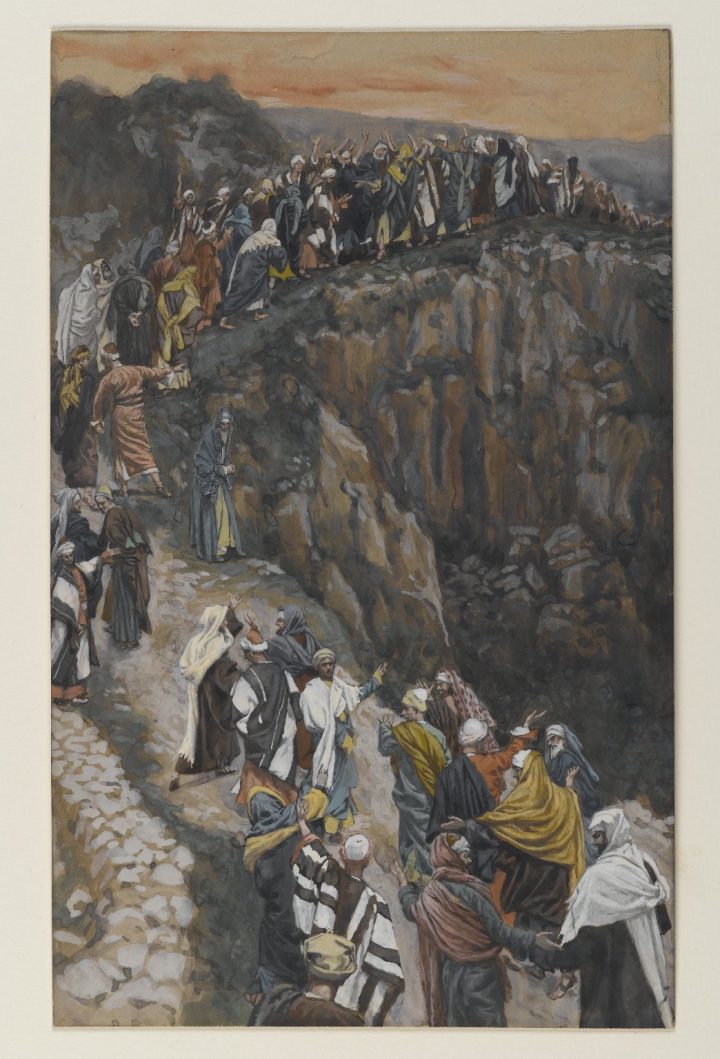
Brow of the Hill Near Nazareth, James Tissot,
c. 1886–1894, Brooklyn Museum
(About this Image)
When the people in the synagogue heard this,
they were all filled with fury.
They rose up, drove [Jesus] out of the town,
and led him to the brow of the hill
on which their town had been built,
to hurl him down headlong.
But Jesus passed through the midst of them and went away.
(Luke 4:28–30)
Fr. Smith’s Commentary on the Second Reading
Fourth Sunday of Ordinary Time
1 Cor 12:31–13:13
January 30, 2022
Today’s reading is among the most beloved passages in the Bible. It is a hymn to love and is by far the most popular reading at weddings. It is indeed beautiful by itself, but as we may suspect from our examination so far of 1 Corinthians, it is immeasurably more so in context. Although we as members of the Global North may have some trouble appreciating its wider context.
Paul is writing to a mixed group Jews, Greeks, slave, free, rich, poor. They are very impressed by oratory, and he will use many rhetorical techniques to reveal his familiarity with “proper speech.” Some of these are extremely effective and provide significant clarity but would take undue time to explain. We will look at this passage from the perspective of community. As we have seen the Corinthian church was not only composed of people from every land but from every class. It was a boom town in constant flux. A religion, indeed, any new society, would experience great tension keeping itself together. The more elite sections would expect to be given the places, positions, and privileges of their station. We see this in 1 Cor when the rich who gave their houses for the communion meeting—Eucharist—would expect better food and wine than the more common members. Others, however, sensed this as a new opportunity and sought to gain status by their participation in the Church. As Paul reminds us, all Christians have been given spiritual gifts and there is always the tendency to hold mine as the most important. We still find this today with people who claim the benefits of “meritocracy.”
Continue reading “4th Sunday of Ordinary Time – Building a Community Through Love” →