19th Sunday Ordinary Time – Light Your Lamps

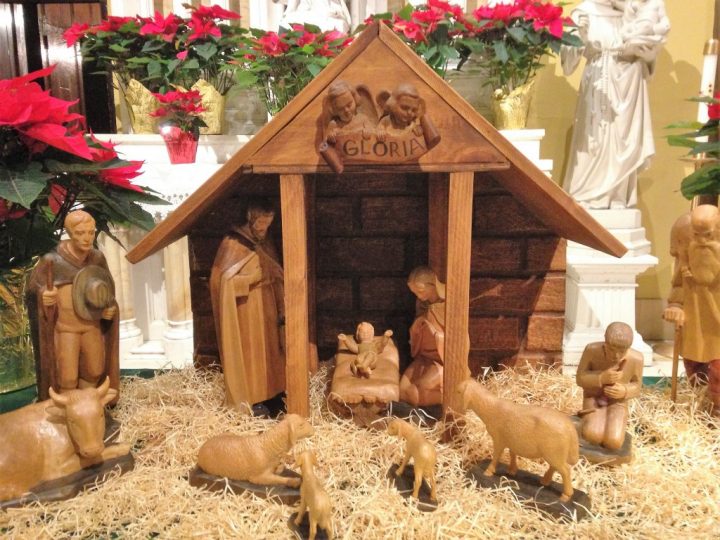
Santa Clara, Isidoro Arredondo, 1693.  St. Clare of Assisi’s feast day is August 11th.

Adult Sacraments and Christian Formation 

Where is God? The summer has been a catalog of horrors: detention centers and raids that separate families on our borders, a public celebration for what would once have been an unthinkable extension of abortions in our State and repeated Mass murders by lonely and disaffected young males, to name the most obvious. The author of the Book of Wisdom, facing a world that presented many difficulties to his faith (see first reading below), urged his readers to make the traditions of their people, both moral and liturgical, the center of their lives. If that was true for the Jews it is even more pertinent for us. Do you know the traditions of the Catholic Church? Have you examined them since high school? Even if you have received all the appropriate Sacraments and attend Mass more than you don’t, seriously think about your further Christian formation with the RCIA. 

Baptism, Communion, and Confirmation: Non-Catholics who wish to become Catholic or Catholics who wish to receive Eucharist or Confirmation are asked to call or email Fr. Smith. The R(evisedC(hristianI(nitiation) of A(dults) classes will begin in the Fall. They are set in a seminar format with meetings once per month until Easter. There are 50 to 75 pages of reading per session. 

Marriage: St. Charles Parish congratulates those who will become engaged this summer and we wish to accompany you on your way to the altar and beyond. Please contact Fr. Smith at your earliest convenience. This includes those who will be married in another Parish and especially those who will be married in another country. 

Please contact Fr. Smith at the Rectory (718-625-1177 ext 409) 


Question from last week’s homily: 

As we had our annual mission talk last week, I suggested a homily by Dr. Meghan Clark of St John’s University (https://www.youtube.com/watch?v=Js1K27ya2Rk) as a substitute.  

She connected the readings to some of the basic issues of Catholic Social thought. I received some comment on the meaning and consequences of “The universal destination of all goods”. Fr. Kenneth Himes clarifies this succinctly and elegantly below: 

  1. Has the teaching on private property evolved over the years?

Yes, basically the development has been in the direction of underscoring the social dimension of private property. 

Pius XI affirmed the “twofold aspect of ownership, which is individual or social accordingly as it regards individuals or concerns of the common good” (Quadragesimo anno 45). Pius XII retrieved the patristic theme of the universal destiny of all goods as the context for thinking about private property (“Pentecost Address,” June 1, 1941). There can be a diversity of ownership schemes that should be left to the particular customs and statutes of a society. However, any such scheme “remains subordinated to the natural scope of material goods and cannot emancipate itself from the first and fundamental right which concedes their use to all” (ibid.). 

In effect, the raising up of the social dimensions of ownership has led CST to insist not only on the individual right of private property but the “social duty essentially inherent in the right” (Pacem in terris 22). 

Paul VI explicitly denied that the right to private property is to be considered “an absolute and unconditioned right,” for “the right to private property must never be exercised to the detriment of the common good” (Populorum progressio 23). This principle extends to the case that “the common good sometimes demands expropriation” of property (24). 

According to John Paul II, all property has a “social mortgage, meaning it has an intrinsically social function based upon and justified precisely by the principle of the universal destination of goods” (Sollicitudo rei socialis 42). While private property remains a right that is “valid and necessary,” in the face of widespread poverty it is important to affirm “the characteristic principle of Christian social doctrine: the goods of this world are originally meant for all” (ibid., italics in original). 

It is in the same vein that Benedict XVI pointed out that some within the richer nations have been guilty of “excessive zeal for protecting knowledge through an unduly rigid assertion of the right to intellectual property, especially in the field of health care” (Caritas in veritate 22). 

Himes, K. R. (2013). 101 Questions & Answers on Catholic Social Teaching (Second Edition, pp. 82–83). New York; Mahwah, NJ: Paulist Press. 

How comfortable are you with the answer to the question: “Who besides myself  has benefited from my possessions?” 

If questions arise from any of the homilies or talks in the Parish, please let me know and I will be happy to answer them as best I can.  

Fr. Bill  


Nineteenth Sunday of Ordinary Time 

August 11, 2019 

Wisdom of Solomon: 18:6-9 

Our reading today is from the Book of Wisdom, often called the Wisdom of Solomon. We read from it several months ago. Let us take a moment to remember its background. Although it sounds ancient, it is perhaps the last book in the Old Testament and could have been written as late as 30 BC. Also, although it takes the name of King Solomon of Jerusalem from about 1000 BC, it was most likely written in Alexandria Egypt for the children of the Jewish elite who were immersed in the Roman world and tempted to give up their faith.  

Alexandria was an important commercial but also intellectual center famous throughout the Roman world. The author of Wisdom is well versed in all the alternatives to Judaism, from Greek philosophy to the cult of Isis. In the other sections we read from Wisdom, the particular city of its composition was not important but today, as we will see, it is very important that it is written in Egypt. The author is first and foremost a man of his tradition. He answers the questions that his young people might have not only as Romans but as Egyptians. He will speak from the Scriptures and shows the superiority of the God of Abraham, Isaac and Jacob and as we will see today Moses 

We read today from Wisdom 18:6-9but the section begins with Chapter 11. His purpose is to show his young aristocrats that the Lord cares for His people at all times and places, not only in the past or only in Jerusalembut in the Diaspora as well. There is no better example for them than the Exodus from Egypt millennia before.  

To develop this, he uses key elements of the Exodus story. Thus, the Lord gave the Israelites water from the Rock, but the river Nile became blood, (Wisdom 11:4-14). The Egyptians lost their appetite with an infestation of frogs, but the Israelites were fed with quail (Wisdom 16:1-4). Even in the midst of deprivation and exile the Lord cared for His people.  

The author has developed this so that the emotional climax is the contrast of the death of the firstborn of the Egyptians with the deaths of many Israelites in the desert.  

The scene is set by the decision of Pharaoh to kill the male babies of the Israelites 

5 When they determined to put to death the infants of the holy ones, (Wisdom 18:5)  


We know the response: 

Thus, says the LORD: At midnight I will go forth through Egypt.5 Every first-born in this land shall die, from the first-born of Pharaoh on the throne to the first-born of the slave-girl at the handmill, as well as all the first-born of the animals (Ex 11:4-5) 

They (The Israelites) shall take some of its blood and apply it to the two doorposts and the lintel of every house in which they partake of the lamb. (Ex 12:7)  

12 For on this same night I will go through Egypt, striking down every first—born of the land, both man and beast, and executing judgment on all the gods of Egypt – I, the LORD! 

13 But the blood will mark the houses where you are. Seeing the blood, I will pass over you; thus, when I strike the land of Egypt, no destructive blow will come upon you. (Ex 12:12-13) 


The author of Wisdom reflects on this: 


That night was known beforehand to our fathers,  

that, with sure knowledge of the oaths in which they put 

their faith, they might have courage. 

7 Your people awaited  

the salvation of the just and the destruction of their foes  

For when you punished our adversaries,  

in this you glorified us whom you had summoned (Ex 12:6-8 

The Lord was faithful to his promises and demonstrated that he was all powerful in every time and place.  

For in secret the holy children of the good were offering sacrifice 

and putting into effect with one accord the divine institution, 

That your holy ones should share alike the same good things and dangers, 

having previously sung the praises of the fathers. (Ex 12:9-11)  

The sacrifice is most directly the first Passover, but it reflects the situation of all the Jews in the Diaspora who faithfully commemorate the feasts and fasts of their people. The author notes that they were an ancient people even when in Egypt, able to sing the songs of their Fathers.  

We note however that there is a comparison. The angel of death came upon the Israelites in the desert as well:  

The next day the whole Israelite community grumbled against Moses and Aaron, saying, “It is you who have slain the LORD’S people.” 

7 But while the community was deliberating against them, Moses and Aaron turned toward the meeting tent, and the cloud now covered it and the glory of the LORD appeared. (Numbers 17: 6-7) 

The Lord is furious with the people and sends destruction among them. Aaron the priest, however, goes into the midst of the carnage and stops it: 

14 Yet fourteen thousand seven hundred died from the scourge (Numbers 17: 14a)  


The author of wisdom reflects: 

But the trial of death touched at one time even the just,  

and in the desert a plague struck the multitude; Yet not for long did the anger last. 

21 For the blameless man hastened to be their champion, 

bearing the weapon of his special office, 

prayer and the propitiation of incense (Wisdom 18:20-21)  

God’s anger at the disobedience of the people did not last long and it was turned away because the Jews, through Aaron, remained faithful to their traditions. Ritual and tradition cannot take the place of repentance, but the future leaders of the People are being warned that without this connection they are no better than the Egyptians – of ancient times or theirs.  

The last few weeks have seen, at the time of this writing, three mass killings. We also cannot ignore the general gun violence in some of our major cities nor the extension of abortion laws. With the latter, I will never forget that when the bill making virtually any abortion legal in New York State was passed and signed buildings and bridges were lit up in celebration. So much for safe, legal and rare. The talking heads of all persuasions were out in force for these events and I, for one, found them unpersuasive. Like the author of Wisdom, some ideas seemed to have merit but there was no compelling system of thought behind them. Like our author today, I think we must go to the history of our people more to point to the God who is revealed most fully in Jesus to know that despite what we see around us, God is with us, we are never abandoned and that he gives us the means to survive as a people and often to have a real effect on our society.  

In these dark times let us take comfort in the last words of The Book of Wisdom which are, for most scholars, the last words of the Old Testament:  

22 For every way, O LORD! you magnified and glorified your people;  

unfailing, you stood by them in every time and circumstance. (Wisdom 19:22)  


18th Sunday Ordinary Time – Fr. Gribowich Homily

Podcast transcript:
Good morning, everyone! Hope that you all had a really fine week, and that you are able to enjoy the blessings of another Sunday, of course, on the heels of some tragic news that we’ve heard of more shootings in our country – in Texas and Ohio – knowing that in this world that’s always filled with brokenness, and suffering, and pain. And when we hear news of that, it reminds us that we’re clearly not in heaven.

Yet, today’s Gospel gives us the hope for us to focus on what is really important: that which is of Heaven. That the challenge is how to be able to be focused on that, in the midst of a very, very broken world. How to focus on that in the midst of our own personal brokenness is, as I was looking at the Gospel for today – and really all the readings – I would, I could not help but think about the situation I am in my own life right now.

As you all know, I’m here in Berkeley because I’m going to school here at the university, and when you’re in graduate school, you share the classroom with lots of other people who were there for lots of different reasons. Some are there because they’ve been almost assigned to do it – their work is kind of paying for them to go to grad school, and this is the next step that they have to do in order to advance within their career. But for many people, a return to school usually indicates a type of wrestling with your own personal identity. What type of name am I trying to present? Who am I really? What’s of a mark or impact can I make in the world.

For many people, when you get to that early midlife, you start to see an uptick on people going and getting degrees – advanced degrees – trying to figure out how they could restart their career, try to figure out a way to somehow bring more satisfaction to their life. And clearly being with my cohort here at Berkeley, I see a lot of that going on. But yeah, it’s not just something I think graduate students wrestle with, trying to see your own personal identity, what you’re about, trying to figure out what is the meaning of life and your role in it.

We all fall into that all of us at some point start to question what is it all about. What is life all about? If we’re honest with ourselves, we know that, as the First Reading says, that you know all is really just vanity. Think about just this deal we’re given life, right? We didn’t choose to be born, yet here we are. And the way it ends is that we end up dying.

Naturally, all of us at some point have to ask yourself the question: what is this all about? And not only are we here not by choice, not only does the whole process end with us dying, there’s a considerable amount of pain between birth and death. So once again, what is it all about? What does it mean to go through this whole process? Why bother?

I think the reason why we continue to wake up every day is because we really understand that, in the midst of a world that we did not choose to be born in, that we do not choose to die in, and in which we participate with much suffering, we see so much goodness, we see so much goodness. What keeps us moving and clinging to the hope that tomorrow will be a better day is because around us, especially in moments of tragedy and suffering and brokenness, we see perhaps the greatest acts of kindness, charity, selflessness.

I often say that there’s nothing more unjust than going to a hospital for children and seeing children suffer so innocently. If there’s ever a moment to question God’s existence, it’s in that very moment to see a child suffer. Yet, the very same moment we see the heroic actions of doctors, nurses, parents, and other support, for people show that in this moment they bring their best selves to the table. We see God’s presence in the selfless actions of others.

And this is exactly what the Lord wants us to focus on in the Gospel today. There’s a conversation I had this week with a friend of mine – actually a member of the class here at Berkeley, and he considers himself to be an atheist – and he asked me, “Like John, how do you identify yourself?”

And of course I think he was expecting something lofty, in relationship to knowing that I am a priest, so maybe he thought I was going to identify myself as being a Catholic, a Christian, a priest. I said, you know, my identity is not wrapped up in the things that I essentially participate in this world. My identity exists in only one thing, and that is I am my beloved son of God, a beloved child of God. That is the identity that all of us have, because it’s the one thing we do not elect to be part of. We don’t actively choose to be part of.

Yes, it’s through God’s grace them have been called to be Christians, Catholics, called to our vocations, and we respond to that grace. But the one thing that does not even demand a response on our part is the fact that we are simply beloved by God for being. And Jesus gives us this parable showing how this rich farmer was trying his darnest to bring about things into his life that would give him security, comfort, knowledge that he is somehow taken care of. But what a burden it is to have to bring your own identity to you. What a burden it is to work to create an identity for yourself – trying to prove to yourself, trying to prove to us, trying to prove to God that you’re doing life right, which is why we work so hard at having a good job, having material things, being successful, because we’re all under this illusion that we have to form our own identity. And of course it extends to our participation and other things. How many of us identify with different groups we are part of, political parties, even religion?

When our identity is caught up in something other than the very fact that we are loved by God simply because we are, we are destined to be let down, because we seek something that is ultimately part of our own doing, that is not solely the doing of God.

Today, we come to Mass, and we participate once again in receiving the Eucharist. And what is this really do for us? It brings us in communion with Jesus, the son of God. Who are we? Sons and daughters of God. We share in the same relationship that God the Father has with Jesus the Son. When we’re in communion with the Son – Jesus – we are reaffirming our identity as sons and daughters of God.

And once we know who we really are, there’s nothing to fear. There’s no need to make sure that all of our ducks are in order, that we have enough money for retirement. There’s no need for us to make sure that we have the exact perfect job, and that we’re making an impact the way that we think we need to make an impact. There’s no need.

Yet, we have to ask ourselves why is it that we have to toil. Why is it that we work? Why is it that we need things and stuff? Why is it that we have to be careful and mindful of what we have so that tomorrow we had at least enough security to get by. And once again is the same Eucharist which brings it all back to the place of Thanksgiving for the job that we have, the material things that we have, the success that we may have, is all opportunity to give thanks to God for allowing us to participate in a very small way in his goodness. And it’s that goodness which makes us get up each day to face the day, face the world, and give us the hope that tomorrow will be a better day.

God bless you all.

18th Sunday Ordinary Time – Living Beyond This Life

View from Mount Holyoke, Northampton, Massachusetts, after a Thunderstorm—The Oxbow,
Thomas Cole, 1836, Metropolitan Museum of Art, New York City (Wikipedia).

Ecclesiastes 1:2; 2:21-23
August 4, 2019

We read today from the Book of Ecclesiastes. It is also called the book of Qoheleth after its author. Interestingly, they can both be translated as Assembly or Church. It is somewhat hard to date, but the best estimate would be about 400 BC in Persian-controlled Jerusalem. It is a time of peace and prosperity and allows Qoheleth time to think and reflect; one might expect a sense of satisfaction, yet the first words of his book are “Vanity of Vanity.”

Qoheleth is a public intellectual. He had students and seems to have edited his thoughts at the end of his life, so that they could be published. He wished to influence the wider society and his message was certainly distinctive, but on first reading somewhat shocking and disappointing.

The Bible we use at Mass translates the Hebrew word hebel as vanity. This emphasizes the pride that we often take in our own successes which are ephemeral and fleeting. Another translation would be futile, and I think we need to keep both in mind as we read today’s text: what we do is futile, and we are vain to think otherwise.

Immediately after the opening verse:

Vanity of vanities, says Qoheleth,
vanity of vanities! All things are vanity.

He continues in verses we do not read at Mass:

What profit has man from all the labor
which he toils at under the sun?
One generation passes and another comes,
but the world forever stays.
The sun rises and the sun goes down;
then it presses on to the place where it rises.
Blowing now toward the south, then toward the north,
the wind turns again and again, resuming its rounds.
All rivers go to the sea,
yet never does the sea become full.
To the place where they go,
the rivers keep on going.
All speech is labored;
there is nothing man can say.
The eye is not satisfied with seeing
nor is the ear filled with hearing.

(Ecc. 1:3–8)

He is very concerned with time. Both time as a cycle, days and seasons and the operations of nature, but also the time we place in our own efforts at both work, “profit from labor,” and thought, “labored speech,” and even the most intent observation. Time crushes accomplishments.

Our passage then provides a most specific instance: why be prosperous and/or wise?

And I saw that wisdom has the advantage over folly
as much as light has the advantage over darkness.
The wise man has eyes in his head, but the fool walks in darkness.
Yet I knew that one lot befalls both of them.
(Ecc. 2:13–14)

Qoheleth does not believe in an afterlife. He sees death as the end of everything:

So I said to myself, if the fool’s lot is to befall me also,
why then should I be wise? Where is the profit for me?
And I concluded in my heart that this too is vanity.
Neither of the wise man nor of the fool will there be an abiding remembrance,
for in days to come both will have been forgotten.
How is it that the wise man dies as well as the fool!
(Ecc. 2:15–16)

In the passage that we read today he draws the obvious conclusion:

For here is a man who has labored with wisdom and knowledge and skill,
and to another, who has not labored over it, he must leave his property.
This also is vanity and a great misfortune.
(Ecc. 2:21)

He observes as well that often the most responsible people have the most futile lives:

For what profit comes to a man from all the toil and anxiety of heart
with which he has labored under the sun?
All his days sorrow and grief are his occupation;
even at night his mind is not at rest. This also is vanity.
(Ecc. 2:22–23)

Qoheleth may be a skeptic but he is not an atheist. He is as much a beneficiary of the Lord’s power and mercy in returning the Jewish people to Jerusalem after the exile as Isaiah, but he is asking a radical question: “What does this mean for me as an individual? Yes, the Jewish people will live forever but what does this mean for me, here and now?”

His answer comes in the next verses:

There is nothing better for man than to eat and drink
and provide himself with good things by his labors.
Even this, I realized, is from the hand of God.
For who can eat or drink apart from him?
For to whatever man he sees fit he gives wisdom and knowledge and joy;
but to the sinner he gives the task of gathering possessions
to be given to whatever man God sees fit.
This also is vanity and a chase after wind.
(Ecc. 2: 24–26)

This is a very profound statement and we need to pause over it. He knows God is powerful and just and sees that he is present in the now. He is not counseling laziness or hedonism by teaching that we need to look for God and the good things he brings in the present moment. He is an acute observer of people and sees how our attempts to outsmart time are pure futility and vanity. The only God we will know we will find in the here and now.

However necessary this lesson, Qoheleth is still the prophet and poet of frustration. But it is a healthy frustration and if we share it, we can see the great insight of the resurrection of the dead. This is great achievement of the Jews immediately before Jesus. They experienced a powerful God of miracles, they had been, as a people, dead and now they had risen. Yet what of God’s justice?

We will read Psalm 90 at Mass this Sunday. Speaking of evildoers, the Psalmist writes:

You make an end of them in their sleep;
the next morning they are like the changing grass,
Which at dawn springs up anew,
but by evening wilts and fades.

And of those who obey God:

Fill us at daybreak with your kindness,
that we may shout for joy and gladness all our days.
And may the gracious care of the LORD our God be ours;
prosper the work of our hands for us!
Prosper the work of our hands!

Is that your experience? Do you see the work of those who are most devout and loving prosper and those who act unjustly wilt and fade? Or do we see at best a mixed bag?

A powerful spiritual exercise is to stand with Qoheleth and the Psalmist and ask, does this reveal the fullness of the God who has shown himself in their Jewish history, who lead them out of slavery in Egypt, and then again rescued them from Babylon? As important, does this reveal the God who sent them the prophets who exhorted them to act justly as a religious act?

We have inherited the belief in an afterlife and, without understanding how it emerged in Jewish history, it may seem like a quid-pro-quo: we avoid mortal sin and God will give us eternal life. By looking at the world with Qoheleth and the Psalmist, we can literally feel the conflict and then understand the gift of knowing the justice of God demands that we live beyond this life. As is always the case, putting God first, clears our minds, opens our hearts, and gives us joy.