Author: St. Charles Borromeo
20th Sunday Ordinary Time – Visions of Justice and Faith in God’s Covenant
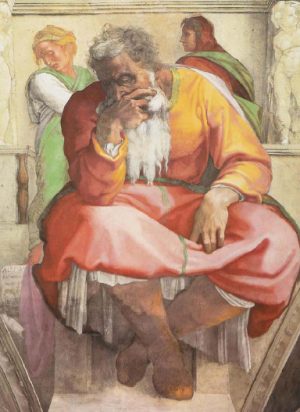
The Prophet Jeremiah, Michelangelo, circa 1508–1512, Sistene Chapel (Wikipedia)
Jeremiah 38:4-6, 8-10
Aug. 18, 2019
We read this Sunday from the Book of Jeremiah. He is called the weeping prophet of the Old Testament because he lived to see the city of Jerusalem destroyed. He might also be called its Cassandra as well. It was her curse to see the future of Troy and speak the truth, but never be believed. So it was with Jeremiah. Continue reading “20th Sunday Ordinary Time – Visions of Justice and Faith in God’s Covenant” →
19th Sunday Ordinary Time – 11:15 am (Fr. Smith homily)
Podcast transcript:
That young men would take up deadly force against innocent people is shocking and horrifying, but as a pattern is it all that surprising? The one common factor – other than being young and male – is that they have been loners. They are detached from society in general, but also even splinter groups of like-minded people. This is unusual in our history. Aging baby boomers like myself may remember the rash of bombings and politically motivated robberies in the 1970’s. Members of the Weather Underground or the Symbionese Liberation Army – however alienated from the general society – were at least able to join together in small groups. This seems to be no longer the case: we are dealing with people who belong to nothing. This is a more general trend in the whole society. We see attendance in churches declining, but also in civic organizations and even bowling leagues and the Boy Scouts. To rework a somewhat familiar saying, “A person who belongs to nothing will believe in anything.” As a church, we should be a home for all. St. Luke today shows us how. Continue reading “19th Sunday Ordinary Time – 11:15 am (Fr. Smith homily)” →
19th Sunday Ordinary Time – Light Your Lamps
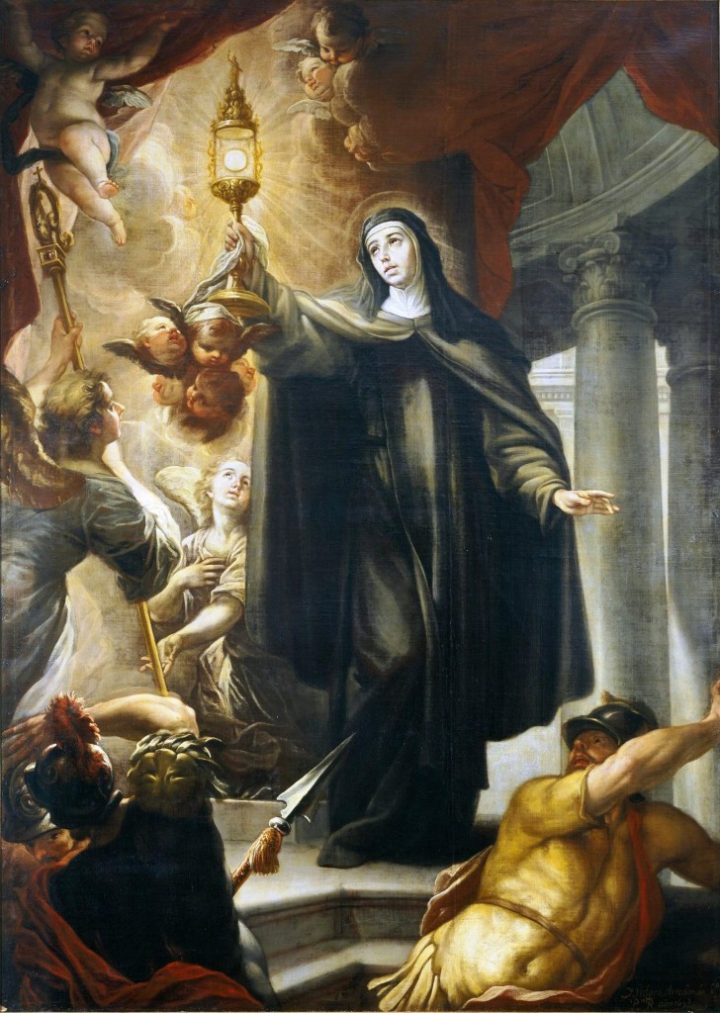
Santa Clara, Isidoro Arredondo, 1693. St. Clare of Assisi’s feast day is August 11th.
Adult Sacraments and Christian Formation
Where is God? The summer has been a catalog of horrors: detention centers and raids that separate families on our borders, a public celebration for what would once have been an unthinkable extension of abortions in our State and repeated Mass murders by lonely and disaffected young males, to name the most obvious. The author of the Book of Wisdom, facing a world that presented many difficulties to his faith (see first reading below), urged his readers to make the traditions of their people, both moral and liturgical, the center of their lives. If that was true for the Jews it is even more pertinent for us. Do you know the traditions of the Catholic Church? Have you examined them since high school? Even if you have received all the appropriate Sacraments and attend Mass more than you don’t, seriously think about your further Christian formation with the RCIA.
Baptism, Communion, and Confirmation: Non-Catholics who wish to become Catholic or Catholics who wish to receive Eucharist or Confirmation are asked to call or email Fr. Smith. The R(evised) C(hristian) I(nitiation) of A(dults) classes will begin in the Fall. They are set in a seminar format with meetings once per month until Easter. There are 50 to 75 pages of reading per session.
Marriage: St. Charles Parish congratulates those who will become engaged this summer and we wish to accompany you on your way to the altar and beyond. Please contact Fr. Smith at your earliest convenience. This includes those who will be married in another Parish and especially those who will be married in another country.
Please contact Fr. Smith at the Rectory (718-625-1177 ext 409)
Question from last week’s homily:
As we had our annual mission talk last week, I suggested a homily by Dr. Meghan Clark of St John’s University (https://www.youtube.com/watch?v=Js1K27ya2Rk) as a substitute.
She connected the readings to some of the basic issues of Catholic Social thought. I received some comment on the meaning and consequences of “The universal destination of all goods”. Fr. Kenneth Himes clarifies this succinctly and elegantly below:
- Has the teaching on private property evolved over the years?
Yes, basically the development has been in the direction of underscoring the social dimension of private property.
Pius XI affirmed the “twofold aspect of ownership, which is individual or social accordingly as it regards individuals or concerns of the common good” (Quadragesimo anno 45). Pius XII retrieved the patristic theme of the universal destiny of all goods as the context for thinking about private property (“Pentecost Address,” June 1, 1941). There can be a diversity of ownership schemes that should be left to the particular customs and statutes of a society. However, any such scheme “remains subordinated to the natural scope of material goods and cannot emancipate itself from the first and fundamental right which concedes their use to all” (ibid.).
In effect, the raising up of the social dimensions of ownership has led CST to insist not only on the individual right of private property but the “social duty essentially inherent in the right” (Pacem in terris 22).
Paul VI explicitly denied that the right to private property is to be considered “an absolute and unconditioned right,” for “the right to private property must never be exercised to the detriment of the common good” (Populorum progressio 23). This principle extends to the case that “the common good sometimes demands expropriation” of property (24).
According to John Paul II, all property has a “social mortgage”, meaning it has an intrinsically social function based upon and justified precisely by the principle of the universal destination of goods” (Sollicitudo rei socialis 42). While private property remains a right that is “valid and necessary,” in the face of widespread poverty it is important to affirm “the characteristic principle of Christian social doctrine: the goods of this world are originally meant for all” (ibid., italics in original).
It is in the same vein that Benedict XVI pointed out that some within the richer nations have been guilty of “excessive zeal for protecting knowledge through an unduly rigid assertion of the right to intellectual property, especially in the field of health care” (Caritas in veritate 22).
Himes, K. R. (2013). 101 Questions & Answers on Catholic Social Teaching (Second Edition, pp. 82–83). New York; Mahwah, NJ: Paulist Press.
How comfortable are you with the answer to the question: “Who besides myself has benefited from my possessions?”
If questions arise from any of the homilies or talks in the Parish, please let me know and I will be happy to answer them as best I can.
Fr. Bill
Nineteenth Sunday of Ordinary Time
August 11, 2019
Wisdom of Solomon: 18:6-9
Our reading today is from the Book of Wisdom, often called the Wisdom of Solomon. We read from it several months ago. Let us take a moment to remember its background. Although it sounds ancient, it is perhaps the last book in the Old Testament and could have been written as late as 30 BC. Also, although it takes the name of King Solomon of Jerusalem from about 1000 BC, it was most likely written in Alexandria Egypt for the children of the Jewish elite who were immersed in the Roman world and tempted to give up their faith.
Alexandria was an important commercial but also intellectual center famous throughout the Roman world. The author of Wisdom is well versed in all the alternatives to Judaism, from Greek philosophy to the cult of Isis. In the other sections we read from Wisdom, the particular city of its composition was not important but today, as we will see, it is very important that it is written in Egypt. The author is first and foremost a man of his tradition. He answers the questions that his young people might have not only as Romans but as Egyptians. He will speak from the Scriptures and shows the superiority of the God of Abraham, Isaac and Jacob and as we will see today Moses
We read today from Wisdom 18:6-9, but the section begins with Chapter 11. His purpose is to show his young aristocrats that the Lord cares for His people at all times and places, not only in the past or only in Jerusalem, but in the Diaspora as well. There is no better example for them than the Exodus from Egypt millennia before.
To develop this, he uses key elements of the Exodus story. Thus, the Lord gave the Israelites water from the Rock, but the river Nile became blood, (Wisdom 11:4-14). The Egyptians lost their appetite with an infestation of frogs, but the Israelites were fed with quail (Wisdom 16:1-4). Even in the midst of deprivation and exile the Lord cared for His people.
The author has developed this so that the emotional climax is the contrast of the death of the firstborn of the Egyptians with the deaths of many Israelites in the desert.
The scene is set by the decision of Pharaoh to kill the male babies of the Israelites.
5 When they determined to put to death the infants of the holy ones, (Wisdom 18:5)
We know the response:
Thus, says the LORD: At midnight I will go forth through Egypt.5 Every first-born in this land shall die, from the first-born of Pharaoh on the throne to the first-born of the slave-girl at the handmill, as well as all the first-born of the animals (Ex 11:4-5)
They (The Israelites) shall take some of its blood and apply it to the two doorposts and the lintel of every house in which they partake of the lamb. (Ex 12:7)
12 For on this same night I will go through Egypt, striking down every first—born of the land, both man and beast, and executing judgment on all the gods of Egypt – I, the LORD!
13 But the blood will mark the houses where you are. Seeing the blood, I will pass over you; thus, when I strike the land of Egypt, no destructive blow will come upon you. (Ex 12:12-13)
The author of Wisdom reflects on this:
That night was known beforehand to our fathers,
that, with sure knowledge of the oaths in which they put
their faith, they might have courage.
7 Your people awaited
the salvation of the just and the destruction of their foes
For when you punished our adversaries,
in this you glorified us whom you had summoned (Ex 12:6-8)
The Lord was faithful to his promises and demonstrated that he was all powerful in every time and place.
For in secret the holy children of the good were offering sacrifice
and putting into effect with one accord the divine institution,
That your holy ones should share alike the same good things and dangers,
having previously sung the praises of the fathers. (Ex 12:9-11)
The sacrifice is most directly the first Passover, but it reflects the situation of all the Jews in the Diaspora who faithfully commemorate the feasts and fasts of their people. The author notes that they were an ancient people even when in Egypt, able to sing the songs of their Fathers.
We note however that there is a comparison. The angel of death came upon the Israelites in the desert as well:
The next day the whole Israelite community grumbled against Moses and Aaron, saying, “It is you who have slain the LORD’S people.”
7 But while the community was deliberating against them, Moses and Aaron turned toward the meeting tent, and the cloud now covered it and the glory of the LORD appeared. (Numbers 17: 6-7)
The Lord is furious with the people and sends destruction among them. Aaron the priest, however, goes into the midst of the carnage and stops it:
14 Yet fourteen thousand seven hundred died from the scourge (Numbers 17: 14a)
The author of wisdom reflects:
But the trial of death touched at one time even the just,
and in the desert a plague struck the multitude; Yet not for long did the anger last.
21 For the blameless man hastened to be their champion,
bearing the weapon of his special office,
prayer and the propitiation of incense (Wisdom 18:20-21)
God’s anger at the disobedience of the people did not last long and it was turned away because the Jews, through Aaron, remained faithful to their traditions. Ritual and tradition cannot take the place of repentance, but the future leaders of the People are being warned that without this connection they are no better than the Egyptians – of ancient times or theirs.
The last few weeks have seen, at the time of this writing, three mass killings. We also cannot ignore the general gun violence in some of our major cities nor the extension of abortion laws. With the latter, I will never forget that when the bill making virtually any abortion legal in New York State was passed and signed buildings and bridges were lit up in celebration. So much for safe, legal and rare. The talking heads of all persuasions were out in force for these events and I, for one, found them unpersuasive. Like the author of Wisdom, some ideas seemed to have merit but there was no compelling system of thought behind them. Like our author today, I think we must go to the history of our people more to point to the God who is revealed most fully in Jesus to know that despite what we see around us, God is with us, we are never abandoned and that he gives us the means to survive as a people and often to have a real effect on our society.
In these dark times let us take comfort in the last words of The Book of Wisdom which are, for most scholars, the last words of the Old Testament:
22 For every way, O LORD! you magnified and glorified your people;
unfailing, you stood by them in every time and circumstance. (Wisdom 19:22)