Beginning and Ending with Jesus

The Prodigal Son in Modern Life: The Return,
James Tissot, c. 1882, Musée des Beaux-Arts de Nantes
(About this Image)

So he got up and went back to his father.
While he was still a long way off,
his father caught sight of him,
and was filled with compassion.
He ran to his son, embraced him and kissed him.
(Luke 15:20)

Fr. Smith’s Commentary on the Second Reading
Twenty-Fourth Sunday in Ordinary Time
1 Timothy 1:12–17
September 11, 2022

For the next month we will be reading the 1st and 2nd letters to Timothy. Together with the Letter to Titus, they form what have been called for several centuries the “Pastoral Epistles.” Scholars disagree if they were written by St. Paul, but all acknowledge that the format is different from the undisputed Pauline letters. They were addressed to individual disciples of Paul instructing them how to be a Pastor. They have more recently been called the “mentoring letters” and as we begin the synodal process again we should take them very much to heart. (Paul wrote the letter to the individual Philemon, but as we saw last week this was a very exceptional case and does not diminish the uniqueness of the mentoring letters.)

Continue reading “Beginning and Ending with Jesus”

Homily – 23rd Sunday Ordinary Time (Fr. Smith)

Last week’s Gospel ended with Jesus’ injunction that “when you hold a banquet, invite the poor, the crippled the lame, the blind: blessed indeed will you be because of their inability to repay you.” The next day the parish supplied volunteers to feed participants in a workshop for asylum seekers. I would like to thank those who responded. Some of the stories were truly heartbreaking but the actions of so many of our members were heart-mending. This was truly putting flesh onto the Gospel and weight into the truism that a Mass should be judged not by how we feel leaving Church on the weekends but by what we do in our community on the weekdays. 

Later that week several buses deposited about 200 more asylum seekers on Court Street. They were told to go to Catholic Charities. There was of course no warning and by Friday Catholic Charites had no supplies. As you may have seen in our parish email, we do not know if people will be sent up this weekend and if they are St Charles will most likely be the first institution they will find. What then does Jesus’ remark today “This one began to build but did not have the resources to finish” mean for us? 

My first reaction was “Ouch, that comes close,” After remembering the background for the passage, my second was “That hit a bullseye.” 

Continue reading “Homily – 23rd Sunday Ordinary Time (Fr. Smith)”

Community Mass – 23rd Sunday Ordinary Time

On Sunday, September 4, 2022, join us in person or online for the 23nd Sunday in Ordinary Time.

Our current Sunday Mass times are:

The readings will be from Cycle C.

Entrance: All Are Welcome – 850

Readings/Psalm: 1160

Offertory: There Is a Balm in Gilead – 640

Communion: Shepherd Me, O God – 35

Closing: Though the Mountains May Fall – 689

The Gather 3rd Edition Hymnal/Missals are available for use in the church – pick one up as you enter and return it after Mass. Instructions on how to use the hymnal missal are available here: https://www.stcharlesbklyn.org/hymnal-missal/ .

Today’s readings are also available to read online at the USCCB website https://bible.usccb.org .

23rd Sunday in Ordinary Time – Seeing and Loving Each Other

Photo by Sarah Durner on Unsplash

You make an end of them in their sleep;
the next morning they are like the changing grass,
Which at dawn springs up anew,
but by evening wilts and fades.
(Psalm 90:5–6)

Fr. Smith’s Commentary on the Second Reading
Twenty-Third Sunday in Ordinary Time
Philemon 9–10, 12–17
September 4, 2022

The letter to Philemon is the Pauline work most people find dissatisfying and would like to change. But we do so at our peril.

Philemon is a slaveholder and both he and his slave Onesimus were converted by St. Paul. Paul is now in prison and Onesimus was so moved by Paul’s plight that he ran away from Philemon to assist him. This put Paul in a difficult position. He is harboring an escaped slave. He also does not want “law-abiding” Romans to think Christianity is a lawless religion. He therefore sends Onesimus back to Philemon.

We would like Paul to denounce slavery and call for its elimination. Slavery, however, was such a part of his society and he might not have been able to conceive of a world without it. Also, he has already said that “There is neither Jew nor Gentile, neither slave nor free, nor is there male and female, for you are all one in Christ Jesus.” (Gal 3:28) These are very provocative indeed dangerous words and would have made him and indeed all Christians suspect during a slave rebellion. He could not count on Romans understanding his intention.

Continue reading “23rd Sunday in Ordinary Time – Seeing and Loving Each Other”

Thank You re: Migrant Information Session

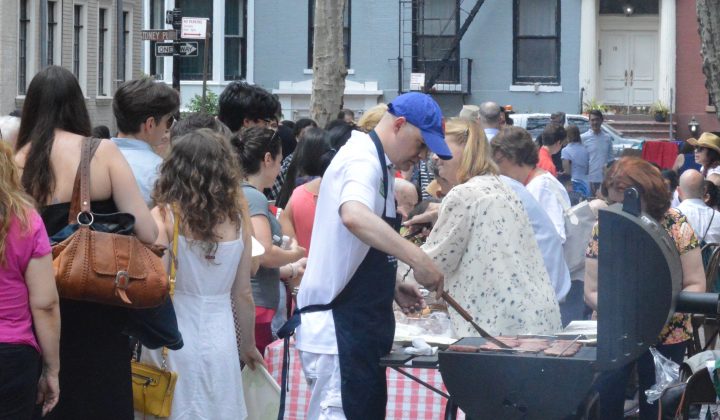
On Monday, August 29, Catholic Migration Services and Catholic Charities Brooklyn and Queens hosted information sessions at our church for migrants who had been bused from the border. Volunteers from St. Charles Borromeo helped serve food and welcome the migrants. Channel 12 News covered the event, a clip can be watched here.

Below is a message of thanks from our pastor, Fr. Bill Smith:

I would like to thank everyone who helped with the workshop for people seeking asylum this past Monday. Whether you helped to set up or serve the food or chatted in Spanish with the families, you helped make a difficult moment a pleasant experience. Indeed, several young men who have been in New York for months told a parishioner, “This is the first meat I have had since coming to New York.”

We at St. Charles are not usually asked to host events for the Diocese because of our limited parking. We, as the Church in Brooklyn and Queens, will be needed to help the poor and disadvantaged in the coming months. Our easy accessibility by public transportation will give us the opportunity to host many more such events. As St. Luke recently reminded us, we are most Christian when we hold a banquet for the poor and marginalized.