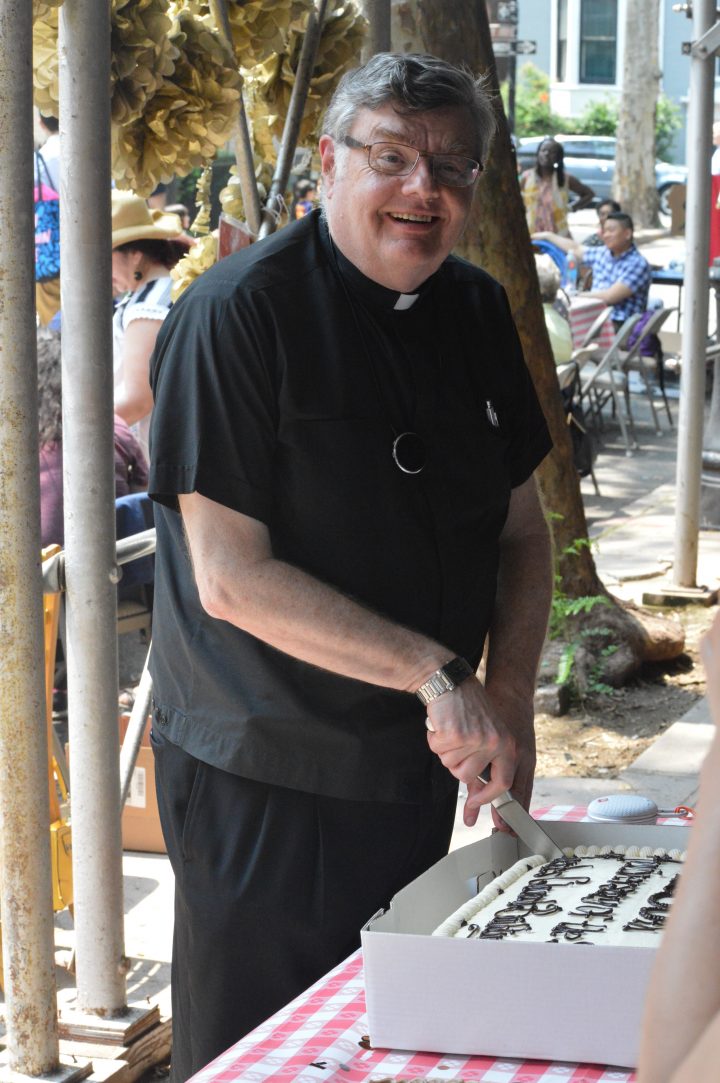
The experience of doing something that does not reflect our usual behavior that is not “who we are” is disconcerting. Usually, it is also unwanted because we have done something worse than usual. Less common, at least for me, is doing something uncharacteristically good and noble showing unconditioned love. St John looks at how this occurs, what it reveals, and how we can build on it in today’s passage and it is wonderful that we read it on Mother’s Day.
Continue reading “Homily – 6th Sunday of Easter – Fr. Smith”Community Mass – 6th Sunday of Easter
Join us in person or online for the 6th Sunday of Easter. Mass times are:
- 9 AM ET Sunday – Morning Mass
- 11:15 AM ET Sunday – Community Mass
- 7 PM ET Sunday – Evening Mass
Watch the video live by clicking in the window above. Automated closed captioning is available.
If you like our online masses, please Like our videos so more people can find them. Subscribe to our YouTube channel stcharlesbklyn at this link to watch on your Internet enabled TV or viewing device.
Today’s readings will be from Cycle A.
Readings/Psalms: 1076
Entrance: Alleluia! Sing to Jesus! – 949
Offertory: I Know That My Redeemer Lives! – 527
Communion: Peace Is Flowing Like a River – 819
2nd communion hymn: Shepherd of Souls – 910
Closing: Let There Be Peace on Earth – 829
The Gather 3rd Edition Hymnal/Missals are available for use in the church – they are at the ends of the pews. Please return the missals to the end of the pew after Mass. Instructions on how to use the hymnal missal are available here: https://www.stcharlesbklyn.org/hymnal-missal/ .
Today’s readings are also available to read online at the USCCB website https://bible.usccb.org .
- Support our Parish – Please contribute to our General Collection online here.
- Help us support Catholic Charities Food Pantries in Brooklyn and Queens online
Sixth Sunday of Easter – The Measure of All Things
Remain in My Love stained glass, 1931
Church of St. Catherine of Siena (New York)
“And whoever loves me will be loved by my Father,
and I will love him and reveal myself to him.”
(John 14:21)
Fr. Smith’s Commentary on the Church Fathers
Sixth Sunday of Easter
St. Gregory of Nyssa (c. 335 to c. 395)
May 14, 2023
Pope St. John Paul II believed that the Catholic Church breathed with two lungs: Western and Eastern. He saw clearly that they brought life to the body of Christ because they reflected different but complementary approaches to the same truth. The Western approach is based upon technological speculation and philosophy, the Eastern on the experiences of those who have best known God. In the West, we attempt to express the truth with clarity and rigor. In the East theologians seek to lead each baptized person to experience God’s reality for him or herself. For them, doctrine develops in response to spiritual experience. Pope John Paul understood that this was a matter of emphasis, Western theologians experienced what they taught and that Eastern theologians accepted that truth extended beyond their feelings and experience but nonetheless we could each learn much from each other’s perspectives. (Ut Unum Sint) In this he reflects one of the most beneficial explorations of many theologians of the last century. Theologians of the East and West read each other’s classics, sometimes with great suspicion but with great profit on both sides. St. Gregory of Nyssa who we read today was one of the first to be discovered in the West and has been especially fruitful.
Continue reading “Sixth Sunday of Easter – The Measure of All Things”
Homily – 5th Sunday of Easter (Fr. Smith)
I don’t think I would have done as well as the apostles in recognizing who Jesus was. From the vantage point of 20 centuries, they can seem somewhat dim but given their justified expectations, they were quite perceptive. They challenge us today.
As our Bible study group is discovering the best way to understand what the Apostles and their Jewish contemporaries felt can be found in the Psalms. They are not only beautiful poetry but heartfelt expressions of faith, doubt and everything in between with often great sophistication.
Continue reading “Homily – 5th Sunday of Easter (Fr. Smith)”Friday Evening Prayer at 5 PM
Please download the worship aid to participate in Friday’s evening prayer, which will begin at 5 PM.
Instructions on how to join are available here.
Community Mass – 5th Sunday of Easter
Join us in person or online for the 5th Sunday of Easter.
Mass times are:
- 9 AM ET Sunday – Morning Mass
- 11:15 AM ET Sunday – Community Mass
- 7 PM ET Sunday – Evening Mass
Watch the video live by clicking in the window above.
Automated closed captioning is available.
Subscribe to our YouTube channel stcharlesbklyn at this link to watch on your Internet enabled TV or viewing device.
Today’s readings will be from Cycle A.
Readings/Psalms: 1073
Entrance: Morning Has Broken – 855
Offertory: I am the Bread of Life – 945
Communion: Christ, Be Our Light! – 590
Closing: All the Ends of the Earth – 604
The Gather 3rd Edition Hymnal/Missals are available for use in the church – they are at the ends of the pews. Please return the missals to the end of the pew after Mass. Instructions on how to use the hymnal missal are available here: https://www.stcharlesbklyn.org/hymnal-missal/ .
Today’s readings are also available to read online at the USCCB website https://bible.usccb.org .
- Support our Parish – Please contribute to our General Collection online here.
- Help us support Catholic Charities Food Pantries in Brooklyn and Queens online
Fifth Sunday of Easter – Entering Heaven Together
Photo by Craig McLachlan on Unsplash
Come to him, a living stone, rejected by human beings
but chosen and precious in the sight of God,
and, like living stones,
let yourselves be built into a spiritual house
(1 Peter 2:4–5)
Fr. Smith’s Commentary on the Church Fathers
Fifth Sunday of Easter
St. Irenaeus on the Eucharist
May 7, 2023
St. Irenaeus (c. 130 to c. 202 AD) was the Bishop of Lyon in what is now France. He was however born in the East most likely in Syrma in today’s Turkey. His assignment to Lyon was not happenstance. It was then, as it is now, a commercial center and had a large population of traders and merchants from the east. Irenaeus spoke Greek knew the culture and was uniquely able to minister to their needs. Also, they not only imported goods but also the church’s first major heresy, Gnosticism.
Gnostic means knowledge and although it came in many forms Gnostics of every kind believed that people were saved by having the right knowledge not by the death and resurrection of Jesus. They usually believed that the body was disposable or even evil and only the non-material spirit was important. This is an eternal temptation. We saw that Paul constantly taught the Gentiles that they would be raised “body and soul”. Pope Francis, as we will see, finds it in our own society, The Gnostics often went far beyond this and considered the human body to be a creation of a lesser god or even the devil. St Irenaeus fought the most dangerous form of Gnosticism devised by a charismatic Roman teacher Valentinus (c. 100 to c. 180 AD).
Continue reading “Fifth Sunday of Easter – Entering Heaven Together”