Celebrated by Fr. Edward Doran
Ash Wednesday
Listen to homily here: [podcast]http://166.84.6.232/stcharles/wp-content/uploads/2009/02/2009-02-25homily.mp3[/podcast]
Matt 6:1-6, 16-18
TRANSCRIPT OF HOMILY BY FR. EDWARD DORAN
Ash Wednesday marks the beginning of a 40-day journey into the desert with Jesus. Before He began his ministry of love, his surrendering his life, He went in order to pray and receive strength from His heavenly Father. For he was about to undertake a mission that involved great suffering and great pain. But it was also a mission of love, and it was the very mission that he was called to.
Lent is the period of 40 days — the exact time Jesus went into the desert. And the exhortation and encouragement off these 40 days involves fasting – that is the disciplining of our bodies to bring about a control of our impulses, a control of our destiny. So fasting is a vital and an important part of these 40 days.
Prayer. Prayer is our union with God, a reaching out to our loving God, to have him come to speak to us and to give us direction, assurance, and encouragement. Prayer is a vital part of these 40 days.
The third leg is the leg of almsgiving . The Lord has blessed us as a people. Every night when I rest my head on the pillow, I rejoice because I have had sufficient food during the day. I rejoice because my thirst has been quenched. I rejoice because my medical needs have been taken care of. I rejoice because I have a warm bed and a warm house. And let me assure you that many, many people in the world do not have what we have. The loving God though, asks only one thing of us: stewardship of what He has given onto us. Taking from our own blessedness, to provide blessedness onto others. Almsgiving is a most important way of telling the Lord how much we love Him. So much so, that we want to give onto others so that they are provided for, or taken care of.
The symbol of the Lenten journey is the imposition of ashes. And in that imposition, turn away from sin, and follow the Gospel. And then from the Old Testament we are reminded that from the earth we came, and onto the earth we shall return. Remember that thou art dust, and onto that dust thou shall return. Tremendously humbling scriptural passages, for one of the things that we are challenged to do are to submerge our strong ego in order to take on Christ, in order to allow Jesus to reach into our very being, to shape and to form a new person in a new image.
Truly, in no way can the imposition of ashes, can the imposing of ashes, guarantee that all of this will happen. But certainly it is a wonderful beginning that we stand in public, with a darkened image on our forehead, acknowledging that we love the Lord so very, very much, that we willing to embark on the journey. For I would dare say to you that the chances of success go up exponentially as you attend mass – minimally on Sunday – as you discipline with fasting of your body, as you take what has been given onto you and share it with others.
Those three ingredients will guarantee that this Lent will bring you to great joy, for you will rise with Jesus on Easter Sunday. You will feel the palpable joy of that resurrection, and at some point you will be called to share with him in the glory of that resurrection.
My brothers and sisters: I say to you that these 40 days are so very, very important. I say onto you that it is my humble privilege to impart the ashes onto your foreheads. It is my humble privilege to bring you the body and blood of Jesus to animate and strengthen you, so that these 40 days might be marked by fidelity, constancy, and absolute commitment to fasting, prayer, and almsgiving. For it is in the embrace of those three that we find our way; it is in the embrace of those three that our journey become clearer.
May He strengthen and guide us this day and every day of our lives.
Interview with Father Edward Doran (Father Ed)
by Dyanne Rosado
We met in the sitting room of the St. Charles Borromeo Rectory on a beautiful Sunday afternoon in early October of 2008.
Father Ed, as you know, parish members would like to ask about your experience and prior parishes, so I have some traditional and other unconventional interview questions.
Q: Where did you grow up?
A: I was born and raised in Nassau County, Long Island; in Glen Cove.
Q: How long have you been a priest?
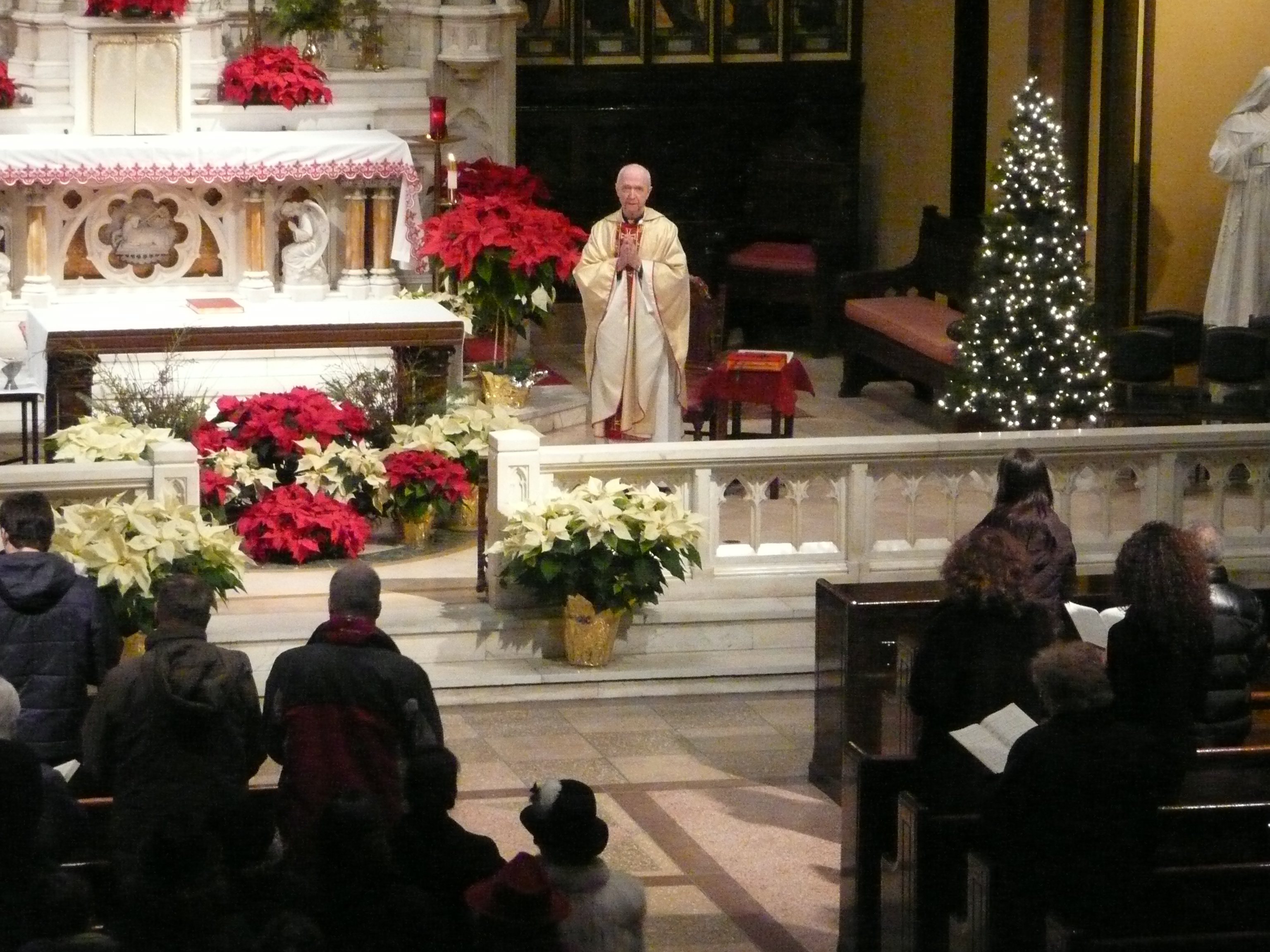
A: I was a Marist Brother for 21 years. I was a professor at St. Francis University in Fort Wayne, Indiana. The chaplain for the campus asked me to join a group that he was forming as a Campus Ministry Board to consult with him and give advice, in order to draw students in to the Campus Ministry and chapel. The priest unfortunately died one day when he was out jogging; he had a known heart condition and died of a heart attack. At that time the Bishop of Fort Wayne asked me to coordinate the Campus Ministry. In that capacity I began to serve students in another way. I was guiding students in their spiritual needs not their educational life, as I had as a professor. This experience led me to feel a call to the priesthood. In response to that, I prayed and discerned that the Spirit was calling me to do ministry in a different way, as a priest.
Q: Prior to coming to St. Charles where were you living and working?
A: Prior to coming to St. Charles I was the Pastor of St. Gerard Majella Parish in Hollis, New York – in Queens for 10 years.
Q: What has surprised you about St. Charles?
A: The warmth and friendliness of the people of the Parish. They are very kind and welcoming.
Q: In your experience, moving from parish to parish, what is one thing that remains the same in each community, no matter how different they seem to be?
A: One thing that is universal is the worship experience; the commonality is the way the Mass is celebrated. It is both a commonality and a distinguishing variable. For example, at St. Francis Xavier, St. Gerard and here the thread that runs through the worship service is singing. The singing at St. Gerard was more Caribbean and Hispanic in orientation; St. Charles and St. Francis, on the other hand, have more of a classical religious tradition in their music. Another variable that differentiates is what I would call the worship space or location. St. Gerard’s is a church within a school building while; St. Charles is a church in a neogothic building. Worship is the same but the churches tend to vary. St. Charles developed from an 1800s immigrant population while St. Gerard’s is an early 1900’s Irish American and German population.
Q: As a new Brooklynite, what is a favorite thing about Brooklyn?
A: The diversity of the people. Glen Cove is very homogeneous, white, and middle class. Brooklyn is very diverse and culturally enriching.
Q: Is there something else that you would like to share with your new community?
A: I would like to share my dream or goal in being here. My primary goal as a priest is to seek the guidance of the Holy Spirit to evangelize the Parish. I believe that evangelization is part of a process or part of a call to holiness. Being holy is the first and most important step in evangelization. Sharing holiness and sharing Jesus with family and friends and neighbors is the second step in fulfilling our baptismal call. One of our strengths in evangelization at St. Charles is a beautiful Church that uses art to convey the presence of God. We need to use that beautiful, magnificent ambiance to bring people, to help them experience the holiness of our church.
Q: Thank you Father Ed, now one last question, what is one little known or unexpected fact about you?
A: (Laughing) I am a star football player!