Please download the bulletin for August 26, 2018.
Bishop DiMarzio Statement on PA Report
Bishop DiMarzio has asked that we distribute his statement on the Pennsylvania report here:
Bp. DiMarzio Statement on PA Report
We urge anyone who is a victim of sexual abuse, or is aware of sexual abuse committed by a member of the clergy, a diocesan employee, or volunteer to report it. Allegations called into the diocesan reporting line at 1-888-634-4499 will be immediately turned over to law enforcement and callers will be met with compassion, support and concern.
20th Sunday Ordinary Time – Wisdom as a way of life

This week’s notes:
Former Parochial Vicar Fr. Anselmus will be saying the 12:10 PM Mass this Thursday, August 23. Welcome back!
Save the date: 9/16 Meet and Greet after each Mass.
Speak with Fr. Smith after Mass if you are interested in completing your sacraments, have a new child to be baptized, or would like to be married at St. Charles.
We would like to invite parishioners with expertise in PR, advertising, media relations, marketing and communications to a meeting on Tuesday, September 18 at 7 PM in the Rectory at 31 Sidney Place. The goal is to plan a strategy for outreach and growing the profile of St Charles in the Brooklyn Heights community and beyond. Food will be served. Please RSVP to [email protected] or call (718) 625-1177 so we can order enough food.
First Reading
Aug. 19, 2018
Twentieth Sunday in Ordinary Time
Proverbs 9:1-6
It is odd to say but the college seminary was an exciting place to be in the late 60s. It may at first seem parochial but to ask why one would privilege a classroom when so much was happening in the streets is to show how far we have slipped from the ideal of a liberal arts education. The aim was to take experiences from the world and examine them with the best ideas available. Many of us were taken aback that we were so comprehensively exposed to the best of pagan thought, old and new, but were gratified by the vigorous Catholic interpretation and indeed amplification of the best of humanism. Fr Robert Lauder’s weekly column in our Diocesan Newspaper, the Tablet, is an example of that tradition. (For full disclosure, Fr Lauder was my teacher then and is a close friend now.) As an example, recently he spent 10 weeks examining personalism, the philosophy he shares with Pope Francis, and showed how the themes that emerged in the late 60s of freedom, community and commitment by decidedly Non-Christian authors could be enhanced by a belief in Jesus.
This is reflected in the Wisdom literature in the Old Testament. It includes the books of Job, Wisdom, Ecclesiastes, many Psalms and as we read today the Book of Proverbs. Wisdom was a term used throughout the ancient Middle East. It was a compendium of reflections used to train young members of the governing class to be wise leaders. The Jewish Elders wanted to show that they could answer the questions of their young in a way that would have made sense to their children but also reflected their traditions and belief in God.
The Book of Proverbs is particularly interesting because it collects Proverbs, short pity statements, from about 1000 to 350 BC, from the court of King Solomon to the rebuilt temple in occupied Jerusalem. The section that we read today is somewhat different because it not a collection of these sayings but part of an extended song to wisdom sung by a father to his son.
Much of what he will say is common sense and would have been repeated by any good father then as now: avoiding bad companions and illicit sex are the first lessons. Yet in chapter one he states:
The fear of the LORD is the beginning of knowledge;
fools despise wisdom and instruction (1:7)
His son should follow the way of right not only for his own peace of mind and good fortune but because of his belief in a God who is involved in history both social and personal. A good Egyptian would not perhaps act much differently in most things. He would not steal or lie but he would not do so as a consciously religious act. We see what kind of religious acts were special to the Jews by looking at Creation. The Jews were unique in holding that the world was created by a loving God. Unlike the other religions of the time the Jews came to see their God as all powerful, he created rather than merely formed the world, and he did so consciously and lovingly certainly not by accident, pride or spite. Thus
The LORD by wisdom founded the earth,
established the heavens by understanding;
20 By his knowledge the depths break open,
and the clouds drop down dew (3:19-20)
By acting wisely, we are reflecting the way the universe is made and showing God we appreciate his love for us.
Our passage today reveals an emphasis on community. This would have been shared with other ancient peoples, but the author wishes to show that the distinctly Jewish understanding of the Divine/ human relation created a deeper bond.
1 Wisdom has built her house,
she has set up her seven columns;
2 She has dressed her meat, mixed her wine,
yes, she has spread her table.
3 She has sent out her maidens; she calls
from the heights out over the city:
4 “Let whoever is simple turn in here;
to him who lacks understanding, I say,
5 Come, eat of my food,
and drink of the wine I have mixed!
6 Forsake foolishness that you may live;
advance in the way of understanding.
Note that Wisdom is personal but not private. It is not obtained by one-on-one instruction but in a community. The simple and those who lack understanding are not invited to a tutorial but to a banquet. People will grow together.
They can also shrink together as well. A characteristic of ancient writing is clarification by comparison. If there is a Dame Wisdom, there will also be a Dame Folly and in this same chapter we read:
13 The woman Folly is fickle,
she is inane and knows nothing.
14 She sits at the door of her house
upon a seat on the city heights,
15 Calling to passers-by
as they go on their straight way:
16 “Let whoever is simple turn in here,
or who lacks understanding; for to him I say,
17 Stolen water is sweet,
and bread gotten secretly is pleasing!”
18 Little he knows that the shades are there,
that in the depths of the nether world are her guests! (Proverbs 9:13–18)
Like Dame Wisdom she invites the simple and those who lack understanding but not to a sumptuous meal but to stolen water and the way is not to understanding and wisdom but to the nether world.
Wisdom is a way of life not just a set of practices and we may find that people may say the same things and seemingly act the same but because they are doing it for different reasons ultimately divide from each other. Recently Pope Francis declared capital punishment inadmissible in all cases. This will strike a cord with many who do not share our faith. This is wonderful, but we must remember that the Pope holds this and exhorts everyone to do the same because of his belief that we are made in the likeness of God and that likeness can never be completely obliterated. This same belief informs the church’s implacable opposition to abortion. Living in a libertarian society we can expect conflict with some of the same people who most enthusiastically applaud the Pope for his stand on capital punishment.
This is not to deny that we can learn from the wisdom the modern world has obtained through psychology, anthropology and the other social sciences, but we must be like the authors of Proverbs and the wise men who taught me a half century ago and begin with an experience of the God of Abraham, Isaac and Jacob. We cannot have the morality of the Judeo-Christian world unless we have the experience of the Judeo-Christian God.
Bulletin for August 19, 2018
Please download the bulletin for August 19, 2018.
19th Sunday Ordinary Time: Exodus and Liturgy
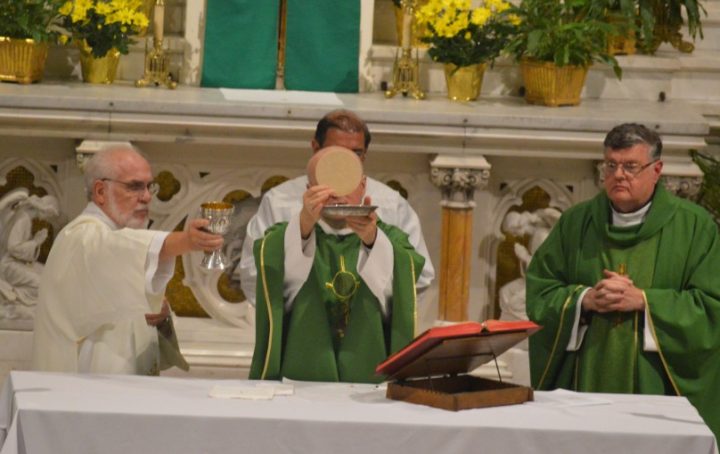
Contact information for Fr Smith: Tel.: 718.625.1177 ext 409 or email ([email protected])
Meet and Greet:
We will meet and greet our new parishioners including the students who will be joining us for the year after all the Masses (9:00 AM, 11:15 AM, and 7 PM) on Sunday, September 16, 2018
If you are have just moved to the community please attend; if you are already a parishioner please bring anyone who might be interested.
Outreach Committee:
We are seeking parishioners to help in our outreach efforts in the community. We will have an organizational meeting on Tuesday, September 18 at 7 PM in the Rectory at 31 Sidney Place. Food will be served. Please RSVP to [email protected] .
Adult Education and Sacraments:
Sacraments:
Baptism, Communion and Confirmation: Non-Catholics who wish to become Catholic or Catholics who wish to receive Baptism, Communion or Confirmation are asked to call or email Fr Smith. The classes will begin in the Fall.
Marriage: St Charles Parish congratulates those who will become engaged this summer and we wish to accompany you on your way to the altar and beyond. Please contact Fr Smith at your earliest convenience. This includes those who will be married in another Parish and especially those who will be married in another country.
Scripture Program:
The Scripture program will begin again in the Fall. As previously they will be small groups which will meet at various times and places throughout the week. If you are interested, please call Fr Smith.
First reading:
Nineteenth Sunday in Ordinary Time
June 12, 2018
1 Kings 19:4-8
The first readings for the Sunday Mass are chosen to compliment the Gospels. They are interesting and beautiful, but would not be chosen for a systematic exploration of the Old Testament. Sometimes, however, a reading can put several Old Testament themes and experiences we have been reviewing in a new light. This is one of those times. Let us remember the readings from the last two weeks.
We met Elijah two weeks ago. He appeared seemingly out of nowhere in Israel, the northern kingdom of Jews, around 870BC. This was about 50 years after the death of Solomon and dissolution of the United Kingdom of the Hebrews. The nation was prosperous but had compromised the worship of the Lord. In the name of God Elijah cursed them with a drought and then fled from the anger of the King and Queen and hid throughout Israel. The section immediately preceding today’s reading says:
1 Ahab told Jezebel all that Elijah had done—that he had put all the prophets to the sword. 2 Jezebel then sent a messenger to Elijah and said, “May the gods do thus and so to me if by this time tomorrow I have not done with your life what was done to each of them.” (1 Kings 19:1–2)
This time Elijah leaves Israel entirely and goes to Beersheba in the southern kingdom of Judea. He is tired and walks into the desert, begs God to take his life and then falls asleep. God sends an angel, wakes him up and gives him food and drink. He falls asleep again and the angel again wakes him up and this time both feeds him and gives him a mission:
7 but the angel of the LORD came back a second time, touched him, and ordered, “Get up and eat, else the journey will be too long for you!”
8 He got up, ate and drank; then strengthened by that food, he walked forty days and forty nights to the mountain of God, Horeb. (1 Kings 19:7–8 )
Now we should remember that Elijah’s ministry has not been without effect. Although the land was cursed with drought God has miraculously fed him and cared for those who took him in. Also, he has had a major triumph over the priests of Baal on Mount Carmel. They were not only humiliated but also killed by the direct power of God. (1 Kings 18)
God did not abandon Elijah, but he chose him as a prophet not as a spectator and he would not let him abandon his role and responsibilities. We see this throughout the entire old testament the chosen people often lose their desire to be chosen. They forget that this their identity and God needs to remind them.
Memory though had a specific meaning for Semitic people. The base word is Zakhor and from it comes the idea of zikkaron. This is the recognition that there were some events so important that they reflect the unique action of God. We remember them not by bringing them to mind but by bringing them to life; commemoration is not enough there must be participation. The key event for the Jewish people was the Passover/Exodus in which Moses led the people through the red sea and after 40 years of wandering in the desert to the promised land. This event made them a people and remembering it was more than simple commemoration. To this day Orthodox Jews believe that when they celebrate the Seder they join with Moses and the people on Exodus. This has been put very well:
Those present are not only remembering something in the past, as if they were witnessing the event from afar, but are participating in the actual Exodus through the liturgy. Their celebration is a part of God’s ongoing saving activity, not only in the past, but here and now (Folke T. Olofsson)
The way we connect to these events is liturgy: the public act of worship of the entire community
Now let us remember last week’s reading from Exodus. Although God has led them out of Egypt and given them a great victory over Pharaoh, they sulk and wish for the safety of their chains. We do not know how much of the feeding with manna is historical, but we do know that it is liturgical. This was a liturgical act because it was a ritual means of participating in the Exodus. Participation in the Exodus is not reproduction of details but connection with the reality behind it. They experienced the Passover/Exodus and then continued it.
In this week’s reading, Elijah is sent to Mt. Horeb; it is another name for Sinai, and it was there that Moses went to stay with God and received the Ten Commandments.
18 But Moses passed into the midst of the cloud as he went up on the mountain; and there he stayed for forty days and forty nights. Exodus 24:18
Elijah’s meeting with God on the mountain was also memorable.
11 Then the LORD said, “Go outside and stand on the mountain before the LORD; the LORD will be passing by.” A strong and heavy wind was rending the mountains and crushing rocks before the LORD—but the LORD was not in the wind. After the wind there was an earthquake—but the LORD was not in the earthquake. After the earthquake there was fire—but the LORD was not in the fire. After the fire there was a tiny whispering sound. When he heard this, Elijah hid his face in his cloak and went and stood at the entrance of the cave. A voice said to him, “Elijah, why are you here?” (1 Kings 19:11–13)
Elijah is here acting out a liturgy; he is remembering the Passover. The echoes of the Passover/Exodus and wandering in the Elijah story are so many that they would be distracting to record here, but note how God reveals his power but also his freedom to act. He causes the usual signs of theophany, divine revelation, seen with Moses and expected by Elijah but chooses not to be in them. He shows himself in a tiny whispering sound. Elijah hears that sound and continues his journey.
Christians have inherited this sense of memory as participation most clearly in the Eucharist. Each Mass is not another sacrifice of Jesus; it is our participation in Jesus’ once and for all sacrifice on Calvary. The ritual can change, as many of us have seen in our own lifetimes, but the reality does not. The Exodus, as we have seen, means lead out by God’s power. We need to remember that we are led to a place by God’s love. Like the Hebrews and Elijah in the desert we know that we must begin by “remembering” God’s decisive intervention in the world. Like them, we do not know where we will end, but we do know that it will be with Him.
Bulletin for August 12, 2018
Please download the bulletin for August 12, 2018.
Assumption of Mary – Wed 8/15
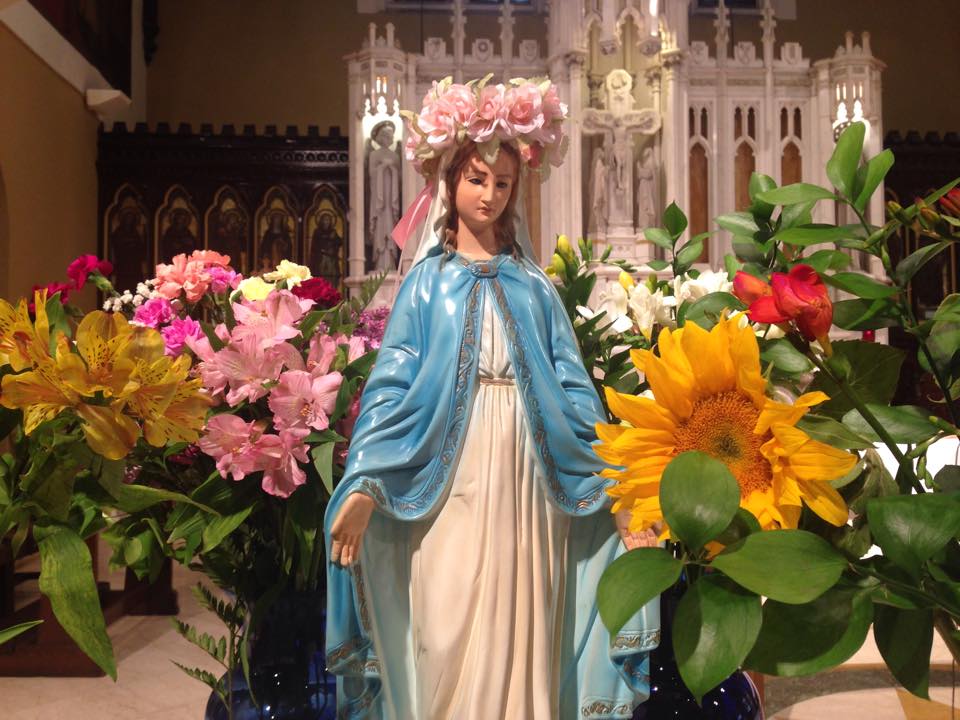
Wednesday, Aug. 15: Assumption of the Blessed Virgin Mary – Holy Day of Obligation
Masses at 12:10 pm and 7 pm.