Please download the bulletin for November 18, 2018.
32nd Sunday Ordinary Time – Yahweh, Speak to Us
MEET & GREET: Nov. 11
This month’s meet and greet is sponsored by the Lectors and Extraordinary Eucharistic Ministers. Please join us for fellowship after each of the Masses on November 11th with food and drink.
UPDATE ON BUILDINGS:
Although work started to increase over the past few weeks, our project was being held back slightly waiting for additional permits. As of late last week’s drawings were approved and additional permits are in place. Work pace should begin to increase further. Mock-ups and samples continue to be installed. These allow Landmarks to sign off on all materials. Masonry work is in progress at multiple areas throughout the building. It is primarily cutting and preparing of the brick joints which will start to be filled with new mortar soon. Window repair is in progress. The wood frame of the windows has been fully surveyed and the repair and replacement of that wood is ongoing. Paint for deteriorated areas of stonework is being sampled now and waiting for the architect’s approval before moving ahead. It has been decided that the gutter condition is worse than originally thought and will need to be replaced. This work will continue into the winter. As the colder weather approaches exterior masonry work will have to stop but roof work, window repair, and other miscellaneous work will continue through the winter to help move the project along as quickly as possible.
Thirty-second Sunday in Ordinary Time
Nov. 11, 2018
1 Kings 17:10–16
In many ways the books of Kings (1 and 2) are footnotes to a passage we read in the Book of Deuteronomy last week about the consequences of obeying or disobeying the commandments:
Hear then, Israel, and be careful to observe them, that you may grow and prosper the more, in keeping with the promise of the LORD, the God of your fathers, to give you a land flowing with milk and honey. Deuteronomy 6:3
When the people, especially the king, obeyed God they prospered; when they did not, they faltered. Obedience most especially means following the first commandment and have no other god before the Lord. This pattern is often referred to as Deuteronomic history.
If its authors found the pattern clear, they did not impose it mechanically and were not without art. The falling away from the law of God began with King Solomon himself. He married women from other countries and allowed them to worship their own Gods. Eventually he himself joined them and by the time of his death around 931 BC the kingdom was divided between the Northern kingdom of Israel and the southern kingdom of Judea. The northern kingdom was richer and more unstable. The kings increasingly abandoning the worship of the Lord. This reaches the crisis point with King Ahab who married Jezebel a pagan princess and and also made a sacred pole. He did more to anger the LORD, the God of Israel, than any of the kings of Israel before him. 1 Kings 16:33
Then Elijah the Tishbite, from Tishbe in Gilead, said to Ahab: “As the LORD, the God of Israel, lives, whom I serve, during these years there shall be no dew or rain except at my word.” 1 Kings 17:1
Elijah’s name means “Yahweh is my God” and he directly challenges the authority of Ahab to change the worship of the people. It will take the drought time to work and Elijah will need to hide. This is where today’s reading takes up the story as God tells him:
9 “Move on to Zarephath of Sidon and stay there. I have designated a widow there to provide for you.” 10 He left and went to Zarephath. As he arrived at the entrance of the city, a widow was gathering sticks there; he called out to her, “Please bring me a small cupful of water to drink.” 1 Kings 17:9–10
Zarephath is outside of the lands ruled by Ahab, but the drought extends there as well. When Elijah asks her for a meal, she responds:
12 “As the LORD, your God, lives,” she answered, “I have nothing baked; there is only a handful of flour in my jar and a little oil in my jug. Just now I was collecting a couple of sticks, to go in and prepare something for myself and my son; when we have eaten it, we shall die.” 1 Kings 17:12
It is clear to Elijah that it will be by the power of God alone that he will be saved:
13 “Do not be afraid,” Elijah said to her. “Go and do as you propose. But first make me a little cake and bring it to me. Then you can prepare something for yourself and your son. 14 For the LORD, the God of Israel, says, ‘The jar of flour shall not go empty, nor the jug of oil run dry, until the day when the LORD sends rain upon the earth.’” 1 Kings 17:13–14
They were able to live on this for over a year. This is very much within the pattern of Deuteronomic history. When evil is seemingly about to triumph, God will send a great prophet to overcome it. The key confrontation between Ahab and Elijah is several chapters later on Mount Carmel when Elijah will challenge all the prophets of Baal to a contest and eventually destroy them. It will be the clearest sign of God’s care for Elijah and use of him.
Yet there is a further clarification of how God enters into the life of his people. This too reflects last week’s reading from Deuteronomy and it is the incident immediately after what we read today.
17 Some time later the son of the mistress of the house fell sick, and his sickness grew more severe until he stopped breathing. 18 So she said to Elijah, “Why have you done this to me, O man of God? Have you come to me to call attention to my guilt and to kill my son?”1 Kings 17:17–18
She felt that holiness was dangerous. It revealed one’s own sin and opened one up to divine wrath. Holiness does reveal sins but for the Jews this allowed God to show his mercy, power and forgiveness. The Jews had heard the voice of God from the mountain and experienced his glory and majesty and thought themselves in deadly peril: If we hear the voice of the LORD, our God, any more, we shall die. Deuteronomy 5:25
God does not tell them that they are being foolish ,but that their words are “well said”. (Deuteronomy 5:29). Contact with the holy, especially with the divine, is dangerous and this should always be kept in mind. Would that they might always be of such a mind, to fear me and to keep all my commandments! Deuteronomy 5:28
God has an extensive repertoire of ways to speak to us, and we can benefit from any means He decides to use. Look at the two we have examined today. We would be diminished if we lacked either the comforting and protecting God whose care saved Elijah, the Widow and her Son or the terror of the God whose holiness reveals our sins. Every way that God reveals Himself shows his love and joins us to him.
This is an important lesson for us as individuals and as a Church. The Bishops of the United States will come together next week for a regular meeting which will need to be extraordinarily focused on the sex abuse crisis and the institutional dynamics which fostered it. If they do not experience the terror at the revelation of God’s Holiness, then no one in the Church will be able to experience his comfort.
Bulletin for November 11, 2018
Please download the bulletin for November 11, 2018.
Bulletin for November 04, 2018
Please download the bulletin for November 04, 2018.
31st Sunday Ordinary Time – Fulfilling the Covenant

St. Charles Borromeo Feast Day
Sunday, November 4th is the feast day of our patron saint, St. Charles Borromeo. We will celebrate it as a Solemnity at all the Masses.
Bro. Beckett Ryan Memorial Mass
There will be a memorial Mass for Brother Beckett Ryan at St. Charles on Saturday, Nov. 10 at 10:00 AM. A reception will follow in the Rectory.
All Souls Novena
There will be a Novena of Masses for all the faithful departed. They will be celebrated on:
1) Friday – Nov. 2 – 12:10 PM
2) Saturday – Nov. 3 – 12:00 Noon
3) Sunday – Nov. 4 – 7:00 PM
4), 5), 6) – Monday, Tuesday, Wednesday – Nov. 5, 6,7 – 12:10 PM
7) & 8) Friday – Nov. 9th – 12:10 PM and 7:00 PM
9) Saturday – Nov. 10 – 12:00 PM
Envelopes may be found in the pews and entrances to the Church or by contacting the rectory.
Meet & Greet Next Sunday
Our next monthly Meet & Greet will be next Sunday, Nov. 11 after each of the Masses. We will have a presentation about Lectors and extraordinary Eucharistic Ministers, for those who may be interested and called to serve. Please join us in fellowship with food and drink.
Holiday Fair and Wreath Sale
We are seeking parishioners to help with the Holiday Fair and Wreath Sale on December 1 from 9 am – 3 pm at the Church. We are also offering tables for vendors who would like to sell for $25. Please contact the Rectory if you are interested.
Reading Matters:
Two quotes from the encyclical “Pacem in Terris” (Peace in the World) from St. John XIII given in 1963:
We must speak of [hu]man’s rights. Man has the right to live. He has the right to bodily integrity and to the means necessary for the proper development of life, particularly food, clothing, shelter, medical care, rest, and, finally, the necessary social services.
In human society one man’s natural right gives rise to a corresponding duty in other men; the duty, that is, of recognizing and respecting that right… Hence, to claim one’s rights and ignore one’s duties, or only half fulfill them, is like building a house with one hand and tearing it down with the other.
Thirty-first Sunday in Ordinary Time
Nov. 4
Deuteronomy 6: 2-6
The Book of Deuteronomy took 1,000 years to be written in its present form and picked up a lot of wisdom along the way. As we saw several months ago when we first read a passage from it, the original exhortation would have been spoken in the late 1,200s BC. It was rediscovered during the reign of King Josiah of Judea, the southern kingdom of the Jews, about 625BC. This provoked a religious revival marked by destroying other temples and centralizing worship in Jerusalem. Within a generation however the newly renovated Temple and indeed the entirety of Jerusalem was destroyed, and the leaders of the people sent into exile in Babylon. The final edition of the book was written when the exiles were permitted to return to Jerusalem and rebuild the temple beginning in 537. It is this version that has the most to teach us today.
The section of Deuteronomy that will be read at this week’s Mass immediately follows the giving of the “Ten Commandments”. As laws, they are rather unexceptional and reflect the common wisdom of their time and place. It is who gave the laws and why he wished them obeyed that is most important.
Immediately before giving the Commandments, God says to the people:
‘I, the LORD, am your God, who brought you out of the land of Egypt, that place of slavery. Deuteronomy 5:6
He speaks not as the chief God of a multitude, like the Greeks, nor a God of Nature but as a person who has entered into the lives and history of his people. He thus establishes his right to give them laws by his previous actions and ongoing commitment.
The Lord spoke to the people directly:
22 “These words, and nothing more, the LORD spoke with a loud voice to your entire assembly on the mountain from the midst of the fire and the dense cloud. Deuteronomy 5:22
The response of the people was fear:
(The leaders of the people said to Moses), ‘The LORD, our God, has indeed let us see his glory and his majesty! We have heard his voice from the midst of the fire and have found out today that a man can still live after God has spoken with him. 25 But why should we die now? Surely this great fire will consume us. If we hear the voice of the LORD, our God, any more, we shall die. Deuteronomy 5:24–25
They understood that this was God showing and sharing himself and that they could easily be overwhelmed by it. Destruction would have been expected but Moses tells them:
28 “The LORD heard your words as you were speaking to me and said to me, ‘I have heard the words these people have spoken to you, which are all well said. 29 Would that they might always be of such a mind, to fear me and to keep all my commandments! Then they and their descendants would prosper forever. Deuteronomy 5:28–29
The fear of the Lord is the beginning of wisdom. The God who lead them from the land of Egypt is continuing to participate in their lives and demanding from them just behavior. If they and their descendants do this, they will prosper; if not, the God who could have destroyed them at that moment will discipline them severely.
Our selection this week follows this admonition. The connection between prosperity and obedience is again stated:
2 so that you and your son and your grandson may fear the LORD, your God, and keep, throughout the days of your lives, all his statutes and commandments which I enjoin on you, and thus have long life.3 Hear then, Israel, and be careful to observe them, that you may grow and prosper the more, in keeping with the promise of the LORD, the God of your fathers, to give you a land flowing with milk and honey.
The next passage, however, has a different emphasis and is one of the pillars of Judaism:
4 “Hear, O Israel! The LORD is our God, the LORD alone! 5 Therefore, you shall love the LORD, your God, with all your heart, and with all your soul, and with all your strength. 6 Take to heart these words which I enjoin on you today.
The God who has led them to freedom and offers prosperity is to be obeyed exclusively. This is not a statement of Monotheism for the original hearers and perhaps not for those implementing the Josiahan reforms, but it states that the Lord alone is to be acknowledged and worshiped. Love here is virtually synonymous with obedience. For the Jews, the first commandment is the pivotal one.
This is to remain with the Jews always. The author continues:
8 Bind them at your wrist as a sign and let them be as a pendant on your forehead.
9 Write them on the doorposts of your houses and on your gates.
This as we know is the origin of the mezuzahs on the homes of pious Jews and the phylacteries worn by Jewish men at prayer.
It is obvious why this would have been so important to the people who returned from Babylon to Jerusalem. They had experienced exile and were now reinstated in their homeland. They recognized that they did not obey the Commandments of the law, and so had not prospered. They had a second chance and were committing themselves to take it. Their experience was so powerful that by this time they could acknowledge a strict monotheism. It is interesting that they now become more precise about other spirits. Pagan gods are demoted to evil spirits which rebelled against the one true God.
This is the great gift of the Jewish people to the world. The all-powerful God wishes to know and lead us. This will be by our loving behavior towards each other, as well as by liturgical worship. This insight has served the Jewish people well. Is there any institution which has survived as long as Judaism? We have been told that for this to occur, that it was through obedience to the commands of God.
This was powerfully brought by the lives of those murdered at the “Tree of Life” synagogue in Pittsburgh. The profiles of the people who were killed were truly inspiring. They led lives of private decency and public service. If that was a cross section of that community, its very existence was a reproach to everything their attacker believed, and living proof of God’s promise to stay with his people if even a remnant were good and just.
However horrible this event and the countless other acts of anti-Semites throughout the years God has been true to his promise and the Jewish people faithful to the covenant. There is much to learn from those who Pope Pius XI called “our elder brothers in the faith”.
Br. Beckett Memorial Mass Sat. 11/10
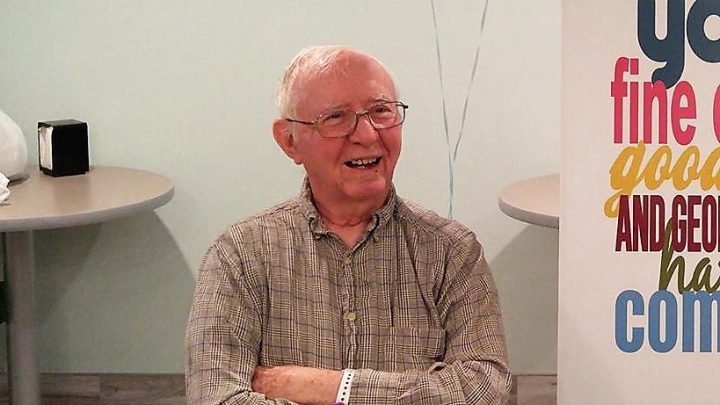
There will be a memorial Mass for Brother Beckett Ryan at St. Charles on Saturday, Nov. 10 at 10:00 AM. A reception will follow in the Rectory.