Please read the bulletin for August 04, 2019 here.
17th Sunday Ordinary Time (11:15 AM – Fr. Smith homily)
Podcast transcript:
It is hard to know if Jesus intends to shock his audience, or if it is just inevitable. His message though, firmly rooted in Judaism – would have been shockingly new for those who heard it for the first time. For us, however, perhaps because of repetition, we have heard the Parables for so long, that often their power may be lost to us. If this is true with that, it is even more true with the Lord’s Prayer. We say it so often, that its challenge has been diluted. So let us take this opportunity to read St. Luke’s unfamiliar version of the Lord’s Prayer to see what we are being told.
And let us begin by changing one word. If we were to begin the Lord’s Prayer by saying, “Lord, hallowed be your name, your kingdom come,” we would perhaps not even notice the change. The Jews, who would have heard it originally, would not have been particularly concerned, either. Lord means the Almighty, and only He can hallow – make holy, make great – His name. We add nothing to God. Continue reading “17th Sunday Ordinary Time (11:15 AM – Fr. Smith homily)”
17th Sunday Ordinary Time (Fr. Gribowich homily)
Podcast transcript:
Good morning, everyone! It’s good to see you on this very beautiful Sunday morning, and I really hope that all of you continue to enjoy the summer months here, and make sure that we are always mindful that our time in nature is a way for us to, I think, strengthen our prayer life. So, I always try to encourage people on nice days to spend time in nature. And really, today’s readings get us to the heart of what is the purpose of prayer.
You know, we hear Jesus make it very clear in the Gospel today that whatever we ask, we will receive. You know, ask, you shall receive; seek and you will find; knock and the door will be open. I think for many of us, this is a very bold pronouncement that Jesus makes and one that we are somewhat confused by, because typically we fall into two camps or in 2 modes, when it comes to us in our prayer relationship with God the Father. For some of us, we may question what we want to ask God or we may not feel like our intentions are pure enough, or we may feel that we’re being selfish, or we’re fearing that work asking the wrong thing. So we don’t really go to God and ask him what we want because we just don’t think that maybe were worthy of that request, for whatever reason. Continue reading “17th Sunday Ordinary Time (Fr. Gribowich homily)”
17th Sunday Ordinary Time – A Remnant Will Return, A Glowing and Faithful Remnant
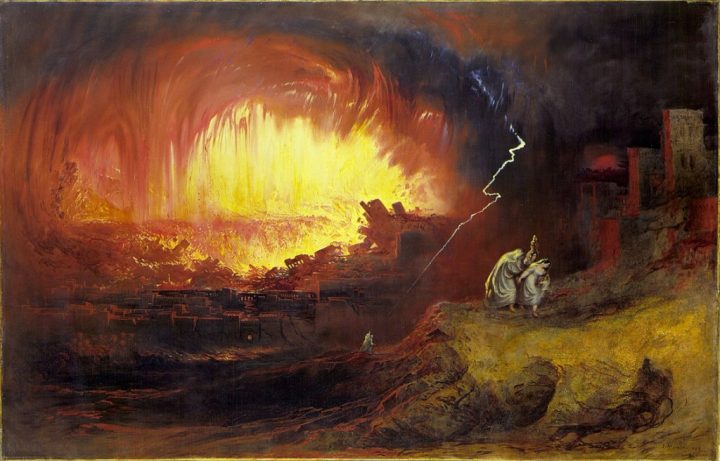
The Destruction of Sodom And Gomorrah,
John Martin, 1852, Laing Art Gallery, Newcastle upon Tyne (Wikipedia).
Genesis 18:20–32
July 28, 2019
Each week we analyze the first reading from the Mass. During most of the year, these are from the First (Old) Testament and are chosen to reflect some aspect of the Gospel (3rd reading) from the Mass. This does not often allow for reading any part of it sequentially. Today is something of an exception. Last week we reviewed Gen 18:1-10A. Today we read Gen 18:20-32. There is a gap of a few verses, so let us begin there.
Last week, we saw Abraham entertain three visitors, including the Lord himself. He has been assured again that, despite her age, his wife Sarah will bear a son. In a somewhat comic scene, Sarah finds this ludicrous and laughs. (Gen. 18: 11-16, a fuller interpretation may be found in the summary of last week’s first reading)
Then rather abruptly, things get very serious. The Lord has heard reports about the great wickedness of the people of Sodom and Gomorrah and is on his way to personally investigate. He tells Abraham who is immediately concerned for their fate. There are two reasons with two different trajectories in the story and indicate two different motivations of the writers.
We saw the first last week. Abraham’s kinsman Lot and his family are residents of Sodom and he fears for them. The authors of Genesis love parallels, and Abraham is contrasted to Lot throughout the story. Lot represents what most of us would consider good fortune and common sense. A man who trusted in his intelligence and talents. He ends his life in a cave as the father, through incest, of hereditary competitors if not enemies of Israel. Abraham represents trust in God and, although elderly, ends his life as the father of nations.
Today we see another level of interpretation.
Most of the Bible reveals a long history of editing, which was finally completed after the return of the people from captivity in Babylon around 510 BC. The Captivity was a traumatic event. Their kings were murdered; their city and temple destroyed; and their leadership, if not killed, brought into the Babylonian civil service. By every rational understanding, they were as dead as Ezekiel’s dry bones. Yet they were resurrected. Cyrus, king of the Assyrians, after conquering Babylon invited the Jews to return to Jerusalem as his subjects to rebuild the city and its temple. Enough did to give the city a new life. This was the great miracle and one which asked the question, “Why did the Lord save them?” Today’s reading is written in response to this question.
The prophets who emerged during the exile were inspired to realize that the Jews were the chosen people but chosen for a task. They were to be in Isaiah’s words “A light to the nations.” The full quote is particularly instructive:
It is too little, he says, for you to be my servant,
to raise up the tribes of Jacob,
and restore the survivors of Israel;
I will make you a light to the nations,
that my salvation may reach to the ends of the earth
(Isaiah 49:6)
Even more beautiful is found in the regrettably little-read book of the prophet Zechariah:
Thus says the LORD of hosts:
In those days ten men of every nationality,
speaking different tongues,
shall take hold, yes,
take hold of every Jew by the edge of his garment and say,
“Let us go with you, for we have heard that God is with you.”
(Zechariah 8:23)
These were the ideas “in the air” when Genesis was being completed and the editors would have sought to find examples of this concern for the nations from the earliest days–genesis–of the Jewish people.
Therefore, as the Lord is on his way to judge Sodom and Gomorrah, he contemplates if he should share his mind with Abraham “now that he is to become a great and populous nation, and all the nations of the earth are to find blessing in him.” (Gen. 18:18)
He decides that he should because Abraham and his successors will need to instruct future generations:
Indeed, I have singled him out that he may direct his sons and his posterity to keep the way of the LORD by doing what is right and just, so that the LORD may carry into effect for Abraham the promises he made about him.
(Gen. 18:19)
Other historical books of the Bible that were edited at this time also demonstrated this international dimension. We have seen that at the Lord’s command Elijah not only anointed the king of Israel but also Hazael as king over Aram. (1 Kings)
It is here that we begin this week’s passage. The Lord tells Abraham that he is seeking to confirm the outcry against Sodom and Gomorrah. Abraham is quite aware of their iniquity but assumes the role of intercessor. He will take the position that the good should not suffer with the guilty and appeals to the Lord’s very nature as revealed throughout the Bible:
Far be it from you to do such a thing,
to make the innocent die with the guilty
so that the innocent and the guilty would be treated alike!
Should not the judge of all the world act with justice
(Gen. 18:25)
The form in which he does this is haggling as over the price of goods. This is very Middle Eastern, but the instinct behind it is universal for all religions which believe in an all-powerful but all loving God: the vindication of divine goodness and providence in view of the existence of evil. Usually called theodicy, it demands that we question God.
The author/editors of Genesis affirm the goodness of the all-powerful Lord not by theological statements but by and in story. When the time of judgment comes there are only six just people and, to highlight God’s predicament, some of them refuse to leave. And one who does is turned into a pillar of salt because she refuses to emotionally separate herself from her old way of life. (Gen 19)
More important however than this is the situation of the immediate audience, the Jews of the post-Captivity era. Most of what they had was destroyed as totally as Sodom, yet they have been given another chance. There was just enough that the Lord could begin again. This is a popular theme in the literature of this time. One example:
A remnant will return, the remnant of Jacob,
to the mighty God.
For though your people, O Israel,
were like the sand of the sea,
Only a remnant of them will return;
their destruction is decreed
as overwhelming justice demands.
(Isaiah 10:21–23)
Here once more we are asked to, as we were told in high school, compare and contrast. Both the people of Sodom and Gomorrah and the Jews were disobedient to the Lord. Yet the former was eradicated from the face of the earth but the Jews, although in reduced circumstances, are now able to rebuild their temple and city. They recognize that the very fact that they are back in their ancient city shows that they are the remnant that was not present in the previous instance. But they have also learned that these events were meant to form them into a people, which not only continues the name of Abraham, but also accepts his mission to the nations.
This speaks to us as well. Although not as cataclysmic, we have seen our churches reduced and some abandoned at least in the Global North. The forces which have done much to cause this also reveal the darkness in the world that we, like those who first read Genesis and Isaiah, have been created to overcome. Pope Benedict 16th has many times said that Christians of the Global North, most particularly Europe and North America, must be a creative minority, a glowing and faithful remnant. That is perhaps truer in Brooklyn Heights and the wider Brownstone Brooklyn than most places. Are we prepared, in Christian terms have we been formed, to take up this task?
Bulletin for July 28, 2019
Please read the bulletin for July 28, 2019 here.
Fr. Michael A. Carrano Month’s Mind Mass 7/23 7 pm
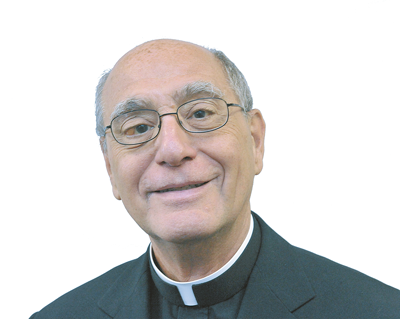
To honor the memory of the former pastor of Assumption Parish, Fr. Michael A. Carrano, a Month’s Mind Mass will be held this coming Tuesday evening, July 23 at 7 pm, at Assumption Church, 55 Cranberry Street in Brooklyn Heights. All are welcome to attend.