Update from Fr. Smith on Ash Wednesday

Wed. Feb. 17
12:10 PM – Mass (will be streamed live and posted online for later viewing)
5 PM – Service

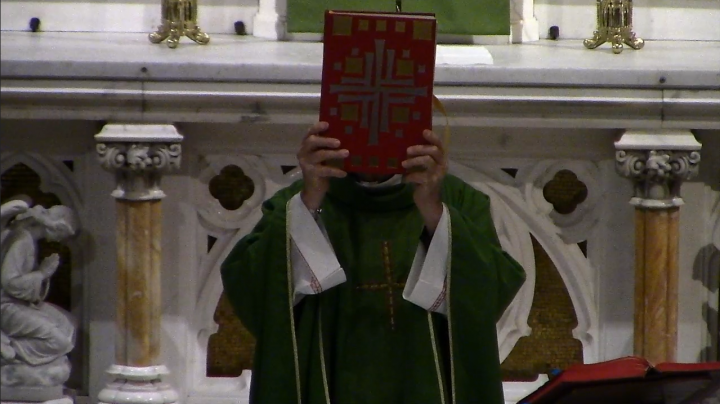
Ash Wednesday will look different this year. To protect everyone, we will distribute ashes the “Roman Way.” In the city of Rome and most of Europe, a cross is not drawn on the head with ashes but rather sprinkled on the head (see above illustration by parishioner Eduardo Crespo). While there is great witness value of making a visible cross, the “Roman Way’ will help to keep us all safe during the pandemic. At both our Ash Wednesday Mass and Service, the distribution of blessed ashes will be at the dismissal. We will follow the same procedure as the reception of Holy Communion to maintain social distancing.

Please remember that you can attend Mass on Ash Wednesday and not receive ashes. It is what is in your heart that matters. I will remain in the Church after the Mass for about 30 minutes after Mass. Ashes will not be distributed on an individual basis at any other time; however, the church will remain open for private prayer until 2 PM.

Please help us spread the word about our Ash Wednesday schedule and the distribution of ashes as we don’t want people trudging over in the cold to find a locked door. Ash Wednesday is usually a busy day where people come throughout the day to receive ashes. However, we will not be able to accommodate that this year due to the pandemic.

In Christ,
Fr. Bill Smith
Black Americans on the Way to Sainthood: Pierre Toussaint

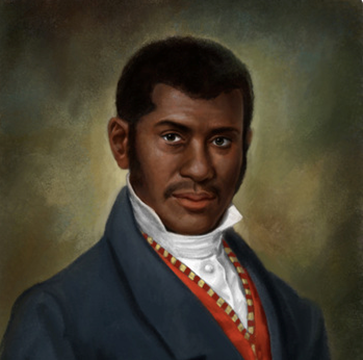
Pierre Toussaint (1766 – 1854) Successful entrepreneur, philanthropist, and former slave
by Fritz Cherubin, Jr.
Venerable Pierre Toussaint was born into slavery on June 27, 1766 on the French colony Saint-Domingue (present-day Haiti). He was educated as a child by his owners, the Bérard family; trained as a house slave; and raised as a Catholic.

On the brink of the Haitian Revolution (a beautiful story for another time), the Bérards moved to New York City along with their slaves, including Pierre and his sister, Rosalie. It was here in New York City, where Pierre first apprenticed and then became one of New York’s leading hairdressers, especially for the upper class. His reputation as a skilled hairdresser allowed him to earn a good living. In fact, he discreetly supported Madame Bérard through his earnings after her husband’s death. He was granted freedom at the age of 45 upon Madame Bérard’s death. By that point, he had saved enough money to pay for his sister’s freedom and purchase a house in Manhattan (unheard of at the time). He took the surname of Toussaint, honoring Toussaint Louverture, the leader of the Haitian Revolution.

Continue reading “Black Americans on the Way to Sainthood: Pierre Toussaint”

Lenten Bible Study: Gospel of John

For Lent this year, we will have a Zoom Bible Study Group. We think this will be a wonderful way to focus on the prayer part of the Lenten pillars of
prayer, fasting, and almsgiving.

We will study the Gospel of John, which we will hear often during the Lenten and Easter season. We will use the Gospel of John study materials published by Little Rock Scripture Study, which is recognized as a leader in assisting Catholic parishes encounter the Bible for over 40 years. A group from the parish used another Little Rock study guide during Advent and found it to be a great resource for understanding more of the Gospels we hear proclaimed at Sunday Mass.

We will be meeting on Zoom on Sunday evenings at 5 PM starting on February 21. Each session will be approximately 1 hour long. Please note that the book has 15 lessons and this series will extend past Lent.

We’ll provide you with the study guide and ask you to read the relevant portions beforehand, look over the questions in the text, and then we’ll use the questions as a guide to our weekly discussions. In order to help defray the cost of the materials, please contribute $5 toward the purchase of the study guides, which will be yours to keep.

Please reach out to Kerin Coughlin, Mike McGowan, or the rectory if you have any questions. You can sign up for the Lenten Bible Study group below.

Lenten 2021 Bible Study
reCAPTCHA

5th Sunday of Ordinary Time – A Joyous Yes to the Living God

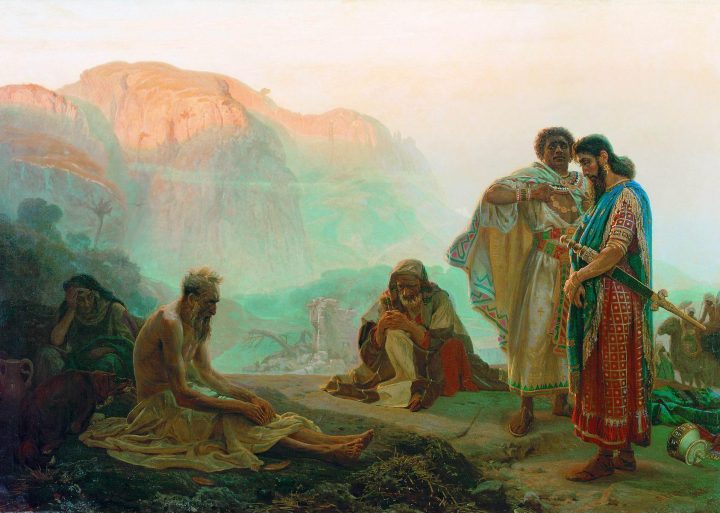
Job and His Friends, Ilya Repin, 1869, Russian Museum

Fr. Smith’s Commentary on the First Reading
Fifth Sunday in Ordinary Time
Job 7:1–4, 6–7
February 7, 2021

The great miracle of the Old Testament is the end of the Babylonian exile. We have examined this and its effects many times in these commentaries. For centuries, the Jewish leaders maneuvered between the major players in the Mid-East with varying success. By 598-96 BC, they had exhausted their options, Jerusalem and its temple were destroyed, and the elite sent off to exile in Babylon. This should have been the end of Judaism both as a religion and a people. Yet Ezekiel and Jeremiah prophesied that both would be reborn. Most memorable was Ezekiel testifying that the dry bones of the people would come back to life. Indeed, this came to pass when the Assyrian leader Cyrus allowed Jews to volunteer to return and rebuild their capital. Enough did that Jerusalem and its Temple rose again. This was a miracle and prophets, poets and scholars attempted to interpret it properly. The book of Job is one attempt to understand and one that has much to offer us today.

The returning Jews collected and edited their sacred writings that now form the basis of the Old Testament. One of the themes they used to give coherence to this material was that the life of Jews—social, religious, and political to the extent that they were separate—was good when they obeyed the law of the Lord and bad when they did not. This became known as Deuteronomic history. It was remarkably useful and explained much. Yet what of the good person whose life has not gone well? Indeed, one who has seen the wicked prosper at his expense. This is the predicament of Job.

Continue reading “5th Sunday of Ordinary Time – A Joyous Yes to the Living God”