Baptism of the Lord – The Other Epiphanies We Need

The Epiphanies 

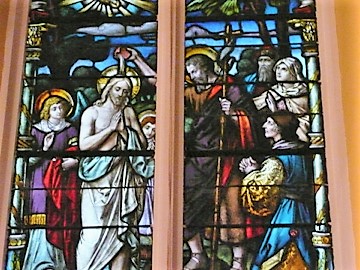
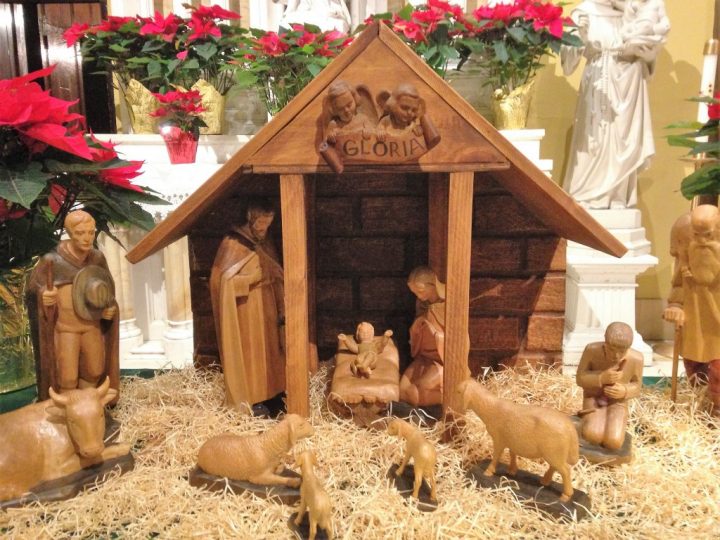
Epiphany derives from a Greek word for “making manifest or shining forth”. We celebrated the Solemnity of the Epiphany last Sunday with the commemoration of the Three Kings. Here, Jesus is revealed, “made manifest’, to the world. Yet, there are other events in which He also shines forth. The Church has recognized this by celebrating two other “Epiphanies”. In the “Baptism of the Lord” which we celebrate this weekend, the voice of the Father comes from heaven and says: “You are my beloved Son; with you I am well pleased”. Here, Jesus is acknowledged as a member of the Trinity. The third is the first miracle at the wedding feast at Cana. Here, the power of Jesus to heal is proclaimed, but also the realization that the clearest manifestation of his reality will not be seen until his death and resurrection. We will read this next week. In the present selection of readings, this order is maintained only in Year C and so we will not celebrate the three Epiphanies again for another three years. I ask you to think about these manifestations, and ask yourselves when Jesus has shined in your own lives. To recognize this in Church, a few Christmas trees will be left in the Sanctuary, and the recessional hymn at Mass next week will be “Joy to the World”.

First Reading:

The Feast of the Baptism of the Lord

Isaiah 42:1-4, 6-7

Jan 13, 2019


The return of the Jewish leaders to Jerusalem was obviously an important event for the Jews. Isaiah, who has a wider view of history, shows us in today’s reading that we must also see it from the perspective of “world” history, God cannot move without disruption. To understand this, we must begin with Chapter 41.

Isaiah is creating a trial scene in which God is the prosecuting attorney and judge. The first case is “who liberated the Jewish People?” As we proceed, note that the proper scriptural passages are placed on the side but only a small section is written out. Hebrew poetry is a bit repetitive to our ears.

Summons to trail 1 41:1

Keep silence before me, O coastlands;

you peoples, wait for my words!

Let them draw near and speak;

let us come together for judgment. Isaiah 41:1


“Coastlands” refer to the trading peoples of the Mediterranean world – they are not Jewish.


Legal questioning 1 – 41:2-4

2 Who has stirred up from the East the champion of justice,

and summoned him to be his attendant?

To him he delivers the nations

and subdues the kings;

With his sword he reduces them to dust,

with his bow, to driven straw. Isaiah 41:2

This is Cyrus, the king of Persia who conquered Babylon and will offer the Jewish leaders an opportunity to return. Yet, it is the God of the Jews who is in control.


4 Who has performed these deeds?

He who has called forth the generations since the beginning.

I, the LORD, am the first,

and with the last I will also be. Isaiah 41:4 (NAB)


Election and reassurance of Israel 41:5-20

8 But you, Israel, my servant,

Jacob, whom I have chosen,

offspring of Abraham my friend—

9 You whom I have taken from the ends of the earth

and summoned from its far-off places,

You whom I have called my servant,

whom I have chosen and will not cast off— Isaiah 41:8–9 (NAB)

Cyrus has been obedient to God’s will and has been rewarded with victory, but the Persians are not the chosen people. It is the people of Abraham who God has recalled from the ends of the earth and have his special favor. Note also that he refers to them as servants. They are chosen and important, but because they have a role.

Many beautiful lines follow but they reinforce the idea that the God of Israel is the Lord of History but as we have seen many times before He demands justice from his people.

Summons to trail 2 41:21

Having established that Israel’s God has worked his will, we begin the second trial, “Are there other Gods?”

21 Present your case, says the LORD;

bring forward your reasons, says the King of Jacob Isaiah 41:2


Legal Questioning 2 41:22-29


Now the “other” gods are on trial, or more specifically their idols:


23 Foretell the things that shall come afterward,

that we may know that you are gods!

Do something, good or evil,

that will put us in awe and in fear. Isaiah 41:23


They cannot, therefore:


24 Why, you are nothing and your work is nought!

To choose you is an abomination. Isaiah 41:24 (NAB)


He uses Cyrus as an example. He called him and the “other gods” did not even know it:


26 Who announced this from the beginning, that we might know;

beforehand, that we might say it is true?

Not one of you foretold it, not one spoke;

no one heard you say, Isaiah 41:26 (NAB)


From this He concludes that they do not exist. This is the earliest clear statement that there are no other gods


29 Ah, all of them are nothing,

their works are nought,

their idols are empty wind! Isaiah 41:29 (NAB)


Election and reassurance of Israel 2 42:1-9

We now come to the section for Sunday’s reading.

We have seen in 41:8 that God has called His servant. He returns to this when explains to the people what accepting Him as the only deity really means.

1 Here is my servant whom I uphold,

my chosen one with whom I am pleased,

Upon whom I have put my spirit;

he shall bring forth justice to the nations. Isaiah 42:1 (NAB)


He is speaking to the Jews who returned to Jerusalem not to a king, or indeed a prophet. As we saw last week the Kings and the traditional leaders failed. They failed to be just to their own people and thus could not fulfill their calling to bring justice to the nations. If the God of the Jews is truly the only God, then he is truly the ultimate course of Justice and peace.

3 A bruised reed he shall not break,

and a smoldering wick he shall not quench,

4 Until he establishes justice on the earth;

the coastlands will wait for his teaching. Isaiah 42:3–4 (NAB)


It shall not be by their own power; certainly not by traditional military might. A plant shall not be crushed by their own efforts, but the power of God will transform the pagans of the Coastlands who, in the quiet of their hearts, await the message that will set them free as well.

6 I, the LORD, have called you for the victory of justice,

I have grasped you by the hand;

I formed you, and set you

as a covenant of the people,

a light for the nations, Isaiah 42:6 (NAB)


By His covenant, sharing of life with His people, He will make them into a light for the nations: the way His name will be known.

Through them he will do for the world what he did for Israel

7 To open the eyes of the blind,

to bring out prisoners from confinement,

and from the dungeon, those who live in darkness. Isaiah 42:7 (NAB


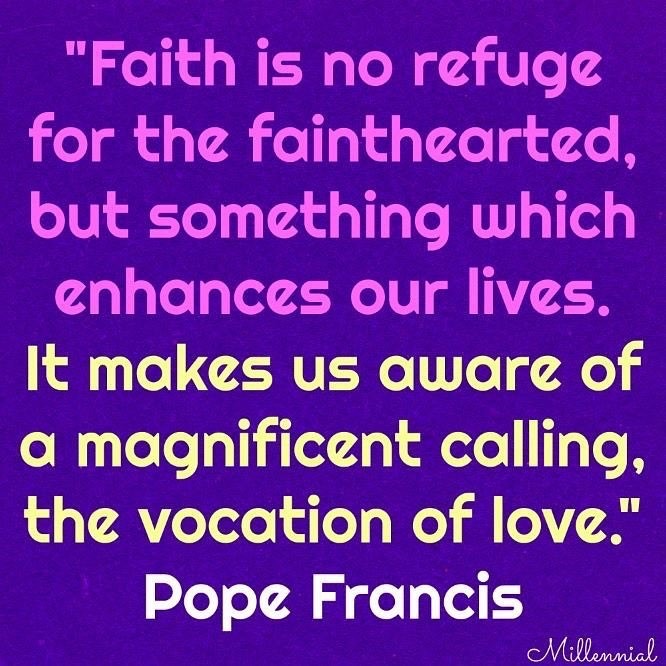
Through our covenant with Jesus, we have joined the Jews in the responsibility of being the light to the nations. As Pope Francis reminded the U.S. bishops on their retreat which concluded last Tuesday, this will be done with a firm commitment to justice. In its clearest form, this means our care for those who are poor and whose needs are not even seen. As of this writing, the “Partial” government shutdown is still in effect. There are contract workers who will never be paid and who are in desperate straits as it is. I  wonder how many congresspeople and bureaucrats, as well as the President and Cabinet members, know the names of the people who clean their offices? Do they know if they have children and can they pay their bills? Or are they as interchangeable as the desks and chairs? The people of Abraham will be visible and will be a light to the nations, but only if we care for those who invisible.

Epiphany – We the People, the Kings

Meet & Greets – Sunday, January 27
Our next Meet & Greets will be on Sunday, January 27. We will be offering coffee and breakfast after the 9 and 11:15 AM Masses, and wine and cheese after the 7 PM Mass. Please join us for hospitality and fellowship!

Bishop’s Visit – Sunday, February 2 3
Bishop DiMarzio will be visiting St. Charles on Sunday, February 2nd 3rd, and will be celebrating the 9 AM Mass that day. Please join us to welcome him that morning.

The Pope and the Bishops:

This week the Bishops of the United States are on a religious retreat suggested by Pope Francis. Their Retreat Master is Fr Raniero Cantalamessa, the official preacher to the Papal Household  and thus preacher to the Pope. Pope Francis has also written to them a most bracing letter. You may find the letter in full at: http://www.usccb.org/about/leadership/holy-see/francis/upload/francis-lettera-washington-traduzione-inglese-20190103.pdf

We would all benefit from reading this part as a parish:

[What we need as a Church] requires not only a new approach to management, but also a change in our mind-set (metanoia), our way of praying, our handling of power and money, our exercise of authority and our way of relating to one another and to the world around us. Changes in the Church are always aimed at encouraging a constant state of missionary and pastoral conversion capable of opening up new ecclesial paths ever more in keeping with the Gospel and, as such, respectful of human dignity. … [The Church] needs bishops who can teach others how to discern God’s presence in the history of his people, not mere administrators.”

All who wish to have a place in Church leadership should listen to these words. I certainly will.

Fr Smith


First Reading

The Epiphany

Jan 6, 2019


Last week we saw the Jewish people move from clan and chieftain leadership to a monarchy. Although this occurred around the year 1000 BC, the book of Samuel revealed a rather sophisticated understanding of the strengths and weakness of each system. This week, we see how the Jews adapted to knowing that they would not have a king in the foreseeable future and an even more sophisticated analysis of the consequences.

This section of the book of Isaiah was written about 500 BC in Jerusalem. It is a difficult time. The Persians invited the leaders of the Jews to return after a generation in exile, but as their subjects. The books of Ezra and Nehemiah give the background to this and it is obvious that many of those who returned were not happy. They were uncertain why they were there and what they were supposed to do.

The author instructed them very shrewdly. The residents of Jerusalem would have prayed the Psalms probably from memory. They would have known Psalm 72, part of which reads:

O God, give your judgment to the king; 

your justice to the son of kings;

That he may govern your people with justice,

your oppressed with right judgment,

3 That the mountains may yield their bounty for the people,

and the hills great abundance,

4 That he may defend the oppressed among the people,

save the poor and crush the oppressor.  Psalm 72:2–4


What does this mean when there is no king? Simply that the entire people, or at least those residing in Jerusalem, have taken on the role of King. As usual with the Old Testament, we first see this negatively. In the chapter immediately before what we read this week:


1 Lo, the hand of the LORD is not too short to save,

nor his ear too dull to hear.

2 Rather, it is your crimes

that separate you from your God,

It is your sins that make him hide his face

so that he will not hear you. (Isaiah 59:1-2)


These sins are from injustice:


No one brings suit justly,

no one pleads truthfully;

They trust in emptiness and tell lies;

they conceive mischief and bring forth malice. Isaiah 59:4


The verdict of Deuteronomy is always present. When the people act justly, they prosper; when they do not, they falter. It is easy to blame a corrupt political or moral system, but the prophets will not have it. This is partly true, but nothing can exempt anyone from acting justly.


Also, common however in the Old Testament is the promise of reversal – that the reward for justice is prosperity and respect among the nations. We see that in the opening verses today:


1 Rise up in splendor! Your light has come,

the glory of the Lord shines upon you.

2 See, darkness covers the earth,

and thick clouds cover the peoples;

But upon you the LORD shines,

and over you appears his glory. Isaiah 60:1–2


The light is the presence of God which accomplishes all things, including the gathering of all the tribes – traditionally the task of kings.


4 Raise your eyes and look about;

they all gather and come to you:

Your sons come from afar,

and your daughters in the arms of their nurses. Isaiah 60:4

The respect of the nations is more than just words, these are physical people, and everything must be in physical terms.

For the riches of the sea shall be emptied out before you,

the wealth of nations shall be brought to you.

6 Caravans of camels shall fill you,

dromedaries from Midian and Ephah;

All from Sheba shall come

bearing gold and frankincense,

and proclaiming the praises of the LORD. Isaiah 60:5–6

Note the reference to Sheba, and remember that the queen of Sheba brought gifts to King Solomon. This reflects the past; interesting, however are the feelings towards the foreign nations.

During the exile, Ezekiel wrote:

You have admitted foreigners, uncircumcised both in heart and flesh, to my sanctuary to profane it when you offered me food, fat, and blood; thus you have broken my covenant by all your abominations.  Ez 44:7


In the passage which follows what we read today:

7 All the flocks of Kedar shall be gathered for you,

the rams of Nebaioth shall be your sacrifices;

They will be acceptable offerings on my altar,

and I will enhance the splendor of my house. Isaiah 60:7 (NAB)


and

13 The glory of Lebanon shall come to you:

the cypress, the plane and the pine,

To bring beauty to my sanctuary,

and glory to the place where I set my feet. Isaiah 60:13

For this author, they rebuild the Temple and provide the offerings. This reflects Isaiah 49 on the vocation of the people of Israel:

6 It is too little, he says, for you to be my servant,

to raise up the tribes of Jacob,

and restore the survivors of Israel;

I will make you a light to the nations,

that my salvation may reach to the ends of the earth. Isaiah 49:6

Last week, we saw that the transition to Kingship could only be accomplished for Jews with the aid of a prophet. We see the same here. There is much conflict and contradiction, but a path is found not by administrators or soldiers or priests but by prophets.

As we begin 2019, we may feel like the Jews in Jerusalem asking: “what happened”? Who will make sense of this? In Jewish and Christian terms, “Where are our prophets?” When Pope Francis addressed Congress in 2015, one of the four Americans he mentioned was Abraham Lincoln. As the Civil War, the bloodiest and cruelest upheaval our country has ever faced, was coming to an end, Lincoln wrote in his Second Inaugural Address:

With malice toward none; with charity for all; with firmness in the right, as God gives us to see the right, let us strive on to finish the work we are in; to bind up the nation’s wounds; to care for him who shall have borne the battle, and for his widow, and his orphan  to do all which may achieve and cherish a just, and a lasting peace, among ourselves, and with all nations.

His interpretation of the moment that charity and generosity were needed, not violence and revenge, was an extraordinary and unwanted insight. It was prophecy in action. Like Isaiah over two millennia before, he was perhaps the only person who could see it clearly and say it eloquently. Enough who heard Isaiah followed him and Judaism has survived and prospered. We have perhaps not followed Lincoln closely enough, which is why the Pope had to include Martin Luther King in his address – enough so that we have stumbled by. Given the gravity of our situation, God will send us  prophets who will share extraordinary and unwanted insights as well.

Will we hear? Will we follow?

Holy Family Sunday – Prophets of Change

Thank you to all that helped with our celebration of the Christmas season: our Holiday Fair, Wreath Sale and Meet and Greet teams, Maureen Pond and the Family Faith Program teachers, families and students, our Music Program: Ulises Solano, Sergio Sandí, Coco Leung, Anne Bordley and our Parish Midnight Mass Choir, the Altar and Garden Committee led by Faith Burges, and our ushers, lectors, Eucharistic ministers, and altar servers.

We are always looking for more volunteers for fellowship and service – talk to us after Mass in the back of the church.

Andy Warhol and the Church

Many parishioners have visited the Andy Warhol show at the Whitney Museum and left with a sense that there was more to his work than they originally believed. Some were surprised that he was a practicing Catholic and suspect that some of the paintings have a religious dimension. “Communion and Liberation”, an ecclesial movement in the Church with a commitment to adult religious formation, sponsors a weekend of Catholic thought and artistic expression every year called “New York Encounter”. This year one of the talks will be “I just happen to love ordinary things”, a presentation by Francis Greene, Art Historian, on Andy Warhol’s realism and the religious sense. Dr Greene is no stranger to St Charles. He wrote the text for the self-guided tour of the stained glass in our church and has attended Mass with us. His talk will be at 1:00 PM, February 17th at the Metropolitan Pavilion (125 W 18th) (This is President’s Day weekend). If you are interested in going as a group, please see Fr Smith. You may also wish to check the web site: http://www.newyorkencounter.org/2019-program/. There are many very interesting talks and exhibits. Speakers include Cardinal Patrick O’Malley and David Brooks and topics range from Loneliness to Pope Francis’ vision for evangelization.


First Reading

Holy Family Sunday

1 Samuel 1:20-22, 24-28

We have two options for the first reading this week. There is Sirach 3 which speaks of the respect and care parents deserve from their children. It contains the line “even if his mind fails, be considerate of him”. This is far too close for comfort, which leaves us with 1 Samuel 1. This tells the story of how Hannah, a woman thought to be sterile, conceived a child by the power of God and gave him to the sanctuary at Shiloh when he was 3 years old. On the surface this is not “mother of the year” material, so let us begin with its political and symbolic meaning.

After leading the Israelites out of Egypt and through the desert for 40 years, Moses ceded leadership to Joshua to enter the promised land. After Joshua died in about 1250 BC, the Israelites formed a loose confederation among themselves and would join together under a leader in times of need. This leader was called a “Judge”, but was more a general than a jurist. A judge was called by God and was not restricted to hereditary clan leaders. Thus Deborah, a woman, could be a judge. This worked well until other groups in the area began to develop a more centralized organization. Especially threatening for the Israelites were the Philistines who used their trading network to import superior weapons. By 1100 BC this had become a crisis and another way of organizing themselves was needed. A King was the obvious solution but the Israelites were quite aware of the dangers of kingship as well as its benefits. Although it would allow for a more coherent response to danger there would be a price to pay. Samuel will himself tell the people:

“These will be the ways of the king who will reign over you: he will take your sons and appoint them to his chariots and to be his horsemen, and to run before his chariots; 12 and he will appoint for himself commanders of thousands and commanders of fifties, and some to plow his ground and to reap his harvest, and to make his implements of war and the equipment of his chariots. 1 Sa 8:11–13)

This continues for quite some time but ends with:

19 The people, however, refused to listen to Samuel’s warning and said, “Not so! There must be a king over us. 20 We too must be like other nations, with a king to rule us and to lead us in warfare and fight our battles.” 21 When Samuel had listened to all the people had to say, he repeated it to the LORD, 22 who then said to him, “Grant their request and appoint a king to rule them.” 1 Samuel 8:19

Note however that the people go to Samuel to find them a king, they do not make such a serious decision without the aid of a prophet. Now for the symbols:

Hannah, the mother of Samuel, was thought barren. She represents the people of Israel who did not have an authentic prophet to proclaim the word of God to them. Although there was Sanctuary in Shiloh presided over by Eli and his sons, the people felt spiritually barren. There was no one who could act in God’s name. Hannah’s conception of Samuel was a sign that prophecy has been reborn and if they must have a king, he will be chosen by God himself.

But there is more, after today’s reading Hannah says:

1 “My heart exults in the LORD,

my horn is exalted in my God.

I have swallowed up my enemies;

I rejoice in my victory.

7 The LORD makes poor and makes rich,

he humbles, he also exalts.

8 He raises the needy from the dust;

from the ash heap he lifts up the poor,

To seat them with nobles

and make a glorious throne their heritage.

9 He will guard the footsteps of his faithful ones,

but the wicked shall perish in the darkness.

For not by strength does man prevail;

This has a very specific meaning. Eli had two sons, Hophni and Phinehas, and they exploited their positions as priests. Once Samuel is given to the sanctuary they are killed in battle. Eli also dies and Samuel is the undeniable leader of the People.

We may find this an odd way to write history, but it demonstrates that prophecy is irreplaceable. Samuel will be king maker and king breaker, and set the pattern for the rest of Jewish history. He will first anoint Sau,l but when he proves too flawed, he will replace him with David. David received God’s promise of eternal favor and help, but this did not mean impunity, When David ordered his officers to kill Uriah the husband of Bathsheba the prophet Nathan confronted David with his sin. David acknowledged it and repented. This is the pattern of the Old Testament. The king may be hereditary, but God will choose whoever he wants as his prophet to keep the king in line. Samuel, Nathan, Hosea and Jeremiah have nothing in common but their calling.

This is relevant for us in two ways: the necessity of power and the primacy of prophecy.

The contrast between the roles of king and prophet in the Old Testament is an early but by no means primitive example of checks and balances and one from which we can learn. The recent scandals in our society about the abuse of power was, as it almost always is, reflected in sexual exploitation. In virtually every case, this was aided by a failure to establish, much less implement effective controls within closed hierarchical organizations.  There was no comparable power to force compliance. An oversight committee, much less an HR department is just not adequate.  A group or institution must have and be seen to have real power before it can exercise constraint.

We say far too easily in the church that this will be lay involvement. Where will the power be? Recently Bishop Frank Caggiano, the Bishop of Bridgeport and formerly an auxiliary Bishop in Brooklyn, appointed a lay person to have effective administrative control of a parish. As she is appointed by the Bishop, she can only be removed for cause. This is the power of the purse strings from below and the means of constraint will develop from it. First the power, then the mechanisms.

This is not a panacea or magic bullet. If there is real power, there will be the opportunity for real corruption as well. But the inevitable tension between this level and the traditional power structure of the Church can be creative and keep both honest. The present attempt of members of the rich and motivated right wing of the church to buy it at fire sale prices is deeply disturbing. We need several locations of power.

But more than anything else, we need prophets. We have experienced sterility. The word of God is not bearing fruit and the message judges the messenger. As in the day of Samuel, we need institutional change, but as in every age whatever develops will need prophets to guide it. Change is difficult and prophets are annoying. Let us pray that we can accept both.

4th Sunday of Advent – Do Right, Love Goodness, Walk Humbly With Your God

Beatitudes for Politicians from Pope Francis

  • Blessed be the politician with a lofty sense and deep understanding of his role.
  • Blessed be the politician who personally exemplifies credibility.
  • Blessed be the politician who works for the common good and not his or her own interest.
  • Blessed be the politician who remains consistent.
  • Blessed be the politician who works for unity.
  • Blessed be the politician who works to accomplish radical change.
  • Blessed be the politician who is capable of listening.
  • Blessed be the politician who is without fear.

They were actually proposed by the late Vietnamese Cardinal François-Xavier Nguyễn Vãn Thuận, who spent 13 years in a Communist prison, nine in solitary confinement.

Christmas Mass Schedule
Monday 12/24:
Mass at 5 PM (Nativity Pageant)
Tuesday 12/25: Mass at Midnight, 9 AM and 11:15 AM. (No 7 PM Mass).

Last Week’s Meet & Greets and Christmas Pageant

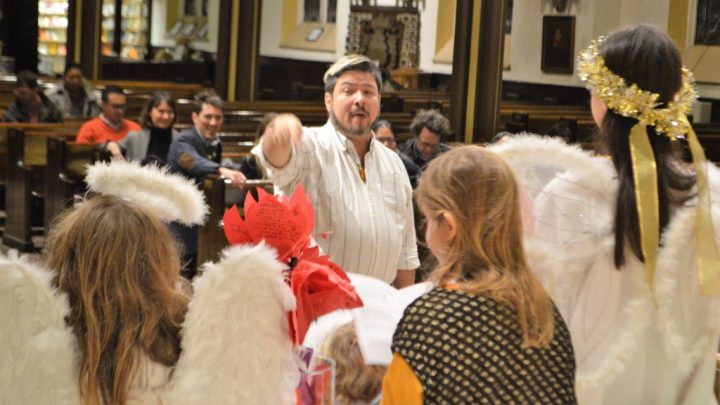
Thank you all for your support and donations last weekend for our Meet & Greets. At the 11:15 AM Mass, the Family Faith students performed the Nativity Pageant at the Gospel. Cantor Ulises Solano (photo above) led the children in song. Young adults from St. Vincent’s Services were our special guests. We will have an encore presentation of the Nativity Pageant at the 5 PM Mass on Monday, 12/24.


Fr. John giving the homily


Parishioner Lauren Pettiette and her support group from St. Vincent’s Services


First Reading

Fourth Sunday of Advent

Dec 23, 2018

Micah 5:1-4a


We read this week from the prophet Micah. He was a younger contemporary of the first Isaiah and reflected his concerns about Justice and society. (737-696BC).  Unlike Isaiah he was from a small town and was particularly enraged about the exploitation of small farmers. Although, his words were written down after his death the “book” was edited several times to show its relevance to contemporary society. Let us look at what would have been so special and pertinent about his message.

The Assyrian empire was at its most ruthless and cruel during this time, but his emphasis was on the sins of his own people:


For the crime of Jacob all this comes to pass,

and for the sins of the house of Israel.

What is the crime of Jacob? Is it not Samaria?

And what is the sin of the house of Judah?

Is it not Jerusalem? Micah 1:5


His attention is on the elite in Jerusalem.


1 Woe to those who plan iniquity,

and work out evil on their couches;

In the morning light they accomplish it

when it lies within their power.

2 They covet fields, and seize them;

houses, and they take them;

They cheat an owner of his house,

a man of his inheritance. (Micah 2:2-2)


These are people who do not work the land but own it. Micah believes that the land was obtained illegally or at least immorally.  This is not only an individual sin but against the entire community, Jews, like Catholics, believe that they are connected to God by being part of his people. They believed as well that He gave this land to Jewish families and that their connection to Him would be through this land. Speculators and others who took this land were not only guilty of theft, but of breaking God’s relationship with his people, one family at a time.


Micah saw how dangerous this was and was he first to prophesize that it would end with the destruction of Jerusalem. These lines follow immediately after the denunciation of the rich found above:


3 Therefore thus says the LORD:

Behold, I am planning against this race an evil

from which you shall not withdraw your necks;

Nor shall you walk with head high,

for it will be a time of evil.

4 On that day a satire shall be sung over you,

and there shall be a plaintive chant:

“Our ruin is complete,

our fields are portioned out among our captors,

The fields of my people are measured out,

and no one can get them back!”


Many scholars believe that he thought this would happen in his lifetime. As we noted the Assyrian Empire was at its most aggressive. They had already destroyed the Northern Kingdom of Israel in 721 and attached Judah (Jerusalem) in 701. That attack was called off by the Assyrians and Jerusalem was spared. A hundred years later when Jerusalem was being attacked by Babylon, these verses were retooled for that occasion.

This was seen as more than merely updating but a clearer revelation of God’s will.  The next section presumes exile and return:

1 In days to come

the mount of the LORD’S house

Shall be established higher than the mountains;

it shall rise high above the hills,

And peoples shall stream to it:

2 Many nations shall come, and say,

“Come, let us climb the mount of the LORD,

to the house of the God of Jacob,

That he may instruct us in his ways,

that we may walk in his paths.”

For from Zion shall go forth instruction,

and the word of the LORD from Jerusalem. Micah 4:1–2

Because of their faithfulness they will be able to share their way of life with other people including the law and worship. Also, as we have seen before this will be without the traditional leadership.

Hear this, you rulers of the house of Jacob … who abhor justice and pervert all equity, who build Zion with blood and Jerusalem with wrong!… because of you Zion shall be plowed as a field; Jerusalem shall become a heap of ruins” (Mic 3:9–10, 12)

And thus


6 On that day, says the LORD,

I will gather the lame,

And I will assemble the outcasts,

and those whom I have afflicted.

7 I will make of the lame a remnant,

and of those driven far off a strong nation;

And the LORD shall be king over them on Mount Zion,

from now on forever. Micah 4:6–7 (NAB)

The section that we read today brings many of these themes together:

1 But you, Bethlehem-Ephrathah

too small to be among the clans of Judah,

From you shall come forth for me

one who is to be ruler in Israel;

Whose origin is from of old,

from ancient times. Micah 5:1 (NAB)

Ephrathah is the ancient name for the area around Bethlehem. It is miles outside of Jerusalem, and is rural and not contaminated by the sins of the city. It is the town of King David. Micah is telling the Jews that to prosper, they must go back to the beginning of the reign of King David and start all over again.

Therefore the Lord will give them up, until the time

when she who is to give birth has borne,

And the rest of his brethren shall return

to the children of Israel. Micah 5:2


It will literally require a rebirth. This resembles Isaiah’s famous lines:

14 Therefore the Lord himself will give you this sign: the virgin shall be with child, and bear a son, and shall name him Immanuel. Isaiah 7:14 .

Yet note the difference. The Message is the same: injustice and idolatry has forced God to begin again, but Isaiah is a man of the city talking to a king. This is court politics. Micah is a man of the provinces and speaks as an outsider.

This reminds us of the thought of Pope Francis. There is always a tension between the center and the peripheries. There must be both, but progress comes from the outside in – from those who the “system” or the establishment are not serving. We see the effects of globalization in our world and gentrification in our own community. Like Isaiah, we know that it has mixed and problematic consequences but at second hand. Micah knew the social and indeed religious effects as well as the financial of the activities of the rich and prosperous of his day and his prophesies were more powerful for it. We need the testimony of those in our own time and community who experience the negative aspects of expansion as well as the reports and analyses of those who will experience the benefits. The former may be the truly prophetic. Let us take the most famous lines of the book of Micah to ourselves:

8 You have been told, O man, what is good,

and what the LORD requires of you:

Only to do right and to love goodness,

and to walk humbly with your God. Micah 6:8 (NAB)