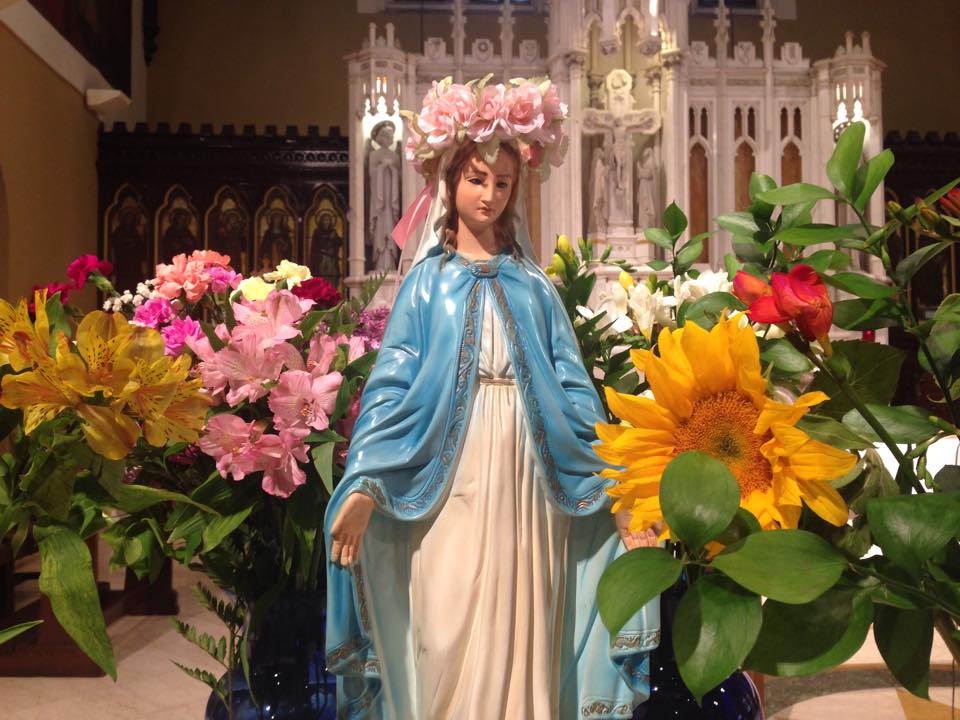
Wednesday, Aug. 15: Assumption of the Blessed Virgin Mary – Holy Day of Obligation
Masses at 12:10 pm and 7 pm.
Wednesday, Aug. 15: Assumption of the Blessed Virgin Mary – Holy Day of Obligation
Masses at 12:10 pm and 7 pm.

Greetings from St Charles:
Contact information for Fr Smith: Tel #718.625.1177 ext 409 or email ([email protected])
INDIVIDUAL MEETINGS:
Summer is a slow time and many of us are away but for those of us still here, I would like to invite you to have a relational (individual) Meeting with a member of the Parish. I try to meet with all new parishioners and I ask you to contact me to arrange a time. We also encourage everyone to meet with other people so that we truly get to know each other and by that to know Jesus better. To speak with me see the above information, to arrange meeting with another parishioner, please contact the rectory at 718.625.1177 or email at [email protected]
RELIGIOUS EDUCATION:
Youth: Youth: Our program will begin again in September, please call or email the Parish office (718.625.1177) to register.
Adult spirituality: The Scripture program will begin again in the Fall. As previously they will be small groups which will meet at various times and places throughout the week. If you are interested, please call Fr Smith.
IN OUR PRINT EDITION:
The parish bulletin which may be obtained in the church or on-line at https://www.stcharlesbklyn.org, has a collection of wonderful quotes from Pope Francis and the Mass readings for every day of the Week.
MEET AND GREET:
Summer is a time when St Charles will receive new parishioners. We welcome everyone and hope that you will find St Charles a true Church family. There will be a “Meet and Greet” after all the Masses on September 16th – 9:00 and 11:15 AM and 7:00PM – to welcome our new parishioners. We especially look forward to greeting the students from our local dorms and parents with school aged children. We remind our present parishioners to invite anyone who might wish to join us to Mass that day.
FIRST READING
Eighteenth Sunday in Ordinary Time
Aug. 5, 2018
We read today from the Book of Exodus. It is the second book of the Bible and means “Going out” in Greek reflecting the “going out” of the Hebrews from captivity in Egypt. It forms part of what Christian’s call the Pentateuch, (first) five scrolls, and Jews “The Torah” usually translated as “The Law” but more accurately “the Teachings”. Until the last 200 years it was held that the Pentateuch was written by Moses during the wandering in the desert but now is seen as being written by several authors over several hundred years. As the Pentateuch is a collection of legends, laws, stories and bits of memory it might best be considered a work of editors from about 600BC – 400BC than authors in the modern sense of the word. The period of composition then would have been from the last days of the Kingdom of Judea to the time of Persian rule when all pretense of even an honorary king from the line of David had disappeared. Its last editor was most likely a priest who wished to show that the Hebrew people, now best called Jews, “People of the land of Judea”, were kept together by majesty of worship and law not the might and cunning of Kings.
The section we read today occurs six weeks after the Hebrews have left Egypt. The last Oasis, place of water, is behind them and their provisions are exhausted. They face a severe shortage of food and there is no place to obtain provisions. The people begin to grumble and express the concern that they will face a long slow death.
“Would that we had died at the LORD’S hand in the land of Egypt, as we sat by our fleshpots and ate our fill of bread! But you had to lead us into this desert to make the whole community die of famine!”
The Lord’s hand here means a “natural” death from Old Age or accident. Fleshpots mean the cauldrons in which meat is cooked. It was quite unusual to eat meat but they are indicating that they may not have had meat regularly but had enough that they missed it. G.K Chesterton wrote that Christianity was not tried and found wanting but found difficult and left untried” This is true of any authentic attempt to follow God as the Hebrews are discovering it in the desert.
Notice however the next scene:
Then the LORD said to Moses, “I will now rain down bread from heaven for you. Each day the
people are to go out and gather their daily portion; thus will I test them, to see whether they
follow my instructions or not (16:4)
The first and most important thing is That God is not bowing to pressure. He sees the need and responds with graciousness. Psalm 105 reads
They asked, and he brought quails,
and gave them food from heaven in abundance (105:40)
Also, they are to go out each day and collect the Mana. This is the secretion of insects living in the tamarisk tree that is still eaten by Bedouins today. It emphasizes not only God generosity but also that it can be received only by changing one’s life to be in turn with God’s demands. The quail also were a sign of God’s generousity. They would not have had such a luxury in the city. God’s care is overwhelming.
For the meaning however we need to read the final lines of our passage.
15 On seeing it, the Israelites asked one another, “What is this?” for they did not know what it was. But Moses told them, “This is the bread which the LORD has given you to eat”.
The Hebrews who left Egypt were city people Mana would have been foreign to them and them quite reasonable asked what it was, Moses does not answer as a naturalist but as a prophet. “This is the bread which the LORD has given you to eat”.
We cannot be certain how much of this relates historical events. As an example, Mania is available only in certain months of the year and only where there are tamarisk trees and quail, can be numerous when migrating, but are simply not in the Middle East for more than a few weeks in the year. This should not be surprising as they relate events that are literally pre-historic, before reliable and consistent records. This is not the case however for the time when Exodus attained its final edition, The Jews were a highly literate people who have left us their reflections on their history. They have had a culturally near-death experience. What other people were cut off from the center of their religious existence, the temple, deported to another land then were able to return and start again eventually building a much grander place of worship all he while under forging domination? The only guidance they could find was from their own history and the liberation from bondage of Egpt: the exodus. The stories which they put in the final edtion were those that had the most to teach them about how to live in their present mment and situation,
The task of those who returned to Jerusalem from Babylon was a daunting one. As we see in the books of Nehemiah and Ezra some were discouraged and wished to return “home” to Babylon as many of the Hebrews wished to turn back to Egypt. Look at the support and confidence they would hate received by reading the stories of the “first” exodus. Not only the triumph at return to the Land but also God’s care for their physical as much as their spiritual needs. Faithfulness to God is always rewarded.
We live in a time of Exile, literally, culturally and spiritually. There are more displaced people today than even after the second world war, there are also people who feel that the world that they knew and loved has been taken from them or never arrived. It is easy to think of non-college educated white men who fear the inevitable change of America into a majority minority (non-white) country. Yet perhaps more of us either are part of or know families who mortgaged their homes and future to give their children the best educations possible and now discover that they may never get out of a mountain of debt and the children will never have lives as secure and prosperous as they did. Personally, I sometimes feel that I have gone to bed in America but have woken up in France. I can, should I so desire, freely worship God but the institutions created to make that worship real diminished by the judicial and administrative actions of the State.
Like the Hebrews and Jews before us we have brought ourselves to our own man-made exile and need to ask ourselves if will join them in a God led Exodus?
Please download the bulletin for August 05, 2018.

Meet and Greet:
We will meet and greet our new parishioners including the students who will be joining us for the year after all the Masses (9:00 and 11:15 AM and 7PM) on Sunday, September 16, 2018.
If you are have just moved to the community, please attend; if you are already a parishioner please bring anyone who might be interested.
Church restoration: Active work will begin again this week.
Contact information for Fr Smith: Tel #718.625.1177 ext 409 or email ([email protected]).
Religious Education:
Youth: Our program will begin again in September, please call or email the Parish office (718.625.1177) to register.
Adults:
Sacraments:
Baptism, Communion and Confirmation: Non-Catholics who wish to become Catholic or Catholics who wish to receive Baptism, Communion or Confirmation are asked to call or email Fr Smith. The classes will begin in the Fall.
Marriage: St Charles Parish congratulates those who will become engaged this summer and we wish to accompany you on your way to the altar and beyond. Please contact Fr Smith at your earliest convenience. This includes those who will be married in another Parish and especially those who will be married in another country.
Scripture Program:
The Scripture program will begin again in the Fall. As previously they will be small groups which will meet at various times and places throughout the week. If you are interested, please call Fr Smith
Liturgical Ministries:
We need more Lectors and Eucharistic Ministers. If you have recently moved into the Parish and were either a Lector or a Eucharistic Minister in a previous Parish, the Military or Campus Ministry or if you feel called to one of these ministries, please contact Fr Smith.
First reading
The Seventeenth Sunday in Ordinary Time
July 29, 2018
2 Kings 4:42-44
Today we turn back to Israel, the northern kingdom, about 50 years after the death of Solomon and the dividing of the unified kingdom. Israel was prosperous but unstable. Several families vied for the kingship and although the they built temples for those who wished to worship the God of their fathers this was more to prevent them from visiting the temple in Jerusalem than for the sincere worship of God. There were many in the land including the king who worshiped other gods. Ahab who ruled from about 870 to 852 BC was the most notorious. It is instructive that his wife Jezebel’s name means “Where is Baal”: the name of a pagan God.
Near the beginning of Ahab’s reign, the prophet Elijah appeared without warning and said to Ahab at the temple at Gilad:
As the LORD the God of Israel lives, before whom I stand, there shall be neither dew nor rain these years, except by my word (1 Kings17)
This was for the sin of apostasy. The authors of Kings insisted that all the troubles which will follow came from the turn to other gods. Elijah immediately fled after this and began a protracted contest with Ahab and Jezebel. After several years God tells him:
Return on your way to the wilderness of Damascus; when you arrive, you shall anoint Hazael as king over Aram. 16 Also you shall anoint Jehu son of Nimshi as king over Israel; and you shall anoint Elisha son of Shaphat of Abel-meholah as prophet in your place (1 kings 19:15-16)
Note that God is telling him to annoint not only the civil leader of Israel, Jehu, but also the leader of a pagan foreign country, Hazael, and the religious leader of Israel as well, Elisha. God is Lord over every nation and every part of life. Hazael and Jehu eventually destroy Ahab but there is more to the story than that.
Unlike the previous prophets we have seen they have left no writings and all we know is what the authors of Kings tell us. They were both fearless, dedicated and were able to perform great miracles. The authors wished to show this continuation. Thus, Elisha asks for a “double portion” of Elijah’s sprit. This was a way of asking to be his “first son” and principal heir.
It was also reflected in the miracles they performed. The miracle we read today is the 3rd in 2 Kings 4. The first is the widow’s oil. A member of Elisha’s company of prophets has died in debt and his children are about to be sold into slavery. His Wwdow asks for Elisha’s help and he asks,
“Tell me, what do you have in the house?” She answered, “Your servant has nothing in the house, except a jar of oil.” 3 He said, “Go outside, borrow vessels from all your neighbors, empty vessels and not just a few. 4 Then go in, and shut the door behind you and your children, and start pouring into all these vessels; when each is full, set it aside.” 5 So she left him and shut the door behind her and her children; they kept bringing vessels to her, and she kept pouring. 6 When the vessels were full, she said to her son, “Bring me another vessel.” But he said to her, “There are no more.” Then the oil stopped flowing. 7 She came and told the man of God, and he said, “Go sell the oil and pay your debts, and you and your children can live on the rest (2 Kings 4:4-7)
Elisha performed a similar miracle (1 Kings 17:14-16). The next wonder is a miraculous birth (2 Kings 4:8-17) to a couple who has shown charity to him and returning that child to life after a fatal illness (2Kings 4:18-37) These too resemble miracles of Elijah.
Now let us look at today’s passage. We must remember the situation. There is a famine and people wish to keep all the food they can. Yet there is custom to give the first results “fruits” of the harvest to the temple or to a someone clearly sent from God:
42 A man came from Baal-shalishah, bringing food from the first fruits to the man of God: twenty loaves of barley and fresh ears of grain in his sack
Elisha had a substantial number of followers:
Give it to the people and let them eat.” 43 But his servant said, “How can I set this before a hundred people?” So he repeated, “Give it to the people and let them eat, for thus says the LORD, ‘They shall eat and have some left (2 Kings 4:43-44)
Elijah also performed a miracle of multiplying food for his household. Elijah and especially Elisha were involved in the affairs of state and participated in political decisions that effected the entire nation and because they worshiped the God of Israel they cared for the people of Israel. The pagan gods worshiped by Ahab, Jezebel and their priests and courtiers did not care for the people and could be placated by worship indeed occasionally by human sacrifice. The prophets we have been looking at this summer have shown us that the God of Israel cares for His people and no amount of worship however splendid will be accepted unless it is complimented by Justice. Thus, the miracles of Elijah and Elisha not only win battles and serve the needs of state but comfort the common people who in most religions fall beneath the radar. God wishes his love and concern to be felt from the top to the bottom of society and his mercy will not fall on the king or prince who ignores this responsibility.
We no longer have kings or princes, but we do have the rich and powerful. It is convenient for us to believe that they are the 1% and if someone is part of that to argue that the real power is in the top .1%. This is a comforting illusion. A recent article in The Atlantic monthly (June 2108) by Matthew Stewart argues that America is developing a virtually hereditary aristocracy, https://www.theatlantic.com/magazine/archive/2018/06/the-birth-of-a-new-american-aristocracy/559130/. Essentially this is the top 10% by income families in the country. The top 10% have a disproportionate share of not only the nation’s wealth but its opportunity. He is just one of the authors examining the hereditary nature of wealth and power. Several authors suggest that 20% of families will improve their financial and social situations the rest will barely hold on or fall behind.
I think most of us would fall into at least that 20% and what would Elijah and Elisha have to say to us? Would they tell us not to use our advantages to help our children, grandchildren and other family members? I do not know, and I do not think very many of us would do so even if they did. I do think that they would tell us to question how our decisions, especially in a democracy our choice of candidates for public office, would affect the poor and marginalized. What would the world be if every Christian, Jew and Muslim followed that advice?
Please download the bulletin for July 29, 2018.
Please download the bulletin for July 29, 2018.
This weekend:
Next week several of our parishioners will be taking the Bar Exam. The 7:00 PM Mass this Sunday will be celebrated for them with a special blessing for the day. We invite not only anyone who is taking the Bar exam but also lawyers who can give them encouragement and support. A wine and cheese reception will follow.
Sacramental Preparation:
Classes for those who wish to become Catholic or for Baptized Catholics who wish to receive Eucharist or Confirmation will start in the Fall. Anyone interested is asked to see Father Smith after Mass or to call the Rectory. 718-625-1177 ext 409
Individual Meetings:
We will be continuing to have individual or relational meetings between parishioners. This is neither an interview nor a request for parish feedback but an invitation to connect to Saint Charles Parish by connecting first with each other. Should you wish to participate please call Fr Smith at 718-625-1177 ext 409, email him at [email protected] or sign the registration sheet in the rear of the Church. A member of the team will contact you.
First reading:
16th Week in Ordinary Time
Jeremiah 23:1-6
Today we return to 6th Century Jerusalem and the commanding figure of the prophet Jeremiah. He was active from about 627 to 585 BC and saw the sputtering and fall of the Kingdom of Judea. As an aristocrat he was very visible in the city and this gave him some freedom to maneuver. Ultimately however this made him an obvious target and he escaped execution several times only because of his connections. None of this prevented him from speaking the word of God forcefully to high and low, native and foreigner.
In the 100 years following the fall of Israel in 721, the northern kingdom of the Jewish people, Judea, the southern kingdom, was subject to the Assyrians. Like all subject peoples they were looking for a chance to escape. In 627 disturbances following the death of the Assyrian King seemed to provide the opportunity. For a while they were able to carve out some space amid the warring parties, but then the Babylonians grasped so much power that the Assyrians made an alliance with the Egyptians, usually their great rivals. Josiah, the king of Judea, realized that this would effectively end any independence they could have and fought the Egyptians in 609 at Megiddo. He suffered a disastrous defeat and the Judeans needed to be rescued by the Babylonians. Things quickly fall apart. There were several kings in his period who tried both to satisfy the people’s desire for independence and the demands of their Babylonians overlords. They ultimately failed and in 597 the Babylonians laid siege to Jerusalem and began the first series of deportations of the leadership to Babylon. A puppet king was installed but he could not control his people and the Babylonians, deciding that this was hopeless, destroyed the city of Jerusalem and the temple in 586.
Jeremiah was involved in all these events, and although passages in the Book of Jeremiah are notoriously difficult to date, today’s section is usually assumed to have been written between the first and final deportations. There may have been some editions later, but Jeremiah’s intent and prophetic word is clear: the job of a king is to protect the people and keep them together, and the Judean kings failed.
1 Woe to the shepherds who mislead and scatter the flock of my pasture, says the LORD. Therefore, thus says the LORD, the God of Israel, against the shepherds who shepherd my people: You have scattered my sheep and driven them away. You have not cared for them, but I will take care to punish your evil deeds. (Jeremiah 23:1-2)
We should not be overly critical of the kings of Judah: they were between a rock and a hard place, and they needed to articulate a vision of sharing a “National” God without civil independence. This is difficult, but necessary, for as we read in the book of Proverbs: “Without vision the people perish” (29:18)
It was necessary then for God himself to bring the people back.
3 I will gather the remnant of my flock from all the lands to which I have driven them and bring them back to their meadow; there they shall increase and multiply. (23:3)
When he does he will raise up shepherd for them who will keep the flock together:
4 I will appoint shepherds for them who will shepherd them so that they need no longer fear and tremble; and none shall be missing, says the LORD.
The chief shepherd, the king, will be from the House of David. He will share vison that it is God who leads the people and after their time in Babylon will know that the power of the Lord is everywhere and at every time. They are bound not only by a shared history but by acting justly and righteously, here and now.
5 Behold, the days are coming, says the LORD,
when I will raise up a righteous shoot to David;
As king he shall reign and govern wisely,
he shall do what is just and right in the land.
6 In his days Judah shall be saved,
Israel shall dwell in security. (23:5-6a)
He shall be the way that God will use to be present to his people and thus his name will be “The Lord our justice”.
Although this may seem mere wishful thinking we know that it was the occasion of a great miracle. The Persians conquered Babylon and offered the Jews the option to return home and rebuild their capital and temple. Enough did that they were able to reestablish themselves, as if not an independent nation, but a people with enough freedom of worship to maintain their identity. But perhaps the greatest miracle was still to come.
It is said that history does not repeat itself, but it does rhyme. Some of the same notes which occurred in the days before the deportations to Babylon were heard again in the generation after Jesus. Those who wished to revolt against Rome eventually attained power in Judea with predictable results. The temple was destroyed in 70 AD and after the mere hint of revolution a generation later Jerusalem was closed to Jews. This should have been the end of Judaism, but it opened a time of unparalleled intellectual and spiritual creativity. They had learned their lesson and realized that God gave them a promise, not a roadmap; they were a people because they shared a relationship with God and that relationship defies the limits of both time and space.
We are called to continue this song. It would be foolish to try to take direct lessons from the ancient Hebrew prophets. This was well before the nation state and the separation of church and state would have been incomprehensible. But there are insights which we could profitably examine. It was a commonplace that the taxes needed to pay the tribute to whatever empire controlled the region were unfairly leveled against the poor. This gave them little reason to accept a national vision of unity between God and the people. Gross unfairness destroys unity and the prophets saw this in “religious” terms and fought against it. If we share this belief, then we will not follow a shepherd who fails to lead us to the unity that comes from Justice and we as a nation will hold a vision that will never perish.