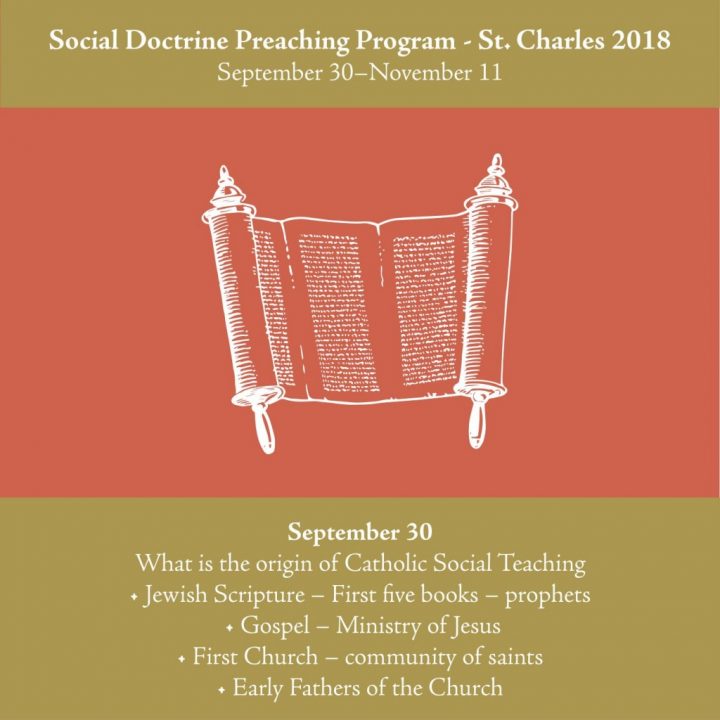
Catholic Social Doctrine Preaching Series

On Sunday, November 18, the Church will observe the second annual World Day of the Poor, a special day of prayer, reflection and action focused on those most in need. With this in mind, St. Charles has prepared a series of homilies, beginning on Sunday, September 30, designed to help reacquaint us with the seven themes of Catholic social teaching and examine ways in which these core pillars can help us turn our faith into action. Join us on a seven-week journey to deepen our faith and renew our commitment to living the Gospel!

See our flyer about the series here:

Catholic Social Doctrine-9-27-18

26th Sunday Ordinary Time – Hunger for the Spirit

Adult Sacrament Classes: The meetings for Adults who wish to receive the Sacraments of Baptism, Confirmation and Eucharist will begin on Sunday, Oct 7th after the 11:15 Mass in the Rectory. They will be held about once per month for 2 hours. Because we recognize that many of our parishioners must travel for work, there will be another opportunity during the week to participate.

A special invitation to any adult in the Parish to participate. This is a wonderful opportunity to not only update your knowledge of the Church’s teaching but also to experience true spiritual formation.

Please contact Fr Smith at the rectory (718.625.1177 ext 409) to get the book we will be using and read the first 2 chapters before the first meeting.

Church renovation: The abatement work at the church is now substantially complete with only a few small areas still in progress.  The closeout paperwork has been filed and once approved it will allow the restoration work to get fully underway.  The paperwork for the restoration work, the surveying of the existing conditions by the contractor, and the planning of the logistics to complete everything have been underway for the past several months.  This advanced planning will allow work to flow smoothly and minimize delays.  In the next few weeks, mockup areas of exterior restoration work will begin to pop up for both architect and Landmarks review and approve.  Masonry and exterior wood restoration work will begin as well.  There will remain a lot of work behind the scenes finalizing details for the window coverings and materials to match the existing.  This work will all begin to catch up to the masonry restoration over the next weeks and months.

Special Preaching Series: In preparation for the second “World Day of the Poor” on Sunday, Nov. 18th, the homilies at all the Masses will be on the Social Doctrine of the Church. You will find further information on this every week on the Parish Website and our weekly email updates.


September 30th

Twenty Sixth Sunday in Ordinary Time

Numbers 11:25-29


After a particularly frustrating day, St Teresa of Avila, the great reformer of the 16th century Church, famously said: “If this is the way you treat your friends O Lord, no wonder you have so few.” Moses feels like this today. To understand why, we need to take a step backwards.

The book of Numbers is the 4th book of the Torah/Pentateuch. It tells the story of the Israelites’ journey from the area around Sinai and, after decades of wandering, arrival at the outskirts of the promised land. It is a complicated book and marked by a very strange and dark humor. As we can easily see on a map the trip from Sinai to Palestine is not a long one and could have been accomplished in a few weeks. Here we are not talking about the military conquest that is found as we saw a few weeks ago in the book of Joshua. This is just getting there, but the difficulty was that God gave Moses the most efficient campaign strategy and the people refused to follow it. They were then doomed to wander until they leaned obedience. Their hardness of heart was such that it required all of the elders but 2 to die before they could finally enter the promised land. They complained constantly, and what and how they complained was very revealing.

At the beginning of the 11th chapter, we read that the Israelites lamented:

“Would that we had meat for food!

5 We remember the fish we used to eat without cost in Egypt, and the cucumbers, the melons, the leeks, the onions, and the garlic.

6 But now we are famished; we see nothing before us but this manna.” Numbers 11:4–6


In words which St Teresa would have understood, Moses said to God:


11 “Why do you treat your servant so badly?” Moses asked the LORD. “Why are you so displeased with me that you burden me with all this people? Numbers 11:11  13 Where can I get meat to give to all this people? For they are crying to me, ‘Give us meat for our food.’ 14 I cannot carry all this people by myself, for they are too heavy for me. 15 If this is the way you will deal with me, then please do me the favor of killing me at once, so that I need no longer face this distress.” Numbers 11:13–15


God’s reaction was two-fold. Most practically he answered the people’s desire for meat. After stating the root cause of the problem:

For in the hearing of the LORD you have cried, ‘Would that we had meat for food! Oh, how well off we were in Egypt!’

He answers their request:

18 “To the people, however, you shall say: Sanctify yourselves for tomorrow, when you shall have meat to eat. For in the hearing of the LORD you have cried, ‘Would that we had meat for food! Oh, how well off we were in Egypt!’ Therefore the LORD will give you meat for food,

19 and you will eat it, not for one day, or two days, or five, or ten, or twenty days,

20 but for a whole month-until it comes out of your very nostrils and becomes loathsome to you. For you have spurned the LORD who is in your midst, and in his presence you have wailed, ‘Why did we ever leave Egypt?’” Numbers 11:18–20


Remember, I did say that there was black humor here.


31 There arose a wind sent by the LORD, that drove in quail from the sea and brought them down over the camp site at a height of two cubits from the ground for the distance of a day’s journey all around the camp.

32 All that day, all night, and all the next day the people gathered in the quail. Even the one who got the least gathered ten homers of them. Then they spread them out all around the camp.

33 But while the meat was still between their teeth, before it could be consumed, the LORD’S wrath flared up against the people, and he struck them with a very great plague. Numbers 11:31–33 (NAB)


He also addresses the even more basic need for what we would call religious education or formation and it is that we see today. There are two points of interest;


16 Then the LORD said to Moses, “Assemble for me seventy of the elders of Israel, men you know for true elders and authorities among the people, and bring them to the meeting tent. When they are in place beside you, 17 I will come down and speak with you there. I will also take some of the spirit that is on you and will bestow it on them, that they may share the burden of the people with you. You will then not have to bear it by yourself. Numbers 11:16–17


The first part of our reading today continues this:


25 The LORD then came down in the cloud and spoke to him. Taking some of the spirit that was on Moses, he bestowed it on the seventy elders; and as the spirit came to rest on them, they prophesied. Numbers 11:25


The gift they received was to prophesy which does not mean foretelling the future but speaking ecstatically and exhorting and encouraging people. Moses is still the chief judge and leader, but he now has help in forming the next generation. This is the one which will enter the promised land, and they will need to be true and fervent believers to fulfill their task.


Now look at the next section:


26 Now two men, one named Eldad and the other Medad, were not in the gathering but had been left in the camp. They too had been on the list, but had not gone out to the tent; yet the spirit came to rest on them also, and they prophesied in the camp. 27 So, when a young man quickly told Moses, “Eldad and Medad are prophesying in the camp,” 28 Joshua, son of Nun, who from his youth had been Moses’ aide, said, “Moses, my lord, stop them.”  29 But Moses answered him, “Are you jealous for my sake? Would that all the people of the LORD were prophets! Would that the LORD might bestow his spirit on them all!” Numbers 11:26–29


Joshua as Moses’ putative successor may well have been seeking to protect his own future power but Moses has a clearer idea of the real situation.  Although for whatever reason Eldad and Medad had not been at the chosen place and the appointed time, nonetheless God wanted them and sent His Spirit to them. It is God who chooses who will speak for Him. That has been developed more fully throughout the years as vocation – a call from God. Although the spirit was given to us in the sacrament of Confirmation, vocation was often interpreted as being limited to priests and religious. It has been a great advance in our day that we now see it as being shared by all the faithful and a reflection of the universal call to holiness. We are all called to something in the body of Christ; we need, however, discernment in deciding to what we are called.


This book is called the Book of Numbers because of the two censuses taken in it. The first is at the start of the journey at Mt Sinai where they become versed in the law of the Lord and leave as a disciplined army of 603,550. Within a few weeks, as we have seen, the spiritual discipline that held them together began to unravel. Thirty-eight years after the first census, there is another as they prepared to enter the promised land.  There were 601,730 men in arms.


These are the ones counted by Moses and Eleazar the priest when they counted the Israelites on the plains of Moab by the Jordan across from Jericho. 64 Not one of them was among those counted by Moses and Aaron the priest when they counted the Israelites in the Desert of Sinai. 65 For the Lord had told those Israelites they would surely die in the wilderness, and not one of them was left except Caleb son of Jephunneh and Joshua son of Nun. (Numbers 26:63)


These are those who were catechized by prophets moved by the Spirit. They were formed by the word of God from their infancy. For a great task, great reliance on the Spirit is required —something the Apostles would discover in millennia to come. It is interesting that there are fewer soldiers in the second census than the first. As the Psalmist says:


Put no trust in princes, in children of Adam powerless to save. Who breathing his last, returns to the earth; that day all his planning comes to nothing (146 3-4)

The Body of Christ is suffering greatly and will only become healthy if we remember that in the death and resurrection of Jesus, the Spirit truly has been bestowed on us all.


25th Sunday Ordinary Time – Why do good?

September 23

Adult Sacrament Classes: The meetings for Adults who wish to receive the Sacraments of Baptism, Confirmation and Eucharist will begin on Sunday, Oct 7th after the 11:15 Mass in the Rectory. They will be held about once per month for 2hrs. Because we recognize that many of our parishioners must travel for work there will be another opportunity during the week to participate.

A special invitation to any adult in the Parish to participate. This is a wonderful opportunity to not only update your knowledge of the Church’s teaching but also to experience true spiritual formation.

Please contact Blanca Anchundia at the rectory (718.625.1177) to get the book we will be using and read the first 2 chapters before the first meeting.

Church renovation: The abatement work at the church is now substantially complete with only a few small areas still in progress.  The closeout paperwork has been filed and once approved it will allow the restoration work to get fully underway.  The paperwork for the restoration work, the surveying of the existing conditions by the contractor, and the planning of the logistics to complete everything have been underway for the past several months.  This advanced planning will allow work to flow smoothly and minimize delays.  In the next few weeks mockup areas of exterior restoration work will begin to pop up for both architect and Landmarks review and approve.  Masonry and exterior wood restoration work will begin as well.  There will remain a lot of work behind the scenes finalizing details for the window coverings and materials to match the existing.  This work will all begin to catch up to the masonry restoration over the next weeks and months.

Meet and Greet: We would like to thank all those who participated in the Meet and Greet last Sunday. Special thanks for the generosity of the Fitzpatrick/Lorelli foundation, Luzzo’s Pizza and Beth Lieu. Hope to see you all again next month.

Special Preaching Series: In preparation for the second “World Day of the Poor” on Sunday, Nov. 18th, all the homilies at all the Masses will be on the Social Doctrine of the Church. You will find further information on this every week on the Parish Website and our weekly email updates.


First Reading – September 23

Twenty-fifth Sunday in Ordinary Time

Wisdom of Solomon 2:12; 12-17


The readings for the last 2 weeks have been from Isaiah and their events have unfolded in the Jerusalem of 520 BC. We have seen the great miracle of the return of the Jewish exiles from Babylon but have seen as well that at least some had a fundamental misunderstanding of what had occurred.  They thought that they would be rewarded with riches, position and power. Instead they were essentially frontiersman. Indeed, last week Isaiah told them that the way to understanding would be through suffering and sacrifice. Why then do good rather than bad, and what indeed is good? Today’s reading gives at least part of the answer.

We return today to the book of Wisdom. We read from it several months ago; let us take a moment to remember its background. Although it sounds ancient, it is perhaps the last book in the Old Testament and could have been written as late as 30 BC. Also, although it takes the name of King Solomon of Jerusalem from about 1000 BC, it was most likely written in Alexandra Egypt for the children of the Jewish elite who were immersed in the Roman world and tempted to give up their faith.

Alexandria was an important commercial but also intellectual center, and the author of Wisdom is well versed in all the alternatives to Judaism, from Greek philosophy to the cult of Isis. He is however first and foremost a person of his tradition. He answers the questions that his young people might have from Scriptures and shows the superiority of the God of Abraham, Isaac and Jacob.

We saw before that the bedrock of wisdom is justice, “For justice is undying”. But there are those who do not place justice at the center of their lives:

1 they who said among themselves, thinking not aright:

“Brief and troublous is our lifetime;

neither is there any remedy for man’s dying,

nor is anyone known to have come back from the nether world. Wisdom of Solomon 2:1 (NAB)


They look at their world and do not experience anything permanent.  So they conclude:

6 “Come, therefore, let us enjoy the good things that are real, and use the freshness of creation avidly”. (2:6)

If acquisition and consumption are all that is then we take whatever we can from whoever has it. In words that are almost chillingly contemporary:

10 Let us oppress the needy just man;

let us neither spare the widow

nor revere the old man for his hair grown white with time.

11 But let our strength be our norm of justice;

for weakness proves itself useless. Wisdom of Solomon 2:10–11


The section that we read today begins here:

12 Let us beset the just one, because he is obnoxious to us;

he sets himself against our doings,

Reproaches us for transgressions of the law

and charges us with violations of our training. Wisdom of Solomon 2:12 (NAB)


We are reminded here that those being addressed received a good Jewish education. They know what is good and right and are unnerved by those who live the good life. They therefore seek to test him and more to the point God himself.  “Let us condemn him to a shameful death; for according to his own words, God will take care of him.” Wisdom of Solomon 2:20

Our passage ends here but let us read further.

21 These were their thoughts, but they erred;

for their wickedness blinded them,

22 And they knew not the hidden counsels of God;

neither did they count on a recompense of holiness

nor discern the innocent souls’ reward.

23 For God formed man to be imperishable;

the image of his own nature he made him.

24 But by the envy of the devil, death entered the world,

and they who are in his possession experience it. Wisdom of Solomon 2:21–3:1 (NAB)

Here we see the importance of creation. We assume that there was a beginning, but this was unique in the ancient world. Non-Jews believed that we were made in all sorts of ways for all sorts of  reasons, They were  rarely good and never loving. Humanity was formed by accident, contempt and spite. For the Jews there was a real creation and one that was conscious and loving. As we were created by a God who was both just and loving the author of wisdom could not conceive that those who responded to that love would not live forever. Being good is acting in conformity to the way we were made. It is in our terms being authentic. It is only the Good who live a life which is truly human and will continue in the world to come. (What happens to those who are bad is left somewhat underdeveloped in Wisdom.)

Now this requires some clarification. Like Daniel and the author of Maccabees Wisdom holds that there is a life after death, but his approach reflects Greek thinking and speaks of immortality or at least its possibility built in to us at creation. The others –  and indeed the one accepted by Christians –  is the resurrection of the Body. This is an even greater gift because it is not a mere extension or continuation of human life – although perfected and without pain or want – but a transformation into a new life. We are not here to be the best we can be but to become Jesus. It is good for us to reflect however on Wisdom. It is only because creation is good and that goodness calls to us that we can be open to the transforming grace of Jesus.

Yet there are this-worldly consequences to how one lives. Because the evil do not know the “councils of God” they do not realize what is truly real and sustaining here and now. Although their lives may often seem better – particularly in material possessions – lack of authenticity ultimately makes one blind, dumb and unhappy. We are, as has been said, not punished for our sins we are punished by our sins.

As we said previously the author of the book of Wisdom was a very learned elder who responded to the many options facing a young person in his very cosmopolitan city. Today he responds directly only to a most superficial, if nonetheless pervasive world view. He reveals however many points of contact with the great western classical authors. Aristotle would have concurred with him that happiness is the ultimate end and purpose of human existence. He would have affirmed Aristotle’s observation that this is obtained by doing good in Aristotle’s terms by exercising virtue. But here is a major difference which would be revealed by suffering and sacrifice. For Aristotle, a virtuous person may have to suffer even being martyred to avoid vice. Suffering, however, would not offer any understanding in this world nor connection to a higher power. His God is principally found by reason; the God of the Jews, however, is found in revelation. There is a different relationship. This will be seen more clearly with Jesus, but it is found in Wisdom as well.

Last week we concluded with a quote from GK Chesterton, perhaps the most famous convert to Catholicism in the last century. Let us end this week with one from Oscar Wilde, on the surface, the most surprising: “Clergymen and people who use phrases without wisdom sometimes talk of suffering as a mystery. It is really a revelation.”


24th Sunday Ordinary Time – Morning after Morning

Reminders:

Meet and Greet after each Mass this Sunday, September 16.  Join us for coffee and get to know your fellow parishioners.

Media Outreach meeting September 18 at 7 PM at the Rectory. RSVP at [email protected]

Faith Sharing groups forming – sign up sheets at Mass or contact the Rectory at [email protected].

Family Faith Formation – classes for RCIA, completing sacraments, and religious education for children starting. See Fr. Smith after Mass.


First Reading September 16

Twenty Fourth Sunday of Ordinary Time

Isaiah 50:4c-9


We return today to the same world that we saw last week: Jerusalem after the return of the exiles around 520 BC. A miracle had occurred. Jerusalem and the temple had been destroyed and the leaders brought into exile in Babylon. This should have been the end of the Jewish People. Yet God through the unlikely intermediary of Cyrus Prince of Persia has given them a chance to start again. Enough decided return to the ruins of Jerusalem that they could contemplate reconstruction. Yet they needed a second miracle to know why they were there.

Many seemed to believe that they would be rewarded by God for their faith in the common way of the world: comfort, wealth and power. They were living however Spartan lives in rubble as the employees of a foreign emperor. They asked Isaiah why God has abandoned them. Like their forefathers who left Egypt they began to believe they were better off in captivity.

In the passage immediately before today’s reading God answers them:

Where is the bill of divorce

with which I dismissed your mother?

Or to which of my creditors

have I sold you?

It was for your sins that you were sold,

for your crimes that your mother was dismissed. (Isaiah 50:1)

They were exiled because of their refusal to follow God but there was no bill of divorce or sale to anyone else. They were not abandoned permanently. God did not want to sever His ties with them but to chastise them. Note, however, this is not the past but the present. He is referring to them, not their forbears:

2 Why was no one there when I came?

Why did no one answer when I called?

Is my hand too short to ransom?

Have I not the strength to deliver? (50:2)

He called them to make a new Exodus following him to a new land and they did not follow with their hearts, only their bodies. Note the references to the Exodus in the next line:

Lo, with my rebuke I dry up the sea,

I turn rivers into a desert;

Their fish rot for lack of water,

and die of thirst. 50:3


The next line however marks a change and it is Isaiah who speaks:


4 The Lord GOD has given me

a well-trained tongue,

That I might know how to speak to the weary

a word that will rouse them.

Morning after morning

he opens my ear that I may hear; (50:4)


A better translation for “a well-trained tongue” would be the tongue of a disciple. His responsibly is not to convey information, however true, but to exhort the people to fulfill their tasks. This requires continued effort (Morning after Morning) and is not the message we might first have considered.

A key part of “Second Isaiah” are the four “suffering servant songs” in which he speaks as one who has taken on the burden of his people. This is the third. We will examine them in greater detail in Lent but let us only look at this one by itself.

5 And I have not rebelled,

have not turned back.

6 I gave my back to those who beat me,

my cheeks to those who plucked my beard;

My face I did not shield

from buffets and spitting.  (50:5–6)

Voluntary suffering was not common in the Old Testament, but it was not unknown. Jerimiah refers to himself as like a trusting lamb led to the slaughter. (Jer 12:19). This was however before the exile. Isaiah wishes to show them what is expected of them in this new world.

7 The Lord GOD is my help,

therefore I am not disgraced;

I have set my face like flint,

knowing that I shall not be put to shame.  (50:7–9)


However unpleasant life may become, he knows that God will never abandon him and dares those who thought him only oppressed to take him to court:


8 He is near who upholds my right;

if anyone wishes to oppose me,

let us appear together.

Who disputes my right?

Let him confront me.

9 See, the Lord GOD is my help;

who will prove me wrong?

Lo, they will all wear out like cloth,

the moth will eat them up. (50:8-9)


In the verse immediately following, he then addresses the people directly:

10 Who among you fears the LORD,

heeds his servant’s voice,

And walks in darkness

without any light,

Trusting in the name of the LORD

and relying on his God? (50:10)


He knows that they do not understand him, that they would be expected to follow God for seemingly no earthly reward does not make sense to them. But it is their role to trust God.


11 All of you kindle flames

and carry about you fiery darts;

Walk by the light of your own fire

and by the flares you have burnt!

This is your fate from my hand:

you shall lie down in a place of pain. (50:10–11)

If they think they are walking by light it is their own and not God’s. Their fate will be pain forever.

There are many statements to the effect that we learn by our successes when young and failures when old. God is teaching the people what he wants them to be mature disciples.

It is too little, he says, for you to be my servant,

to raise up the tribes of Jacob,

and restore the survivors of Israel;

I will make you a light to the nations,

that my salvation may reach to the ends of the earth. (Isaiah 49:6)

The Jews were called to lead others to the God of Abraham, Isaac and Jacob. They would need to learn that the required humility comes by sacrifice and suffering. It is not a lesson we want to live, but as a now deceased professor told me at 20, “wisdom makes a bloody entrance”, which I began to understand at 50 and hope to live at 70.

This is a necessary lesson for us as individuals and I think for the church as well. The prestige and power of the church have been declining for years and the recent cover up scandals will accelerate this trend. This diminishment comes at a bad time for the nation. Msgr. LoPinto and I will preach about the social teachings of the Church during the weeks preceding world day of the poor on Nov 18th. They are a valuable indeed unique way to analyze the world and create productive polices. The actual implementation of these policies through organizations such as Catholic charities allow our teachings to be made tangible. We may have great difficulties being both heard and funded. Nevertheless, the humiliation if embraced in the spirit of Isaiah can be a real purification from the root to the branch,

Next week we will read from the Book of Wisdom (2:12, 17-20) and its author will have some excellent suggestions for us, until then let us remember the words of G. K. Chesterton from his long poem, the “Ballad of the White Horse”. They may be the best commentary ever written on today’s reading:

But the men signed of the cross of Christ
Go gaily in the dark. . .