4th Sunday of Advent – Do Right, Love Goodness, Walk Humbly With Your God

Beatitudes for Politicians from Pope Francis

  • Blessed be the politician with a lofty sense and deep understanding of his role.
  • Blessed be the politician who personally exemplifies credibility.
  • Blessed be the politician who works for the common good and not his or her own interest.
  • Blessed be the politician who remains consistent.
  • Blessed be the politician who works for unity.
  • Blessed be the politician who works to accomplish radical change.
  • Blessed be the politician who is capable of listening.
  • Blessed be the politician who is without fear.

They were actually proposed by the late Vietnamese Cardinal François-Xavier Nguyễn Vãn Thuận, who spent 13 years in a Communist prison, nine in solitary confinement.

Christmas Mass Schedule
Monday 12/24:
Mass at 5 PM (Nativity Pageant)
Tuesday 12/25: Mass at Midnight, 9 AM and 11:15 AM. (No 7 PM Mass).

Last Week’s Meet & Greets and Christmas Pageant

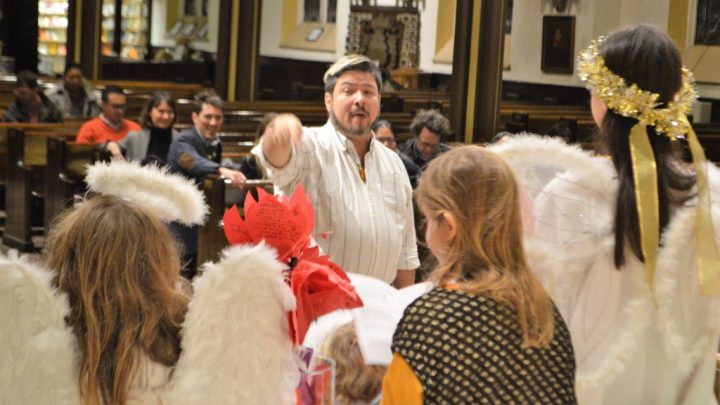
Thank you all for your support and donations last weekend for our Meet & Greets. At the 11:15 AM Mass, the Family Faith students performed the Nativity Pageant at the Gospel. Cantor Ulises Solano (photo above) led the children in song. Young adults from St. Vincent’s Services were our special guests. We will have an encore presentation of the Nativity Pageant at the 5 PM Mass on Monday, 12/24.


Fr. John giving the homily


Parishioner Lauren Pettiette and her support group from St. Vincent’s Services


First Reading

Fourth Sunday of Advent

Dec 23, 2018

Micah 5:1-4a


We read this week from the prophet Micah. He was a younger contemporary of the first Isaiah and reflected his concerns about Justice and society. (737-696BC).  Unlike Isaiah he was from a small town and was particularly enraged about the exploitation of small farmers. Although, his words were written down after his death the “book” was edited several times to show its relevance to contemporary society. Let us look at what would have been so special and pertinent about his message.

The Assyrian empire was at its most ruthless and cruel during this time, but his emphasis was on the sins of his own people:


For the crime of Jacob all this comes to pass,

and for the sins of the house of Israel.

What is the crime of Jacob? Is it not Samaria?

And what is the sin of the house of Judah?

Is it not Jerusalem? Micah 1:5


His attention is on the elite in Jerusalem.


1 Woe to those who plan iniquity,

and work out evil on their couches;

In the morning light they accomplish it

when it lies within their power.

2 They covet fields, and seize them;

houses, and they take them;

They cheat an owner of his house,

a man of his inheritance. (Micah 2:2-2)


These are people who do not work the land but own it. Micah believes that the land was obtained illegally or at least immorally.  This is not only an individual sin but against the entire community, Jews, like Catholics, believe that they are connected to God by being part of his people. They believed as well that He gave this land to Jewish families and that their connection to Him would be through this land. Speculators and others who took this land were not only guilty of theft, but of breaking God’s relationship with his people, one family at a time.


Micah saw how dangerous this was and was he first to prophesize that it would end with the destruction of Jerusalem. These lines follow immediately after the denunciation of the rich found above:


3 Therefore thus says the LORD:

Behold, I am planning against this race an evil

from which you shall not withdraw your necks;

Nor shall you walk with head high,

for it will be a time of evil.

4 On that day a satire shall be sung over you,

and there shall be a plaintive chant:

“Our ruin is complete,

our fields are portioned out among our captors,

The fields of my people are measured out,

and no one can get them back!”


Many scholars believe that he thought this would happen in his lifetime. As we noted the Assyrian Empire was at its most aggressive. They had already destroyed the Northern Kingdom of Israel in 721 and attached Judah (Jerusalem) in 701. That attack was called off by the Assyrians and Jerusalem was spared. A hundred years later when Jerusalem was being attacked by Babylon, these verses were retooled for that occasion.

This was seen as more than merely updating but a clearer revelation of God’s will.  The next section presumes exile and return:

1 In days to come

the mount of the LORD’S house

Shall be established higher than the mountains;

it shall rise high above the hills,

And peoples shall stream to it:

2 Many nations shall come, and say,

“Come, let us climb the mount of the LORD,

to the house of the God of Jacob,

That he may instruct us in his ways,

that we may walk in his paths.”

For from Zion shall go forth instruction,

and the word of the LORD from Jerusalem. Micah 4:1–2

Because of their faithfulness they will be able to share their way of life with other people including the law and worship. Also, as we have seen before this will be without the traditional leadership.

Hear this, you rulers of the house of Jacob … who abhor justice and pervert all equity, who build Zion with blood and Jerusalem with wrong!… because of you Zion shall be plowed as a field; Jerusalem shall become a heap of ruins” (Mic 3:9–10, 12)

And thus


6 On that day, says the LORD,

I will gather the lame,

And I will assemble the outcasts,

and those whom I have afflicted.

7 I will make of the lame a remnant,

and of those driven far off a strong nation;

And the LORD shall be king over them on Mount Zion,

from now on forever. Micah 4:6–7 (NAB)

The section that we read today brings many of these themes together:

1 But you, Bethlehem-Ephrathah

too small to be among the clans of Judah,

From you shall come forth for me

one who is to be ruler in Israel;

Whose origin is from of old,

from ancient times. Micah 5:1 (NAB)

Ephrathah is the ancient name for the area around Bethlehem. It is miles outside of Jerusalem, and is rural and not contaminated by the sins of the city. It is the town of King David. Micah is telling the Jews that to prosper, they must go back to the beginning of the reign of King David and start all over again.

Therefore the Lord will give them up, until the time

when she who is to give birth has borne,

And the rest of his brethren shall return

to the children of Israel. Micah 5:2


It will literally require a rebirth. This resembles Isaiah’s famous lines:

14 Therefore the Lord himself will give you this sign: the virgin shall be with child, and bear a son, and shall name him Immanuel. Isaiah 7:14 .

Yet note the difference. The Message is the same: injustice and idolatry has forced God to begin again, but Isaiah is a man of the city talking to a king. This is court politics. Micah is a man of the provinces and speaks as an outsider.

This reminds us of the thought of Pope Francis. There is always a tension between the center and the peripheries. There must be both, but progress comes from the outside in – from those who the “system” or the establishment are not serving. We see the effects of globalization in our world and gentrification in our own community. Like Isaiah, we know that it has mixed and problematic consequences but at second hand. Micah knew the social and indeed religious effects as well as the financial of the activities of the rich and prosperous of his day and his prophesies were more powerful for it. We need the testimony of those in our own time and community who experience the negative aspects of expansion as well as the reports and analyses of those who will experience the benefits. The former may be the truly prophetic. Let us take the most famous lines of the book of Micah to ourselves:

8 You have been told, O man, what is good,

and what the LORD requires of you:

Only to do right and to love goodness,

and to walk humbly with your God. Micah 6:8 (NAB)


Third Sunday of Advent: Gaudete – Shout of Joy

Meet & Greets + Children’s Nativity Pageant

This Sunday, we will have our monthly Meet & Greets after each of the Masses. We will serve breakfast after the 9 and 11:15 PM mass, and wine and cheese after the 7 PM Mass. The Children’s Nativity Pageant will be held during the Gospel at the 11:15 AM Mass – this is a highlight of our Family Faith Program each year. Our special guests will be young adults from St. Vincent Services. Please join us for fellowship and good cheer in this special season!

Connecting at St Charles

Do you work insane hours? Do you travel so much you don’t know where you will be next week much less where you will attend Mass? Do you feel that you really don’t belong to any Parish and want to feel more connected to St Charles? Please join us this Monday, Dec 17th,  7:30 PM at 31 Sidney Place (The Rectory) Parlor Floor

Fr John Gribowich, a resident at St Charles who is continuing his studies in media at the University of California Berkley, will assist us in developing ways to connect with each other. He will be joined by Davd Plisky from DeSales Media.

I hope and pray that you will be able to attend.

Christmas Collections

Catholic Charities Brooklyn and Queens was recently featured in the New York Times Neediest Cases column for its Intern and Earn program, which gets 16-24-year olds back on track in their home, school, or career lives. Read more at https://nyti.ms/2zG3cJW (free article). The second collection at Christmas will be dedicated to Catholic Charities.

We are also continuing to have the following collections:

  • Christmas Collection and Christmas Flowers for our Church – Give online at https://stcharlesbklyn.weshareonline.org/ChristmasSpecialCollection or use your mass envelope.
  • 7th Annual Toys for Tots drive at the The Custom House  – Unwrapped Toys & Gift Cards to be distributed by Catholic Charities. Drop off at The Custom House at 139 Montague Street by December 15th.
  • Family Faith Program Collection of Winter Hats, Scarves, Gloves for St. Charles Seniors – drop off unwrapped items at box at front of church by Sunday, December 16.

Thank you very much for your support!

Fr William Smith

Pastor


Third Sunday of Advent

Dec. 16, 2018

Zephaniah 3:14-18a


Today we read from the Book of the prophet Zephaniah. He is rarely quoted directly but will be somewhat familiar to classical music enthusiasts for providing the opening words to the Dies Irae, a hymn which was part of the old Requiem Mass.

A day of wrath is that day

a day of anguish and distress,

A day of destruction and desolation,

a day of darkness and gloom,

A day of thick black clouds


Zephaniah 1:15


He does however have much to teach us that is particularly suited to the Advent season.

He gives us a brief autobiography at the beginning of his book.


The word of the LORD which came to Zephaniah, the son of Cushi, the son of Gedaliah, the son of Amariah, the son of Hezekiah, in the days of Josiah, the son of Amon, king of Judah.

Zephaniah 1:1

He is very well connected – a descendant indeed of the good king Hezekiah (716-687 BC), he also dates himself to the reign of the reforming king Josiah. (640-609) This would make him a slightly older contemporary of Jeremiah and Ezekiel. As we have seen before this was a time when the military power of Assyria was diminishing. The Jews were able to take some breathing room not only to attempt to obtain greater political autonomy but also greater religious independence. During the reigns of Manasseh and Amon (687-640) many foreign elements were added to Jewish worship and practice. This was good politics but bad religion. Zephaniah was the first prophet since Isaiah, and he encouraged King Josiah to purify religious practice. Much of the first chapter of Zephaniah is virtually incomprehensible to us because it speaks of pagan religious practices that were successfully purged from Jewish worship. For instance, “the Lord will punish all who leap over the threshold”, (Zephaniah 1:9) This refers to the worship of the pagan god Dargon. The effect however is familiar:

12 At that time I will explore Jerusalem with lamps;

I will punish the men …

Who say in their hearts,

“Neither good nor evil can the LORD do.”


Zephaniah 1:12 (NAB)


Once worship is adulterated and tradition weakened, ultimately belief is surrendered and God may seem irrelevant. It is Zephaniah’s message that the Lord is always a player.

For Zephaniah, the fish stinks from the head down.

1 Woe to the city, rebellious and polluted,

to the tyrannical city!

2 She hears no voice,

accepts no correction;

In the LORD she has not trusted,

to her God she has not drawn near.

3 Her princes in her midst

are roaring lions;

Her judges are wolves of the night

that have had no bones to gnaw by morning.

4 Her prophets are insolent,

treacherous men;

Her priests profane what is holy,

and do violence to the law. Zephaniah 3:1–4


A fairly comprehensive list and a realistic evaluation. Bad leaders bring bad ends. Realistic also is Zephaniah’s address to the poor:


2 Before you are driven away,

like chaff that passes on;

Before there comes upon you

the blazing anger of the LORD:

Before there comes upon you

the day of the LORD’S anger.

3 Seek the LORD, all you humble of the earth,

who have observed his law;

Seek justice, seek humility;

perhaps you may be sheltered

on the day of the LORD’S anger.


Zephaniah 2:2–3


This reveals a unique feature of the Old Testament. The Lord is concerned about the poor and the marginalized, and calls those who are rich and prosperous to task for the means by which they obtained and maintained their prosperity and position. Characteristic as well is that – as we have seen before – the prophets will call down God’s wrath on foreign nations.


4 For Gaza shall be forsaken,

and Ashkelon shall be a waste,

Ashdod they shall drive out at midday,

and Ekron shall be uprooted.

Zephaniah 2:4

It goes on for quite a while and is very comprehensive, but is balanced by the oracles against the Jews themselves. As the history of the Jewish people clearly shows being the Chosen people is not a free pass. All are subject to the justice of God, but also his mercy. After He has shown His wrath on the nations, He will make them His own:

9 For then I will change and purify

the lips of the peoples,

That they all may call upon the name of the LORD,

to serve him with one accord;

10 From beyond the rivers of Ethiopia

and as far as the recesses of the North,

they shall bring me offerings.

Zephaniah 3:9–10


The Jews will be the means he will use to accomplish this:


11 On that day

You need not be ashamed

of all your deeds,

your rebellious actions against me;

For then will I remove from your midst

the proud braggarts,

And you shall no longer exalt yourself

on my holy mountain.

12 But I will leave as a remnant in your midst

a people humble and lowly,

Who shall take refuge in the name of the LORD;

13 the remnant of Israel.

They shall do no wrong

and speak no lies;

Nor shall there be found in their mouths

a deceitful tongue;

They shall pasture and couch their flocks

with none to disturb them. Zephaniah 3:11–13

Here we see an important theme in the first testament. The Jewish people are not chosen for themselves, but to be the light to the nations and the means by which all people will come to know the Lord. Thus, Zephaniah speaks of a remnant that will live in Jerusalem after the others have been removed.

This is where our reading today begins. Before examining it, we need to look at a bit of editing. As we have seen before, the final editing of many of the books in the first testament was after the exile about 500 BC. Most scholars believe that this section was added as a fitting conclusion to the book.

It is a shout of joy for the saving work of God. It is also a very realistic one. We believe that God has entered into history and reveals himself through it. It takes time to see that those who live as if God matters will be vindicated. That what may have seen immediately as disaster was a means of holiness and that the God who is in our midst will:

18 as one sings at festivals.

I will remove disaster from among you,

so that none may recount your disgrace.

Zephaniah 3:18 (NAB)

Christmas Giving Requests

We ask for your help in our gift raising this Christmas season:

  • Christmas Collection for our Church – Give online at https://stcharlesbklyn.weshareonline.org/ChristmasSpecialCollectionor use your mass envelope
  • 7th Annual Toys for Tots drive at the The Custom House  – Unwrapped Toys & Gift Cards to be distributed by Catholic Charities. Drop off at The Custom House at 139 Montague Street by December 15th.
  • Collection for gift cards for St. Vincent Services young adult guests at 12/16 Family Faith Nativity Pageant – Donate online at https://stcharlesbklyn.weshareonline.org/FamilyFaithFormationGiftCards or in the basket at back of the church.
  • Family Faith Program Collection of Winter Hats, Scarves, Gloves for St. Charles Seniors – drop off unwrapped items at box at front of church.

We are grateful for any gift that you can make!

Second Sunday of Advent – Equality and Justice

Collection for retired and infirmed religious:

Sunday, Dec. 9th

All Masses.


How do we connect to each other as members of St Charles today?

Many of our parishioners travel extensively or work exhausting hours. How can we feel that we belong to a Parish if we attend sporadically? This is not a matter of fulfilling one’s religious obligation. Our parishioners attend Mass literally all over the world and have shared many good ideas and excellent bulletins and web sites with me. We need to focus on a sense of participation and belonging. What we are calling a “Media Meeting” is not for techies only. They are very important and indeed essential, but we need road warriors and people working hard to make partner to tell us where they are and explore ways of connecting us all together.

To accomplish this, we invite you to join with Fr John Grimowich and myself

 on Monday, Dec 17th

at 7:30PM

in the Rectory Parlor.

Fr John is a resident at St Charles continuing his studies in media at the University of California,  Berkeley and is uniquely qualified to assist us to the next steps whatever they will be.

I urge as many people to attend as possible.

Fr William Smith

Pastor.


Second Sunday in Advent

Baruch 5:1-9

Dec. 9, 2018

The book of Baruch is something of a misnomer. It is a collection of 5 “essays” in different forms by separate authors that use the name of Baruch – the secretary to the prophet Jeremiah. Baruch lived in the time of the exile c. 587BC but like the book of Daniel the book of Baruch,  was compiled around the time of the Maccabean revolt c. 175-142BC.  Baruch was well chosen to speak for them. He expressed the wisdom of the ancients who endured exile to those who were experiencing another exile and they hoped return.

The section that we read today is from the 4th section of the Book. It is a long hymn – a psalm – explaining why the Jewish people have suffered but how they can return to stability and happiness. Baruah’s generation saw the destruction of the temple of Jerusalem and what should have been the end of the people, but as Jeremiah and Ezekiel prophesized God was not abandoning his people but purifying them. The God who led them from slavery in Egypt centuries before would give them a new exodus and return them to Jerusalem from Babylon. Against all odds this occurred. The author of today’s Song sees a parallel to both exiles. It is so astute that the words could be applied in most cases to both the exiles in Babylon and the people reestablishing a degree of independence in 1st century Palestine. He is showing that the God who expresses himself in history may not repeat himself, but He does rhyme.

This section begins with the voice of Mother Jerusalem:

Fear not, my people!

Remember, Israel,

6 You were sold to the nations

not for your destruction;

It was because you angered God

that you were handed over to your foes. Baruch 4:5–6


After recounting the history of God offering his love and the people rejecting it, mother Jerusalem says:


21 “Fear not, my children; call upon God,

who will deliver you from oppression at enemy hands.

22 I have trusted in the Eternal God for your welfare,

and joy has come to me from the Holy One Baruch 4:21–29


The situation that those to whom this is addressed were facing was the tyranny of Antiochus IV who sought to exterminate Jewish culture so thoroughly that the Jewish people would cease to exist. The people were still in the land but had to fight for control of it. The author of Baruch is asking if the leaders have control of themselves. Did they realize that this extreme oppression was not result of their political miscalculations or of the impersonal functioning of geopolitical forces but their betrayal of their relationship – covenant – with their God.


Fear not, my children; call out to God!

He who brought this upon you will remember you.

28 As your hearts have been disposed to stray from God,

turn now ten times the more to seek him;

29 For he who has brought disaster upon you

will, in saving you, bring you back enduring joy.”


This is a sentiment that we have seen so often that it is part of the DNA of the Jewish people. It earliest form was Deuteronomic history: “Hear then, Israel, and be careful to observe (the law of God) , that you may grow and prosper the more, in keeping with the promise of the LORD, the God of your fathers, to give you a land flowing with milk and honey.  Deuteronomy 6

When the Jewish people observed the law, they prospered; when they did not, they faltered and failed. Even with the development of international political realities like the empire of Alexander the Jews were always cautioned not to see themselves as mere pawns of external and impersonal forces. God was always in control.

Now that is was possible for the Jews to have to take political control of their own land,s this was still true. Our passage today begins:

1 Jerusalem, take off your robe of mourning and misery;

put on the splendor of glory from God forever:

2 , Wrapped in the cloak of justice from God

bear on your head the mitre

that displays the glory of the eternal name.

3 For God will show all the earth your splendor:

4 you will be named by God forever

the peace of justice, the glory of God’s worship. Baruch 5:1–2


Victory is at hand, but note the assumptions; It will be true victory only if it is wrapped in the cloak of justice from God and exists for the glory of God. Note also the connection of Jerusalem and worship. Only then will Jerusalem and the Jewish people be able to look for restoration:


5 Up, Jerusalem! stand upon the heights;

look to the east and see your children

Gathered from the east and the west

at the word of the Holy One,

rejoicing that they are remembered by God. Baruch 5:5


The people are returning to Jerusalem and God is preparing the way for them


7 For God has commanded

that every lofty mountain be made low,

And that the age-old depths and gorges

be filled to level ground,

that Israel may advance secure in the glory of God. Baruch 5:7


This of course sounds very much like the return of the Jews to Jerusalem after the exile:


3 A voice cries out:

In the desert prepare the way of the LORD!

Make straight in the wasteland a highway for our God!

4 Every valley shall be filled in,

every mountain and hill shall be made low;

The rugged land shall be made a plain,

the rough country, a broad valley.

5 Then the glory of the LORD shall be revealed,

and all mankind shall see it together;

for the mouth of the LORD has spoken. Isaiah 40:3–5


As we have seen, the exiles differed: with Isaiah, the people were separated from Jerusalem physically; with Baruch, politically. The returns were also different – the Jews from Babylon  knew it was by the power of God and that they did not have the final word. The Maccabees were military victors – did they realize that to God belonged the glory or did they delude themselves?


The measuring stick is clear. We know that God is with us when we as a people show concern for equality and justice. When we do not, we have created our own exile for which there is no return. The poem ends:


 For God is leading Israel in joy

by the light of his glory,

with his mercy and justice for company.

Baruch 5:9