1st Sunday of Lent – Needing Both Jesus and Neighbor

Christ in the Wilderness, Ivan Kramskoi, 1872 (Tretyakov Gallery)

Filled with the Holy Spirit,
Jesus returned from the Jordan
and was led by the Spirit into the desert for forty days,
to be tempted by the devil.
(Luke 4:1–2)

Fr. Smith’s Commentary on the First Reading
First Sunday of Lent
Deuteronomy 26:4–10
March 6, 2022

Very few sections of the Bible are oracles of a wise teacher from a distant perch. The Jews believed in a God who was involved with their history and demanded that those who would speak for him be the same. Christians hold the same belief, and we find in Jesus most especially a connection with daily life. Although the scriptures emerge from divine commitment to a particular time and place as we discover in all great literature, this makes them more relevant for and applicable to every time. Yet there are some events which will make a certain passage shed an almost uncanny light. Recent events have made today’s reading from the Book of Deuteronomy unfortunately revealing for today, indeed perhaps the very day you read this.

Continue reading “1st Sunday of Lent – Needing Both Jesus and Neighbor”

Ash Wednesday Schedule

9 AM – 11 AM – Food Pantry Packing
12:10 PM – Mass with ashes (live streamed)
1 PM – 2 PM – Church open for private prayer and confession
4-5 PM Walk-in Confession
5 PM – Service with ashes
7 PM – Mass with ashes

Ashes will not be distributed on an individual basis outside of service. During Lent, Catholics are encouraged to pray, fast, and give to the poor to prepare for the celebration of the passion, death, and resurrection of Jesus. This year, Pope Francis has appealed “to everyone, believers and nonbelievers alike” to make Ash Wednesday “a day of prayer and fasting for peace.”

8th Sunday Ordinary Time – Homily (Fr. Smith)

Today’s Gospel is the perfect selection to prepare for Lent. We are reminded so clearly that good deeds must flow from a good heart. Luke’s genteel, gentile audience would have endorsed this heartily but would have been bewildered by how Luke thought a good heart would be formed and how it would be tested and shocked as to how it would be expanded. 

All the examples of ethical living in today’s passage may be found in classical authors. Other New Testament writers such as Matthew or Paul may show familiarity with the moral theories of their day, but Luke is quoting them, and he knows that his highly educated audience knows that he is. They would have enthusiastically agreed that for ethical excellence a person must seek out a good teacher who is wiser and more experienced than he or she may be. They understood that teaching was a dynamic activity. At first a novice would blindly follow the master but in time he or she would be “fully trained” and be like his or her master making mature decisions. Until then he was if not ethically blind, at least visionally impaired.  

Classical authors found the efforts of the poorly formed to act like a master humorous and worthy of derision. These were usually young men who acted as if they had wisdom that they did not, caused general chaos and, in plays, were usually physically injured for their impertinence.  

Most importantly the noble pagans would have agreed that moral education sought what we now call conversion: an interior change. A good tree does not bear rotten fruit, nor does a rotten tree bear good fruit would have been understood by all  

How then is one formed into a good person? 

This is where Luke must show his genteel readers that they may be doing the same things, but they will be doing it for different reasons and for more people. 

A classical adage states “I hate and cast aside the vulgar crowd” (odi profanum vulgus et arceo, Horace). Contact with the ignoble would make a noble person base. The more contact with those whose hearts are not virtuous would challenge the virtue of another. This makes perfect sense. Classical people, indeed, most people up to the 18th century, understood that we were formed by communities. A community which held out great virtues could lift a person up. Should one fall into a bad – literally vicious – community he or she would be dragged down. A good community would need to police itself so that those who lost their virtue would be removed without pity or delay. The noble romans would have included the poor, certainly the urban poor, and the uneducated among the base. We may find this morally unacceptable but at least they were honest about it. Our modern meritocracy often does the same but not as honestly or self-consciously. 

The power of groups is so great that this is a positive natural reaction. But Luke knows that there is more. There is the power of a loving God. Last week Luke told us to love our enemies. To make matters worse he said that the most high God is kind to the ungrateful and the wicked. His comments about the poor, which we have come to call a preferential option, would also be scandalous for them. The prosperous gentiles are told to be merciful to the very people the best pagan authors told them to cast aside. . This is possible and indeed desirable because the creator of the universe is more powerful than anything in the universe. The power of sin is great and without the risen Lord as Paul shows us so beautifully in our second reading this week it will triumph: indeed, with original sin, it did. The church speaks of sin of the world. Without Jesus, it will overpower us. By ourselves we are not good enough. Luke knows that this is not a mere doctrine on paper but a living and challenging reality. We are expected to love those around us – the good, the bad and ugly – every day. Let us remember here the tendency to find ways of including the financially poor and the poorly credentialed in this. This is how we connect most intimately to each other and finally to God. Immediately after today’s passage Luke writes: “Why do you call me, ‘Lord, Lord,’ but not do what I command? (Lk 6:46). 

Continue reading “8th Sunday Ordinary Time – Homily (Fr. Smith)”

Community Mass – 8th Sunday Ordinary Time

On Sunday, February 27, 2022, join us in person or online for the 8th Sunday of Ordinary Time.

Our current Mass times are:

  • 9 AM EST – Morning Mass
  • 11:15 AM EST – Community Mass
  • 7 PM ESTEvening Mass

    Watch the video live by clicking in the window above.
    Automated closed captioning is available.
    Subscribe to our YouTube channel at youtube.com/stcharlesbklyn to watch on your Internet enabled TV or viewing device.

The readings will be from Cycle C.

Entrance: Alleluia! Sing to Jesus – 949
Offertory: Eye Has Not Seen – 728
Readings and Psalm: 1115
Communion: Precious Lord, Take My Hand – 955
Closing: Canticle of the Sun – 576

The Gather 3rd Edition Hymnal/Missals are available for use in the church – pick one up as you enter and return it after Mass. Instructions on how to use the hymnal missal are available here: https://www.stcharlesbklyn.org/hymnal-missal/ .

Today’s readings are also available to read online at the USCCB website https://bible.usccb.org .

8th Sunday in Ordinary Time – Embracing the Resurrection of the Body

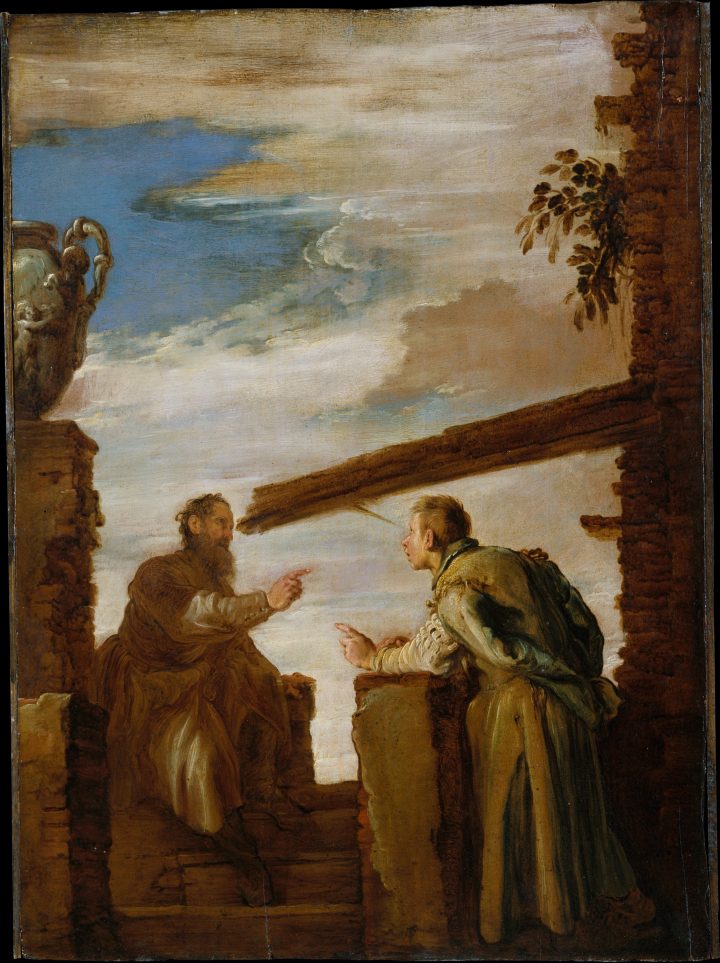
The Parable of the Mote and the Beam,
Domenico Fetti, c. 1619 (The Met 5th Ave.)
(About this Image)

Why do you notice the splinter in your brother’s eye,
but do not perceive the wooden beam in your own?
How can you say to your brother,
‘Brother, let me remove that splinter in your eye,’
when you do not even notice the wooden beam in your own eye?
(Luke 6:41–42)

Fr. Smith’s Commentary on the Second Reading
Eighth Sunday in Ordinary Time
1 Cor 15:54–58
February 27, 2022

We complete our reading of the 15th chapter of 1 Corinthians today with the conclusion of Paul’s argument for the Resurrection of the Body. This is also the end of the teaching section of the entire letter. This topic is so important that the Church brings it to our attention for five Sundays. Even though we read it in greater detail than almost any other section of Scripture we still have skipped sections and today we must begin several verses before this week’s selection.

This I declare, brothers:
flesh and blood cannot inherit the kingdom of God,
nor does corruption inherit incorruption.

(1 Co 15:50)

“This I declare” means pay attention. “Flesh and Blood” is a typical Jewish expression for the human body as a physical entity which of itself will decompose. As his audience was composed of many non-Jews, he translates this for them “as corruption.”

Continue reading “8th Sunday in Ordinary Time – Embracing the Resurrection of the Body”